A Delaware woman was treated at CHOP for cancer as a child. Now she’s working there full time.
Since being treated at Children's Hospital of Philadelphia for cancer as a child, Emma Walz made it her mission to work there. Her father likewise was inspired down his current path by her journey.
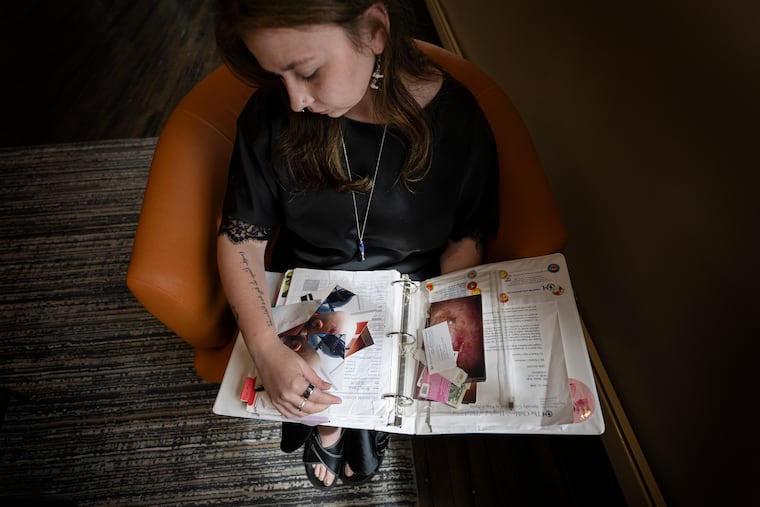
When Emma Walz learned she landed an internship at Children’s Hospital of Philadelphia, she ran to the bathroom, jumped up and down, and cried happy tears.
She had dreamed of working at CHOP since being treated there for cancer as a child, but hadn’t expected to get to start her career there. After the internship, Walz graduated from Eastern University in 2024 and returned to work full time at CHOP that year as a research assistant in psychology.
Finding her passion for helping children with behavioral challenges has helped her overcome survivor’s guilt.
“I have this expectation on me to do better,” said the 25-year-old from Wilmington.
After beating rhabdomyosarcoma, a rare, aggressive cancer of the soft tissues, in 2008, she struggled with reconciling her survival with others’ cancer-related deaths. She recalled an older neighbor, who was diagnosed with cancer, telling her, “If Emma can do it, I can too.”
He ended up dying.
Walz wondered why she got to live while his whole family was now suffering from his death.
“When I was in high school, I felt like I wasn’t living a life that was worth any of the life that I was given back,” she said.
That changed when she took Advanced Placement Psychology at Mount Pleasant High School in Wilmington and connected with the material. She started focusing on going to college, getting the job she wanted, and becoming the person she wanted to be.
Now, her goal is to become a psychologist who helps develop school-based interventions for children with behavioral problems. Serving the CHOP community is part of that dream. She hopes to attend a psychology doctoral program next year.
Her childhood experience at CHOP inspired more than just herself. Her father, Matt Walz, was inspired to work in the clinical trial space after watching her go through trials.
“You ever had those moments where something just lights you up?” the 51-year-old said. “You just know, ‘I’ve got to do this.’”
Childhood cancer
Walz was diagnosed with rhabdomyosarcoma in 2007 after a lump the size of a golf ball appeared on her head.
The tumor’s location made surgery difficult, and radiation carried risks of side effects due to being close to her brain.
Matt Walz recalled being told to prepare himself to lose his daughter if treatment failed.
“We do OK with rhabdomyosarcoma, but at the time, not phenomenally well,” Jeffrey Skolnik, a former CHOP oncologist who treated Walz, said in an interview.
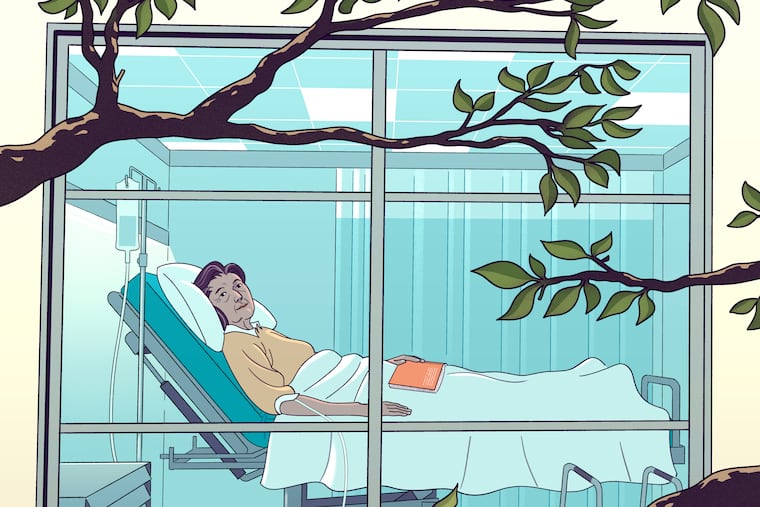
Walz entered clinical trials that tested different combinations of chemotherapies and evaluated the way her port, a small device implanted under the skin for treatment delivery, was placed.
The hardest part for her, at 6 years old, was losing her hair over the course of surgery, chemotherapy, and radiation.
She began to notice her life was different when she interacted with children her age at school.
One day, she asked a friend, “I’m going to the hospital tomorrow, are you?”
To her shock, they told her they had never been there.
Even after finishing treatment and entering remission in 2008, she struggled with being different. Her surgery had left a scar that extended halfway across her head.
To cover it up, she underwent tissue expansion therapy that required inserting a latex water balloon-like device under the scalp. When she went outside, kids would stare and ask their parents what was wrong with her.
“I was just a girl trying to look like everybody else,” Walz said.
Today, she has learned to appreciate her scar, which though less visible, is not fully gone. It helps her relate to children and teenagers she works with who may be scared of surgery or have their own scars.
“I’m always able to bend down and say, ‘Look at mine as well, what I went through,’” she said.
Full circle
When Walz was little, she would ask her mother if cancer survivors ever grew up and became doctors.
She asked because she wanted to work at CHOP and thought her only option was to become a doctor. That was until she discovered psychology in high school and set her sights on becoming a psychologist at the hospital instead.
“It felt like I was born with a set of skills to do something like that,” she said.
After interning at CHOP in college, she worked as a counselor for a summer treatment program at Penn State for kids with behavioral problems — a patient population she loved caring for.
She returned to CHOP after graduating to work on a research project helping kids with ADHD develop homework, organization, and planning skills. Now, she is applying to doctor of psychology programs in hopes of researching school-based interventions for kids with ADHD or behavioral problems.
“They deserve all of the resources the school has to offer because they’re also the kids that are at risk for things later on in life,” Walz said.
With her newfound purpose, the survivor’s guilt that once plagued her has eased.
Her father, too, found unexpected meaning in her cancer journey.
After spending three months interviewing for jobs and whittling down options in 2020, he verbally accepted an offer. And when a firm representing a different company, Trialbee, reached out to him about a CEO job, he was ready to decline.
But as they described the company’s mission of spreading awareness of clinical trials and recruiting patients, his heart lit up.
He thought back to Emma and how fortunate she was to be able to access clinical trials at CHOP. He abandoned his previous plan and accepted the Trialbee CEO job.
“This really painful, hard event in our lives completely changed the trajectory of our lives, and I couldn’t be happier,” Matt Walz said.