Reconciling with a difficult parent may seem impossible. Being their caregiver might help. | Expert Opinion
The Springsteen biopic "Deliver Me from Nowhere" contains touching scenes of a father and son finding common ground after years of strained relations. It doesn't have to be just a Hollywood dream.

There are two remarkable scenes of family reconciliation in this past fall’s Bruce Springsteen biopic, Deliver Me from Nowhere. After years of alienation from his alcoholic, physically abusive father, Dutch, a slowly maturing Bruce begins to recognize that his father has struggled with lifelong mental illness. By this stage of his later years, Dutch has been diagnosed with bipolar disorder and is becoming increasingly confused as he ages.
In the first reconciliation scene, Bruce searches for his father in bars and restaurants all over Los Angeles at the request of his mother after Dutch disappears for several days. Bruce finally finds him sitting at the bar of a Chinese restaurant. Rather than upbraiding him, Bruce sits down next to his father and asks, gently like an old friend, if he would like to go out for breakfast before heading home.
In the second scene, a disoriented Dutch asks Bruce to sit on his lap — as if his son is 3 years old, not 32. Bruce obliges but feels awkward, telling Dutch that he never asked him to sit on his lap before. “I didn’t?” Dutch asks, appearing shocked and regretful that he hadn’t sought loving contact with Bruce when he was a child.
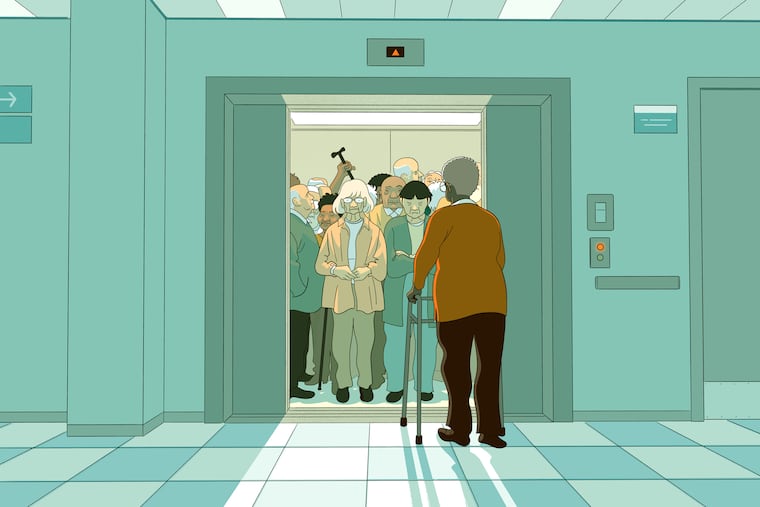
These scenes come at the end of a narrative arc illuminating the surprising turnabout that can be achieved through family caregiving for an older adult: A harshly punitive parent can turn into a softer, “toothless tiger” as they become frail. An angry adult child can develop greater empathy for the vulnerability of that hated parent while witnessing their decline. The parent-child relationship is transformed through the giving and receiving of care. Reconciliation is possible, the scenes suggest, by letting go of the past and extending kindness and understanding to a now diminished and needy parent.
Some viewers may regard this plot line as unrealistic, corny, and overly Hollywood. Our current cultural moment seems to favor alienation and complete estrangement, not reconciling. In our clinical psychology practices, we have also worked with adult children and parents who have decided to cease talking with one another after years of conflict, frustration, and continued emotional pain. These are not bad therapeutic outcomes. They represent hard, courageous work on the part of clients who now refuse to be hurt any longer. We respect their decisions.
But as clinicians specializing in supporting family caregivers, especially those caring for aging parents, we have also seen ways that alienation can be surmounted and improved relationships formed. It requires adult children to risk getting hurt all over again by deciding to care for an aging parent who previously tormented them. Taking this chance in the hopes of forging something better doesn’t work out well in every case, but it does produce emotionally powerful results for some.
We saw this happen with one of our patients, Gloria, who at age 43 never expected to find such healing. She had always felt belittled by her mean, narcissistic mother from whom she kept a healthy geographic and emotional distance to protect herself throughout her adult life. But then her aging mother developed diabetic complications, including sensory neuropathy in her feet, and suffered a series of harmful falls. After weighing the pros and cons, Gloria decided to become her mom’s caregiver.
This could have gone disastrously. Gloria might have allowed herself to hope that she’d finally win her mother’s approval by being there in her hour of need — only to be rejected by her mother yet again. Like Bruce Springsteen in the biopic, Gloria avoided reliving this destructive family dynamic by being her own person, refusing to allow her hurtful parent to loom over her life. The twist here is that she managed this while immersing herself in her mom’s day-to-day care.
To motivate her caregiving, Gloria drew on her moral convictions, not some old yearning for her mother’s love. Helping others had always provided her with a deep sense of meaning. It underpinned her successful career as a hospital floor nurse and, later, an administrative leader in her health system. She could tend to her mother’s needs because that was consistent with her values and core identity, not simply because her “patient” now would be the woman who gave birth to and raised her.
Secondly, Gloria made a point of approaching the present as the present, not the past. Certainly, she still craved some measure of justice for the years of mistreatment that she endured as a child. An apology on her mother’s part would be a nice start. But the caregiving was not about winning justice; the current mission was limiting her mother’s falls to help her live out her final years with less suffering. Gloria had the skills and professionalism to achieve this goal.
Perhaps most importantly, she decided to just accept her mother for the very flawed person she had always been. It no longer made sense to Gloria to wish her mother was kinder or to believe she had the power to make her happy. Mom was a sour person who inflicted her sourness on others, especially her only daughter, a personality that did not grow sweeter with her diabetic complications later in life.
True to form, Gloria’s mother initially found a dozen ways to criticize Gloria for how she provided care. But Gloria now shrugged off her barbs, keeping her focus on helping a vulnerable older adult. To her great surprise, her mother responded by changing her behavior, too. It was akin to what happens when you steadfastly ignore the taunts of a schoolyard bully. Once her daughter stopped reacting emotionally, Mom began to respect her more. During the last two years of the mother’s life, the dynamic between them slowly shifted from mean mom/hurt child to appreciative mom/competent adult child. For the first time in her life, Gloria didn’t feel that her mother resented her. While not exactly love, it was pretty good.
Just like there are not many Bruce Springsteens in the world, there aren’t that many Glorias so able to separate their past from present circumstances that they can turn caregiving into a transformative experience of reconciliation. But there is always that possibility. If you are like Gloria or Bruce and decide to provide some care, we have several suggestions to keep in mind:
Maintaining rage against a parent takes energy; it can be a relief to let it go.
Choosing to be a parent’s caregiver shouldn’t be undertaken with the intent of proving or winning anything; it should be about living your values.
You are not offering forgiveness — especially if, as is likely, your parent never expresses remorse. You are gaining pride in who you are, regardless of how your parent was or is.
Barry J. Jacobs, Psy.D. and Julia L. Mayer, Psy.D. are clinical psychologists based in Media and the co-authors of the 2025 book, “The AARP Caregiver Answer Book.”