Why did this teen struggle to get her swollen leg into her pants?
Could it have been a long train ride, a leg waxing kit, or something else entirely?
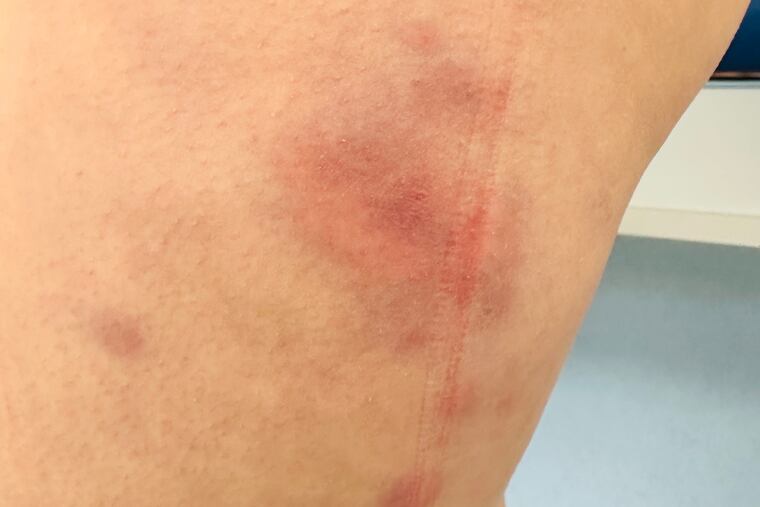
A 17-year-old girl went to the emergency department because her left leg was painful and had been swollen for the last two days. She knew things were really bad when it barely fit into her pant leg! She had also noticed bumps on her leg that looked like bruises. When the doctor looked at her leg, she noticed about four purplish, quarter-sized bumps on the teen’s lower leg. Even the slightest touch to the bumps caused the teen to flinch.
The doctor asked her some questions to assess her risk for having blood clots in her leg, as that is a potentially very dangerous cause of one-sided, or unilateral, leg swelling. Two days previously, she had taken a long train ride and had been sitting for many hours. She also admitted to vaping nicotine a few times a week. Since both inactivity and nicotine raise the risk of a deep vein thrombosis, the doctor ordered an ultrasound to check the flow of blood in her leg. It was normal.
The doctor also asked about her general health. She didn’t have any other medical conditions, and she hadn’t been ill recently or had any fevers. The doctor wondered whether she might have a bacterial skin infection (also called cellulitis) or if she had a pocket of pus underneath her skin (called an abscess). Since the skin wasn’t red, warm, or continuing to get worse, the doctor felt an abscess or infection was less likely.
On further questioning, the teen said that the week prior, she bought a kit to wax her legs, which was new for her. The doctor considered that she could be having an allergic reaction to the product, but the bumps were only on one leg and she had waxed both legs.
When the doctor asked if the teen took any medications she paused before answering no. She clarified that she wasn’t taking any medications any more.
And with that, the mystery began to clear up.
Solution
Though the teen wasn’t taking any medication when she came in with her badly swollen and painful leg, she did tell the doctor that a few weeks before she had been diagnosed with strep throat and prescribed a 10-day course of antibiotics. She took the antibiotics for three days but didn’t take the rest of the course since her sore throat had gone away.
Knowing this, the doctor diagnosed this teen with erythema nodosum, a painful skin condition that most often produces red, tender bumps (also called nodules) on the shins. It is more common in women than men. There are many different causes of erythema nodosum, including infections, medications, or certain inflammatory conditions, and sometimes no specific cause is found.
One of the most common triggers is a streptococcus infection, like this patient had. Because she did not finish her antibiotic course, her streptococcus infection was not cured and though her throat felt fine, the infection eventually led to erythema nodosum.
The emergency department called a pediatric specialist who recommended re-treating the streptococcus infection with the full 10-day course of antibiotics. The doctor counseled the teen on the importance of taking her medications as prescribed, especially because untreated strep throat can cause problems down the road for other body systems including the heart, skin, and joints. The doctor gave the teen a prescription for a nonsteroidal anti-inflammatory drug (NSAID) to help her pain. After completing her antibiotic course, she had a full recovery with no expected long-term effects.
Take-home point
Even if you feel better, it is very important to finish the full course of antibiotics when they are prescribed. Here are some examples of ways to remember to take your pills.
Make medications part of your daily routine. Put pills beside your toothbrush so you remember to take them when you brush your teeth.
Set an alarm on your phone as a reminder.
If you are on multiple medications, use a pill box so you can easily keep track.
Samantha Starkey is a third-year pediatric resident and Hayley Goldner is a pediatrician in the adolescent medicine department at Nemours Children’s Hospital, Delaware.