‘A punch in the gut’: After years of waiting, many opioid victims will be shut out of Purdue settlement
Nearly 140,000 people filed claims against Purdue for the harm they said its opioid drugs caused. Fewer than half of them will get any compensation from the company's $7.4 billion settlement.
This article was produced in partnership with ProPublica. Sign up for Dispatches to get ProPublica stories like this one as soon as they are published.
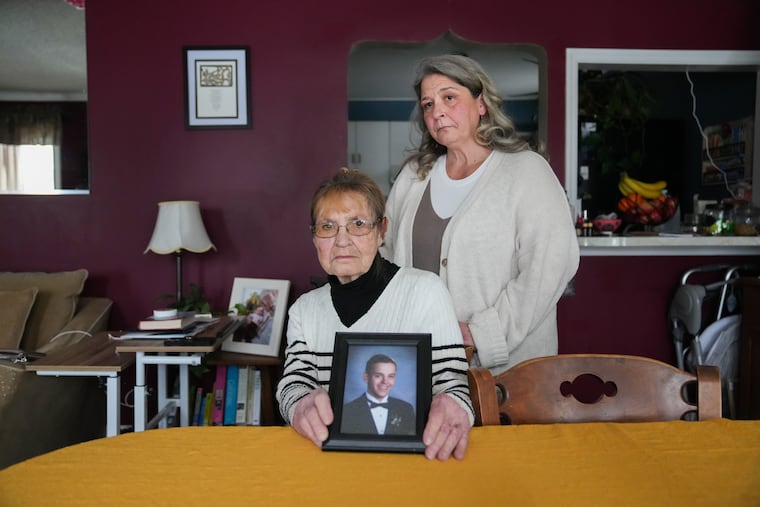
Mary Jannotta sliced meat and cheese behind deli counters at Acme and Pathmark supermarkets in the Philadelphia suburbs for decades, developing aches that came with working on her feet. A botched back surgery in 2008 made the pain worse. Her doctor repeatedly prescribed OxyContin, Purdue Pharma’s marquee painkiller — the high-dose opioid the company later admitted it criminally marketed and distributed.
Jannotta said she soon became dependent on opioids. Cut off by her doctors, she found her way to Kensington, home of Philadelphia’s dangerous open-air drug market, to score pills. She eventually lost her car, her home — and her grandson. Tyler Cordeiro first pilfered Jannotta’s prescription pills as a teenager. He was 24 when he died of an overdose.
When Purdue filed for bankruptcy in 2019, Jannotta, along with nearly 140,000 other people, filed claims against the company for the harm they said its drugs caused. Though the money could not bring back what they lost, a financial settlement represented an opportunity to get justice from the company and its multibillionaire owners, the Sackler family.
Then they waited. The Supreme Court in 2024 rejected the first bankruptcy settlement because it shielded the Sacklers from future lawsuits. Finally, last November, a federal judge approved a new plan that would allow the payouts to start.
But this $7.4 billion bankruptcy plan — including $870 million that has been set aside for individual victims — will shut out tens of thousands of those who originally applied for a settlement, ProPublica and The Philadelphia Inquirer found. Fewer than half of those who filed claims against Purdue will get any kind of help under the new plan, despite the company touting it as “the only opioid settlement to date that meaningfully compensates individual victims.”
Court records show the new plan slashed payments for victims, imposed tougher eligibility requirements, and eliminated compensation for teenagers who bought Purdue drugs on the street. Estimated settlement amounts for people whose family members fatally overdosed dropped to as little as $8,000; the previous payout for an OxyContin death had been $48,000.
Most significantly, the new plan removed a key provision that allowed victims to submit a sworn affidavit, in lieu of a prescription or other medical or legal records, to prove they purchased Purdue opioids.
Similar sworn statements have been permitted in other major bankruptcy cases — such as those driven by sexual abuse in the Boy Scouts and the Catholic Church — to account for harm done years earlier where physical evidence is scant or impossible to obtain.
Several victims told ProPublica and The Inquirer that the loss of the affidavit option meant they had no hope of receiving a settlement. Purdue sold painkillers for decades, and, while laws vary by state, generally doctors, hospitals and pharmacies must keep prescription records for only a few years.
“I can’t turn up prescriptions for my son back when he was young, years ago,” Michigan resident Ellen Isaacs said. “They’re not available anymore.”
Her son, Ryan, died from an overdose at 33 in 2018 in Florida, the result of an addiction she said began when he was prescribed OxyContin after a high school injury.
The changes between the initial and revised settlement agreements were negotiated out of the public eye for months, with key details later scattered across thousands of pages of court filings, hearing transcripts and sworn declarations. To date, they have not received any media attention or public scrutiny. The winnowing of victims has been the result of byzantine legal procedures, strict vetting and tightened eligibility rules, which victims told ProPublica and The Inquirer took them by surprise.
I can’t turn up prescriptions for my son back when he was young, years ago. They’re not available anymore.
To receive compensation, victims also have had to face a series of deadlines twice — once in connection with Purdue’s first bankruptcy plan and then again once a new plan was approved to address the Supreme Court decision. First, to qualify for a settlement at all, victims had to have used Purdue opioids before Sept. 15, 2019, the day Purdue declared bankruptcy. The deadline to file a claim was in June 2020. But that deadline changed multiple times, once to July 2020 and then again to September 2021. After that, the door to a settlement under the bankruptcy plan shut for good.
Just under 140,000 people met that final deadline, but years of litigation ensued and it wasn’t until almost four years later, by late July 2025, that they had to file evidence for their claims. About 63,000 did, according to a November court filing from settlement trust administrator Edward Gentle.
Purdue and its attorneys moved to formally eliminate most of the 80,000 individuals who missed the deadline from any payout under this settlement plan, and the judge approved the expungement motion Tuesday. Under certain circumstances, these excluded victims and others who missed earlier filing deadlines can still sue the Sacklers directly.
Purdue’s attorneys said in court that the company played no role in designing the claims process. The company referred questions for this story to Akin, the major Washington D.C.-based firm representing the victims and other creditors. Akin endorsed the new bankruptcy plan despite the tighter eligibility criteria and lower survivors’ benefits. The firm declined to speak on the record. It said the official creditors’ committee had no comment.
Andrews & Higgins, a firm that also represented victims, did not respond to requests for comment.
Edward E. Neiger, the comanaging partner of ASK LLP, another major firm representing victims, also endorsed the plan. His firm twice praised the 2021 affidavit option in early court pleadings but made no mention in hearings of its disappearance from the new plan.
Neiger said “contractual and court-imposed confidentiality provisions” prevented him from discussing the changes. He said in a written statement that his firm is “proud of helping facilitate the record-breaking and historic $850 million-plus settlement on behalf of the actual, human victims of the opioid crisis.” The Purdue fund is more than eight times as big as the combined victims’ funds financed by the two other big bankrupt opioid makers, Endo and Mallinckrodt.
More than 300,000 people have died from opioid prescription drug overdoses and millions more became addicted. Federal prosecutors have twice brought charges against Purdue itself. The drug firm pleaded guilty in 2007 to misleading the public about the dangers of its opioids.
A federal judge on Tuesday delayed until next week the sentencing of Purdue on three felony charges related to paying kickbacks to doctors and reckless sales of its opioids.
The Sacklers, who have never been criminally charged, have denied wrongdoing.
Gut punch
Under standard procedure, those who filed a claim against Purdue with the bankruptcy court in the first round — including cities, hospitals, and individual opioid victims — were entitled to vote on the new bankruptcy plan. Proponents of the new plan point to a higher minimum payment for all qualifying claimants of $8,000, up from the previous $3,500. They also say it will streamline the settlement process so payments go out faster and in full. The Sacklers also put an additional $100 million in the victims’ fund.
About 58,000 of the 140,000 individual claimants voted on the plan last September, nearly all in favor. But nearly two dozen victims — a mix of people who voted for and against the plan and who didn’t vote at all — said they were unaware of the tighter evidence requirements until ProPublica and The Inquirer contacted them.
Shortly before the judge approved the revised bankruptcy plan, Jannotta appeared via video call in November to address the court, delivering a statement that her daughter, Susan Ousterman, helped craft.
The Bucks County, Pennsylvania, grandmother, then 76, looked frail but resolute. She had voted against approval of the plan.
“The legal system should be where the powerless can finally be heard, but in this courtroom it’s being used to shield the powerful,” she told a session packed with more than 100 lawyers and victims.
The day after Jannotta spoke, U.S. Bankruptcy Court Judge Sean H. Lane hailed the new plan. He said it imposed a “very modest burden of substantiation” for victims to show Purdue had harmed them, “an exceedingly low bar.”
The trust for Purdue’s victims has twice indicated that it plans to reject Jannotta’s claim, once for missing a 2021 claim deadline that had been changed at least twice, and then again for inadequate proof of prescriptions.
The legal system should be where the powerless can finally be heard, but in this courtroom it’s being used to shield the powerful.
But Jannotta shared with ProPublica and The Inquirer a pharmacy record of her prescriptions that she says she sent to the trust. It includes 16 qualifying prescriptions for Purdue opioids listed on the trust’s website. Gentle, an Alabama lawyer who specializes in running trusts to compensate victims of disasters and corporate scandals, did not respond to multiple requests for comment.
Jannotta is fuming.
“After everything I went through, what my family went through, and to find out nobody was really being held responsible really hit me in the gut,” Jannotta said. “It was a punch in the gut.”
Crossed-out text
After the Supreme Court rejected the original 2021 bankruptcy plan, Purdue attorney Marshall S. Huebner said that the task ahead was straightforward: to undo immunity for the Sacklers but “not to go back to ground zero.”
Attorneys representing Purdue, the Sackler family and other stakeholder groups, including victims, began months of confidential mediations. Court records do not explain why the more generous benefit and eligibility requirements in the first plan underwent significant revisions.
What they do show is that after years of litigation, hearings, negotiations, and delays, dramatic changes to the claim criteria occurred in a matter of five weeks.
In a flurry of activity beginning on March 8, 2025, Purdue filed documents that show lines crossing out the eligibility criteria and victim compensation amounts, with no explanation or substitute language. Purdue then filed additional documents with new requirements but no mention of the earlier affidavit option for adults or teens. In April, Lane approved the changes to the claim process and, in the same hearing, approved requests from Purdue, with the support of victims’ attorneys, to hire Gentle and jump-start his review of claims.
That meant victims started to submit claims with accompanying evidence even before Lane approved the new bankruptcy plan in November 2025. Trust administrator Gentle already had been sending letters to potential claimants stating they could be denied unless qualifying evidence was provided within 30 days.
A ProPublica and Inquirer examination of nearly 1,000 pages of transcripts covering 10 open court hearings about the plan found that Lane and lawyers representing Purdue and opioid claimants held no in-depth public discussions about the differences in criteria between the original and revised plans — or their potential impact.
Florida resident Cindy Singer was among the claimants who voted for the plan and now regrets it. She said her son, Rory, began taking OxyContin after a construction accident and died three years later, in 2015, of an overdose at age 28. According to the letter she received from the trust, she failed to produce a prescription linking him to a Purdue opioid.
Singer said she didn’t understand how critical the affidavit option would be to her claim.
“We never even knew it existed,” she said.
Cheryl Juaire of Massachusetts lost two sons to overdoses. She served on Akin’s oversight committee as a representative for victims. Juaire is waiting to hear whether her claims will be approved.
She said she does not recall Akin lawyers telling her about the changes to eligibility. Even so, Juaire said she stands by her support for the new plan because the Purdue case had dragged on too long.
But she acknowledged that the loss of the affidavit option seems to have caught fellow claimants by surprise.
“I’m being bombarded with calls from folks saying, ‘Hey, I put in a claim and I’m getting rejected. I can’t get that prescription,’” Juaire said. ”It’s breaking my heart.”
Holdbacks, lawyer fees, and smaller checks
What is especially galling, some victims said, is that their compensation for years of fighting for justice will boil down to a day’s pay for a Purdue attorney like Huebner, who charges $2,935 an hour.
Many of us buried children and you are going to walk away with more money than we will ever see.
Well over $100 million of the settlement money will go to the plaintiff law firms that have represented Purdue victims through the bankruptcy and to cover the cost of running the trust. Administration fees in similar opioid victim funds, also run by Gentle, range from about 15% to more than one-quarter of the victims’ awards, according to documents from those trusts.
ASK LLP and its partner, Andrews & Higgins, signed up 30,000 Purdue victims in exchange for up to 40% of their individual awards.
“To me, it’s appalling. It adds further injury to the family of the victims,” said Maureen Kielian of Florida. “Many of us buried children and you are going to walk away with more money than we will ever see.”
She became a vocal critic of the opioid industry after helping her son recover from addiction. In November, Gentle faulted her claim for lack of evidence. She has appealed to the trust but isn’t optimistic.
Connecticut couple Beverly and David Melenski, whose son was addicted to opioids for 20 years, were on an 8,000-page list of late filers whom Purdue and Akin, the court-appointed victims’ lawyers, sought to expunge.
They didn’t have the prescription records that told the story of their son’s decades of dependency on opioids. But they did have a letter they wrote a doctor in 2009 pleading with him to stop giving their son OxyContin. That doctor, records show, lost his license two years later for recklessly prescribing Purdue drugs and other opioids.
The Melenskis have since successfully appealed, and Gentle is vetting their claim.
The Purdue money won’t cover even a fraction of what they spent on rehab, but David Melenski said it would “at least it would be an acknowledgment of their wrongdoing.”
They are waiting for a decision from the trust.
» TELL US: Did you seek payment from the court-appointed trusts funded by the drugmakers Purdue, Mallinckrodt and Endo? Please click here to tell us your story.
Craig R. McCoy is a former Inquirer investigative reporter who also worked as an editor and Trenton and Philadelphia City Hall bureau chief. He was twice a Pulitzer Prize finalist. He can be reached at craigmccoy7@comcast.net or 215-313-813
Bob Fernandez was an Inquirer reporter for 29 years, mostly as a business reporter who also produced enterprise and investigative pieces. Among his last stories at The Inquirer were those on the bankrupt Endo opioid firm in the Philadelphia suburbs. He can be reached at bobyardleyfernandez@gmail.com or 267-443-3517

The Inquirer’s journalism is supported, in part, by the Lenfest Institute for Journalism and readers like you. News and editorial content are created independently of The Inquirer’s donors. Gifts to support The Inquirer’s high-impact journalism can be made at inquirer.com/donate. A list of Lenfest Institute donors can be found at lenfestinstitute.org/supporters.