Drug companies line up to make deals with Trump after initial hesitation
When President Donald Trump declared in May that he wanted drug companies to voluntarily cut their prices, few wanted to go first. Now, no one wants to be last -and risk the wrath of the president.
When President Donald Trump declared in May that he wanted drug companies to voluntarily cut their prices, few pharmaceutical executives wanted to go first. Now, no one wants to be last — and risk the wrath of the president.
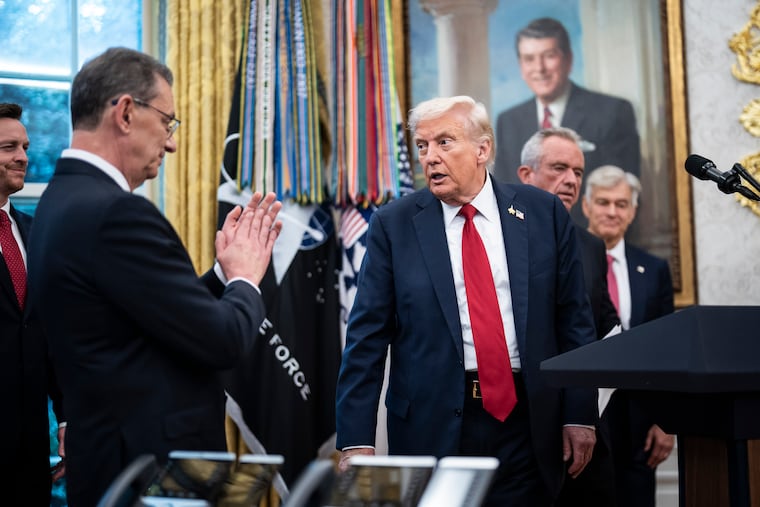
Nine drug companies announced price cuts with Trump at the White House on Friday, touting discounts on medication to treat diabetes, heart disease, HIV, hepatitis B, and other conditions. The deals will offer discounts on drugs sold to the government and to Americans through a new website, TrumpRx.gov, in exchange for tariff relief and other incentives, including faster FDA reviews for future approvals.
The program, known as the Most Favored Nation initiative, is an effort to link U.S. drug prices to lower costs abroad.
“Every president for a generation has promised to reduce drug prices, but … I am the only one of them to ever even think in terms of ‘favored nations,’” Trump boasted Friday, flanked by drug-company executives and health officials.
Friday’s announcements follow similar deals with five other companies, beginning in September when Pfizer CEO Albert Bourla joined Trump to unveil price cuts. Since then, other drug-company executives have joined Trump to announce discounts on fertility and GLP-1 drugs and other offerings. In return, the administration has lifted the threat of tariffs and offered the companies other benefits, such as priority vouchers to expedite FDA reviews, which can lead to hundreds of millions of dollars in additional revenue for a company if a new drug is quickly approved.
Amgen, Boehringer Ingelheim, Bristol Myers Squibb, Genentech, Gilead Sciences, GSK, Merck, Novartis and Sanofi all announced new price cuts Friday. Three of the 17 pharmaceutical companies initially targeted by the Trump administration — AbbVie, Johnson & Johnson and Regeneron — have yet to appear with the president to tout price cuts, but officials said that those companies are set to make their own announcements soon.
Trump has heralded his initiative — which he attempted to pursue in his first term — as one of his most significant achievements this year, arguing that even small savings matter amid the difficulty of curbing drug prices. The deep-pocketed pharmaceutical industry has repeatedly blocked most major efforts at reform for decades, and U.S. drug spending continues to rise, outpacing other wealthy countries.
“This is the biggest thing ever to happen on drug pricing and on healthcare,” Trump claimed. He also criticized other countries for relying on high drug prices in the United States to subsidize the cost of pharmaceutical research and development, saying that global prices needed to be more equitable.
“We were subsidizing the entire world. We’re not doing that anymore,” the president said.
Democrats and outside experts have credited the deals as potentially helping some patients but said the initiative’s overall savings to the U.S. health system will be negligible and dismissed Trump’s hyperbole.
“It’s a bit laughable to call this ‘the biggest thing ever’ in health policy. I’m not even sure this cracks the top 10 health policy changes,” said Craig Garthwaite, director of healthcare at Northwestern University’s Kellogg School of Management. “Giving Most Favored Nation prices to Medicaid, particularly for older drugs, likely won’t save that much.”
The president has sought to make regular announcements about his drug-price deals, aiming to show progress and counter voter frustration over rising healthcare costs entering a midterm year that favors Democrats. Trump is timing Friday’s event to be one of his final White House events of the year, before he heads to North Carolina for a rally on affordability and then to his Mar-a-Lago resort.
Pharmaceutical companies also touted their willingness to cut U.S. prices. A Bristol Myers Squibb executive said the company would provide its blood-thinning drug Eliquis, its most-prescribed medicine, to Medicaid free. Merck said it would offer discounts on its drugs Januvia, Janumet, and Janumet XR, which are used to treat Type 2 diabetes.
“I reflect on your goal, driving affordability and access to Americans, but equally getting prices up outside the United States,” Merck CEO Robert Davis told Trump. “We’re 100 percent supportive of your actions.”
Democrats have questioned whether Trump’s dealmaking with the companies is creating a quid pro quo, with pharmaceutical executives striking agreements to give the president a political win in exchange for potential profit.
“Congress and the American people remain in the dark about the contours of your agreement with the Trump Administration,” Sen. Ron Wyden (D., Ore.) and Reps. Richard E. Neal (D., Mass.), Frank Pallone Jr. (D., N.J.) and Robert C. “Bobby” Scott (D., Va.) wrote in letters sent this week to pharmaceutical executives participating in the initiative. The lawmakers are the top Democrats on four congressional committees that oversee aspects of the U.S. health system.
Several former FDA officials — including two physicians who recently oversaw the agency’s drug-regulation center — have warned that the voucher program may be illegal and risk undermining public health by streamlining reviews. While the agency’s drug reviews can traditionally take about a year, as scientists pore over safety and effectiveness data, Trump officials have said that the voucher program can guarantee a review within one or two months. The administration has defended the program, saying that safety and effectiveness remain priorities despite the accelerated timetable.
Trump officials have used other levers, too. The administration has relied on the Centers for Medicare and Medicaid Services’s innovation center, which allows officials to pilot payment changes without seeking congressional approval, to pressure drug companies that do not voluntarily lower prices. Several drug-payment pilots have already been announced, and more are expected on Friday, the people said.
Wall Street analysts say the companies have incentives to strike quick deals with the administration, rather than tempt Trump’s ire. Medicaid represents a relatively small portion of their business, and many companies are agreeing to price cuts similar to discount programs they have begun.
Pfizer’s announcement with Trump also sent a signal to the rest of the industry, several pharmaceutical executives and industry analysts have told reporters.
“When you saw the lack of impact to earnings of the initial companies’ deals, for most coming after, it’s a no-brainer,” said Chris Meekins, a managing director at Raymond James.
Trump officials have said that the initial negotiations were tough, and securing concessions has become easier over time.
“I think the first five companies that came through the pipeline were some of the hardest ones to get through,” CMS Administrator Mehmet Oz said in an interview on Dec. 7, pointing to the size of companies like Pfizer, AstraZeneca, and Eli Lilly, which were among the first companies to agree to deals.
Trump officials have leaned on the healthcare companies’ civic responsibilities, in addition to applying pressure through tariffs and the CMS innovation center.
Chris Klomp, the head of the Medicare program and a lead negotiator on the drug-price cuts, said he stressed “duty and patriotism” in a conversation with one prominent CEO.
“And when we got done, he said, ‘I didn’t get into this business for [quarterly earnings],” Klomp said in remarks at last month’s MAHA Action summit. “I have children. I want to make them proud. I understand this is important to you and the president. We will show up.’”