Kids hated the presidential fitness test. Researchers aren’t fans, either.
Asking readers to share their memories brought back a great deal of shame to adults who long ago endured the tests, originally ordered by President Eisenhower.
Hey, did you hear that President Donald Trump plans to bring back the presidential fitness test?
The news that the once-nationwide fitness test for young people might soon return ricocheted across social media and countless group text chains.
“I’d guess that people’s memories of that test are still very strong,” said James Sallis, an emeritus professor at the School of Public Health at the University of California at San Diego, who has been involved with exercise testing for decades.
He was proved right when we asked Post readers what they remember about the fitness testing and how it affected them. Replies flooded in by the hundreds. Many read like a scribbled shudder.
The responses, overwhelmingly negative, are important indicators of how deeply some experiences etch themselves into people’s memories, according to experts in exercise testing, physiology, and behavior. They’re also at the heart of the question of whether bringing back the test will improve — or undermine — the health and well-being of the nation’s children.
“The Presidential Fitness Test was the bane of my childhood existence. I was a straight-A student, but I could not do the bar hang for more than five seconds.” — Aileen Bryan, 51
“There were six or seven tests. Maybe I could pass one or two. Humiliating. I could never run and certainly not fast. I will never be a runner. Maybe I could have been, but the way it was approached destroyed any interest.” — Susan Savage, 67
“It was the single most discouraging part of the school day.” — Michael Ryan, 78
Why was the presidential fitness test created?
The presidential fitness test and accompanying award began in the late 1950s, under President Dwight D. Eisenhower, largely in response to concerns that “children in the U.S. weren’t as fit as European kids,” said Scott Going, an emeritus professor of exercise and nutrition studies at the University of Arizona in Tucson, who has long been involved in exercise testing.
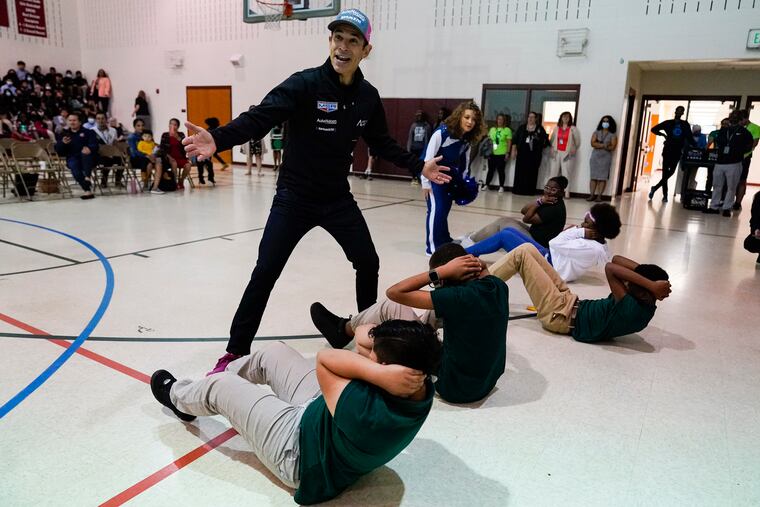
The test involved evaluations of endurance, strength, and flexibility, usually with shuttle and mile runs, pullups, pushups, situps, the broad jump, and a sit-and-reach test, although the specific test components changed over the years.
“It was really built around identifying sports talent,” Sallis said. “And a lot of that, you’re born with or you’re not.”
To earn the fitness award and badge, children had to score in the top 15% nationwide on each test. “Only about 1 or 2 or maybe 3% of kids ever earned the presidential award,” Sallis said. “The rest were told they’d failed.”
“As a child, I was challenged by some early-life health problems, bullying, and was a slow developer. Physically, I was not able to complete some of the expectations of the test, which resulted in more bullying. I failed at that young age and it stayed with me.” — Craig Spofford, 54
“I remember loving and being motivated by the test, even though I could never do a pullup.” — Laura Walker, 41
“It made me dread gym class. I still remember how badly I felt about not succeeding at pullups, etc.” — Sharon Rathi, 69
Questions about the test’s usefulness
By the early 1990s, exercise scientists were beginning to doubt the usefulness of the presidential fitness test, said Russell Pate, a professor of exercise science and director of the Children’s Physical Activity Research Group at the University of South Carolina in Columbia. “By then, research was accumulating that demonstrated the important health impacts of physical activity.”
But the presidential fitness test wasn’t measuring fitness as it related to health or offering advice to parents, teachers, or students about how children could improve their fitness and become healthier, Pate said. “There was no follow-up education.”
It also wasn’t reducing childhood obesity or inactivity, Going said, since both were rising precipitously throughout the 1990s and early 2000s.
“What was it doing?” he asked. “Mostly making a lot of kids really want to skip gym class.”
“The presidential fitness test scarred me for years and made me think I was physically incapable of doing anything exercise related. I’m 68 now, but I will never forget the humiliation. I avoided exercise for years because of it.” — Carol M. Connor, 68
“It was one of the worst times of the year. The teacher always expressed disappointment in us, which was extra embarrassing. Maybe that is why I hate exercise at the gym so much to this day.” — Natalie Krueger, 46
“One of the worst memories of childhood and that’s significant coming from someone who was bullied.” — Gigi Jarvis, 60
Why don’t people exercise?
Exercise behaviorists have devoted considerable research in recent years to understanding what makes people choose to exercise or not. So many of us don’t, with barely a quarter of adults and a similar percentage of young people meeting the exercise guidelines from the Centers for Disease Control and Prevention.
Why? “We’re pretty clear at this point in the research on exercise and motivation that how people feel while they’re active will have a profound influence on whether they’ll continue to be active,” said Michelle Segar, a professor who studies exercise behavior at the University of Michigan in Ann Arbor.
If people don’t enjoy exercise while they’re doing it, she said, they’re unlikely to become regular exercisers. It doesn’t matter if you tell them it’s good for them or they should exercise, she continued, if it doesn’t feel good in the moment, most people won’t exercise.
And many young people seem not to have enjoyed the presidential fitness testing.
“I think you’d be hard-pressed to find many exercise scientists who’d say the president’s fitness test convinced a generation of kids to be active,” Going said.
“The fitness test was an annual exercise (pun intended) in teacher belittling and peer sneering.” — Jack Campbell, 64
“I still have my Presidential award patch and certificate, which my parents framed. I was so proud! I believe this program instilled a lifelong understanding of the importance of fitness.” — Cynthia Antoinette, 69
“The test was an annual embarrassing reminder that I was the fat kid in the class. You would get tested on each of the elements in front of the other 30 kids in the class, so everybody knew how unfit and inadequate I was. I remember the stigma and the shame all these years later.” — Dawn Leijon, 56
What replaced the presidential fitness test
In 2012, President Barack Obama ended the presidential fitness test and award. By then, the program was already on the way out, often replaced by a different test called the Fitnessgram. Developed with input from scientists including Pate, Sallis, Going, and others, it was meant to be more focused on “how the testing related to health, not athletic performance,” Pate said. Some of the evaluations were similar to those from the presidential program, including a shuttle run, but teachers were encouraged to frame these as group activities rather than competitions.
Afterward, children received a report card showing how they had scored and how to improve aspects of their fitness. “The majority of children pass” the Fitnessgram testing, Sallis said. “It wasn’t meant to be punitive.”
Many schools continue to use the Fitnessgram test. Since fitness testing isn’t mandated nationally, states and local school districts can decide whether and how to test. It’s unclear whether the new executive order will require schools to implement the presidential fitness test. (The Department of Health and Human Services did not respond to an e-mailed request for details by press time.)
“I vividly remember this test. I hated it. Exercise has always felt dreaded. This test certainly didn’t help me overcome that feeling.” — Janet Moga, 55
“The trauma of that test still reverberates decades later. At nearly 40 years old, I don’t love group fitness classes and prefer to try to stay anonymous at the gym. I do not think it’s a stretch to say that the presidential fitness test made me hate exercising for a very long time.” — Rachel Marshall, 38
“The pullup was the hardest event for me as a young boy, and I can recall training for it weeks in advance. There was a real sense of accomplishment in passing.” — Edward Burley, 64
Some people enjoyed the original test
Many young people did enjoy and find validation in the original presidential fitness test and awards, and might again if the program returns, Going said. Many others, though, might not.
“It didn’t work before, if by ‘work’ you mean combat childhood obesity” and inactivity, he said. “So why would we think it will work now?”
Likewise, the Fitnessgram tests haven’t managed to reduce obesity and inactivity in young people, he added. “This isn’t a problem that can be fixed with fitness tests. We’re up against an entire culture” of prolonged screen time by young people and almost constant sitting.
“What’s needed are resources” for physical education classes and after-school programs that promote play and fun activities, he said, that help children learn that movement is enjoyable, and their bodies can and will respond.
“I didn’t see any of that in the executive order,” Going said.
The order doesn’t include details about what evaluations the new presidential test will include, how children will be measured, or whether and how schools will be compensated for the time and expense involved in testing.
“There is no magic bullet” to the problems of childhood obesity and other health concerns, Pate said. “Have we adequately addressed the problems yet? No. Will reinstating the presidential fitness test help much? No.”
Trump, however, seems enthused. “This was a wonderful tradition,” he said at the order-signing ceremony, “and we’re bringing it back.”