A Bucks County toddler will advocate for less toxic treatments as an ambassador for a national cancer charity
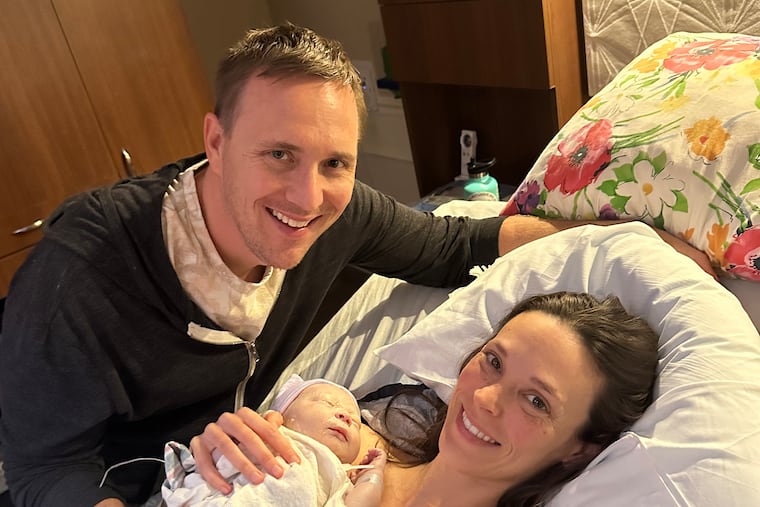
Adalyn Hetzel, a 3-year-old from Southampton, was chosen as an ambassador for the St. Baldrick's Foundation. She was treated for rhabdomyosarcoma at CHOP.
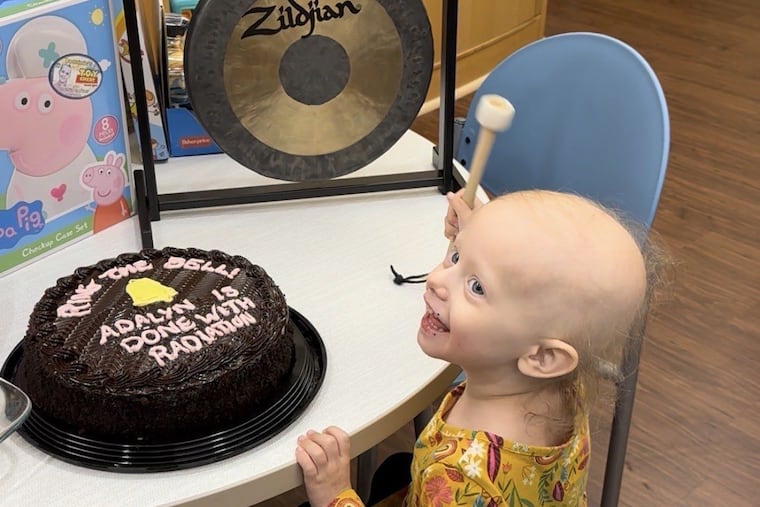
Adalyn Hetzel had just celebrated her second birthday in the spring of 2024 when doctors at Children’s Hospital of Philadelphia diagnosed her with an aggressive soft tissue cancer.
She endured 40 weeks of aggressive chemotherapy and a month of daily proton radiation therapy on her road to remission.
Now, the Bucks County toddler will spend the next year sharing her story as one of five ambassadors for the St. Baldrick’s Foundation, one of the nation’s largest childhood cancer charities.
The California-based organization has awarded more than $369 million in research grants since 2005, with $18 million going to Philadelphia-based institutions.
The selected children and their families will attend advocacy days in D.C., to appeal to lawmakers, share their stories with the public, and spread awareness on social media.
Kristopher Hetzel, Adalyn’s father, said their goal will be to advocate for research into more effective, less toxic treatments.
While more than 80% of kids diagnosed with cancer in the United States now survive the disease, many sustain long-term side effects due to the harsh therapies. One study found that by age 45, 95% of survivors had at least one chronic health condition, and 80% had one that was disabling or life-threatening.
Adalyn will likely have severe dental issues, limited jawbone growth, and an increased risk of developing secondary cancers due to the treatment later in life.
The threat of recurrence also still looms.
“It can’t be like that for these kids. We got to come up with better treatment,” Hetzel said.
» READ MORE: Alex’s Lemonade Stand Foundation worries about federal cuts to childhood cancer research
Diagnosis to treatment
Hetzel first noticed a small nodule on Adalyn’s tongue in April 2024.
After appointments with her pediatrician, dentist, and two oral surgeons left the family without a diagnosis, they went to CHOP, where a biopsy confirmed she had a highly aggressive form of soft tissue cancer called rhabdomyosarcoma.
“All of a sudden your world becomes so small and it’s just your kid. Nothing else matters,” Hetzel said.
Doctors started Adalyn immediately on an intense chemotherapy regimen combining three drugs. She also received a month’s worth of daily proton beam radiation, requiring general anesthesia each session due to her age.
By the end of the 40 weeks of chemotherapy, Adalyn dropped down to the 0.4th percentile of weight. She was so immunocompromised due to the treatment that when she contracted the flu, a critical response team at CHOP had to rush in.
Doctors withheld her final chemotherapy session for fear it could be life-threatening.
Being an ambassador
In April, nearly a year after her diagnosis, Adalyn was declared to be in remission. She still receives scans every three months due to the potential for recurrence.
“[Adalyn] turned back into this playful, happy, joyful toddler who finally has the energy to be herself,” Hetzel said.
Her family decided to get involved with St. Baldrick’s after benefiting from their services firsthand. Right after Adalyn’s diagnosis, Hetzel recalled being given a binder with their logo on the front that laid out a “game plan of what our life was going to look like.”
That resource, called the Children’s Oncology Group Family Handbook, is funded by St. Baldrick’s and is given to newly diagnosed families around the country.
Given her age, her father said he is cautious of not crossing the line in their advocacy and making her uncomfortable, and hopes that when she is older, she will understand the importance of sharing what she went through.
Jane Hoppen, director of family relations at St. Baldrick’s, said the family always has veto power. The foundation focuses on highlighting each child’s unique personality and interests to “serve as the face and voice of the foundation.”
For example, Adalyn, who loves chocolate-dipped croissants, will be featured on its social media for National Croissant Day.
“What we want for every kid who’s diagnosed is the ability to just go back and enjoy being a kid again,” Hoppen said.