Medicaid cuts threaten rural hospitals — and access to maternity care
More patients in rural areas are on Medicaid, and can little afford to commute long distances for high-risk pregnancy care and deliveries, as one mother's story illustrates.
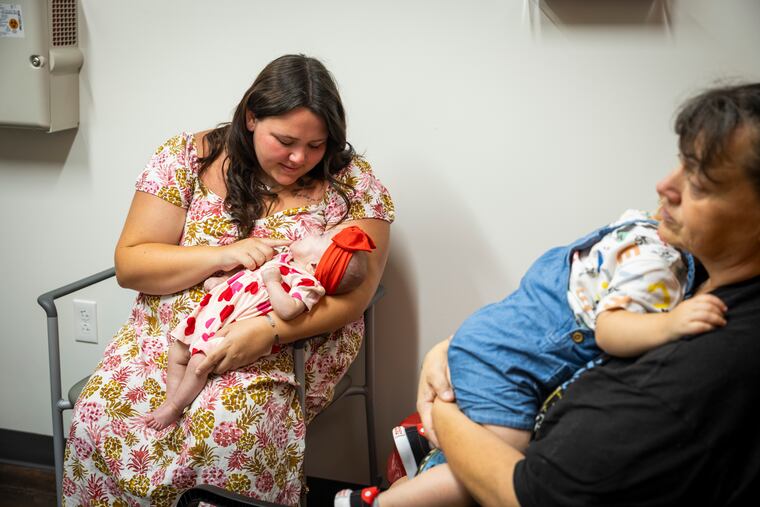
MOREHEAD, Ky. — Jacalyn Stuff was nearing the end of her first trimester when doctors at UK St. Claire Regional Medical Center delivered shattering news: her twins were in danger.
Then came a second blow: Those doctors — the ones she had come to know and trust, the ones less than 10 minutes from her home — could no longer treat her.
During the following 10 weeks, Jacalyn — then 19 — had to travel repeatedly to hospitals able to provide more advanced maternity care. Appointments at the one 70 miles away in Lexington required $30 for a tank of gas. Appointments at the one 100 miles away in Cincinnati required gas and a hotel stay. And they all required Jacalyn either to bring her infant son or to find a babysitter.
While Jacalyn’s pregnancy was extraordinarily high-risk, more women are expected to face disruptive travel even for routine pregnancies because of Medicaid cuts in President Donald Trump’s massive tax and spending plan. Approved in July, the measure cuts Medicaid by almost $1 trillion over the next decade, and the loss of revenue is expected to force scores of rural hospitals to curtail services or close, according to hospital groups.
The impact is likely to be particularly severe for maternity care, one of the most expensive services hospitals provide. Recovering the cost of maternity care is particularly difficult in rural areas, where there are fewer patients and a higher percentage on Medicaid, which pays far less than private insurance, said Katy Kozhimannil, a professor at the University of Minnesota School of Public Health. Since the bill passed, a handful of hospitals, including in Kentucky, already have paused previously planned projects, among them labor and delivery services.
Kentucky is expected to be among the states hardest hit, with an estimated loss of almost $11 billion in rural Medicaid spending over 10 years, according to KFF, a health policy research organization. Thirty-five hospitals in the state are at risk of closing, according to a nationwide analysis by the Sheps Center for Health Service Research at the University of North Carolina, which was requested by Senate Democrats. Only a dozen still provide labor and delivery services; one of the at-risk hospitals announced in February that it was discontinuing those services.
“Each of those hospitals will have to end certain lines of service and, sadly, I believe that maternity and delivery are on that list, given the small margins,” Kentucky Gov. Andy Beshear (D) said in an interview. “If those close down, so many Kentuckians will be two hours away from a hospital they can deliver in.”
“What does that mean in terms of difficult pregnancies?” Beshear said. “It’s going to hit Kentucky and our people really hard.”
The Medicaid cuts are only one of several changes across the federal government that are making it harder to safely have a baby — especially for low-income women, according to hospital administrators, maternal health researchers, obstetricians, and healthcare advocates. The changes come even as Trump and his allies have embraced a pronatalist agenda, with Trump floating a $5,000 “baby bonus” and Vice President JD Vance saying he wants “more babies in the United States of America.”
Trump, who has repeatedly vowed to protect Medicaid benefits, has cast the cuts as targeting only “waste, fraud, and abuse.” The savings are achieved primarily by imposing federal work requirements for the first time on Medicaid recipients. The nonpartisan Congressional Budget Office projects 10 million people will lose coverage in the next decade, an estimate the White House has disputed.
Asked about the risk to rural hospitals, a White House official said those institutions have long struggled financially and argued that their problems will not be exacerbated by the bill. The official noted that a number of hospitals identified as being at risk have said they do not expect to close, including UK St. Claire in Morehead.
“Misleading doom-and-gloom ‘One Big Beautiful Bill’ analyses hinge on flawed projections that overestimate previous Medicaid spending in rural areas and how many people will refuse to work or even volunteer part time to stay on Medicaid,” White House spokesman Kush Desai said in a statement, adding that the measure includes a $50 billion fund to help keep rural hospitals open.
Medicaid is the largest source of funding for pregnancy services nationwide, covering 41% of births in the U.S. and almost half births in rural areas, according to KFF. The work requirements, set to go into effect in 2027, mandate that able-bodied adults between 19 and 64 work at least 80 hours a month or complete other qualifying activities, such as volunteering or schooling, to qualify for Medicaid, which is jointly funded by the states and the federal government.
Women are exempt from the work requirements during pregnancy and while raising children 13 and under. But experts warn that documenting an exemption — or even qualifying work or school attendance — could prove difficult. Meanwhile, healthcare advocates say they worry that the cuts may force some states to pare back Medicaid eligibility overall. Many states provide Medicaid coverage to women up to one year postpartum, for example.
‘You just don’t go’
Even before the cuts hit, many women in rural Kentucky counties were traveling an hour or more to receive prenatal care, according to obstetricians and maternal health researchers in the state. A Washington Post analysis found that the average driving distance to the nearest birthing hospital in Kentucky is about 31 miles. That could increase by about 11 miles if the 35 at-risk hospitals close.
In 22 rural counties, the drive to the nearest hospital with birthing services could increase by 30 miles or more, the analysis shows. For example, in Bell County on the Tennessee border, the drive would jump by 71 miles if the at-risk hospitals close.
For now, Morehead is among the lucky rural towns with convenient maternity care. Alyssa Oatman, a 23-year-old mother of three, had a healthy twin pregnancy in 2024 and was able to receive prenatal care at UK St. Claire, about 15 minutes from her home.
But services are limited. The hospital has no neonatal intensive care unit, or NICU, and typically does not handle deliveries earlier than 35 weeks, according to officials at UK St. Claire. High-risk pregnancies — which constitute as many as 8% of pregnancies, according to multiple health organizations — are typically referred to UK Kentucky Children’s Hospital in Lexington.
Oatman decided to deliver in Lexington, knowing that twins often need NICU care. One of her twins, Cade, lost oxygen during delivery and spent 56 days in the NICU. He now has a host of long-term complications.
Meanwhile, the long weeks of driving back and forth to visit her son took a toll. Oatman said she was diagnosed with depressive psychosis, severe anxiety, and depression.
Rebecca Todd, an obstetrician and gynecologist who practices in Morehead, worries about the impact of the looming cuts. She said she already sees patients who travel an hour or more to Morehead for prenatal care.
“I can’t imagine where other people are going to have to start coming from if facilities near them start closing down,” Todd said. “If you have to drive far, you just don’t go.”
‘It’s really scary’
That’s what happened to Jacalyn Stuff.
In the summer of 2024, it took Jacalyn a few weeks to get used to the fact that she was pregnant again. Jacalyn and her boyfriend were still adjusting to life with their 4-month-old, Xavier. During her first appointment at UK St. Claire, Jacalyn had to wrap her head around another surprise: She was expecting twins.
After having a “full mental breakdown” in her doctor’s office wondering how she would make it all work, she learned she was having identical twin girls. She pictured matching dresses and bows and how her son would dote on his “little sissies.”
But at the end of her first trimester, she learned she had twin-to-twin transfusion syndrome — a rare and potentially life-threatening complication in which one twin receives too much blood and nutrients while the other receives too little. Her pregnancy had become exceedingly high risk, so Jacalyn was sent to Lexington.
There, doctors told Jacalyn her babies were deteriorating rapidly. They referred her to a third hospital, this time in Cincinnati — three hours from Morehead. She had two days to get there.
The Cincinnati hospital was enormous — bigger than anything Jacalyn had ever seen — and able to offer the family some financial help, including gas cards and a single night in a hotel. “A weight lifted off our shoulders,” Jacalyn said.
But the news was not good: The babies were getting sicker by the minute. Surgery could help balance the blood flow between the twins. But all Jacalyn could think about was that both their lives — and her own — were in danger.
“I was just about to turn 20, I already had a baby, and then having to be told, like, ‘You can risk your own life, you can risk your babies’ lives’ — it’s really scary,” Jacalyn said.
“They wanted to do the surgery really bad,” she said. But she had no way to pay for a hotel for her mother and Xavier, whom she feared leaving. She also worried that if one of the twins died during the surgery, “it’s my fault.”
‘Girl A’ and ‘Girl B’
So Jacalyn went home.
She went to a couple of follow-up appointments in Morehead, where she was more comfortable. But one night when she was barely 21 weeks pregnant, she started to feel intense back pain.
At the emergency room in Morehead, she learned she was already five centimeters dilated. The doctors and nurses who had come to know her told her they were sorry. She was taken by ambulance to Lexington.
The following 10 days felt like an eternity. Poked and prodded at all hours, Jacalyn couldn’t sleep. Her boyfriend — a union carpenter then working at a store — took several days off to stay with her and wound up losing his job. Jacalyn’s mom was taking care of Xavier, but didn’t have a car to bring him for visits.
Finally Jacalyn received the news she was dreading: She was fully dilated. About 15 people rushed into her room, she said, a sea of scrubs and masks, and started telling her what could happen: They might be able to save only one baby. They might not be able to save either of them. Jacalyn could have her own complications.
Jacalyn asked them to stop. It was out of her control. She rarely prayed, but she started to pray now.
Everything was going to be fine, she told herself.
The doctors told her to push, but the babies were so small Jacalyn couldn’t feel anything. They were taken straight to the NICU: “Girl A” — Roselynn — was 20 ounces. “Girl B” — Jaylynn — was only 13 ounces.
A few hours later, a nurse told her that “Girl A” was doing well. But they were having issues with “Girl B.” They told Jacalyn it’d be best if she went down to spend time with her.
Jaylynn was so small she fit in the palm of Jacalyn’s hand. She held the baby for six hours, until Jaylynn took her last breath. She gave Jaylynn her first bath after she died.
Roselynn ultimately spent five months in the NICU. Between caring for Xavier and trying to pull together gas money, Jacalyn could barely visit once a week. For about two months, Jacalyn said, she didn’t see her daughter at all because her car broke down and she needed $950 to fix it. A social worker arranged visits via FaceTime.
Now 9 months old, Roselynn is a little over 10 pounds — about the size of a one-month-old. She has multiple serious medical complications requiring ophthalmology, pulmonary care, neurology, and surgery — all in Lexington. Jacalyn has to make the trip once or twice a week.
Meanwhile, Jacalyn is pregnant again. On a humid afternoon in August, she sat in an exam room at UK St. Claire with her mother, Xavier and Roselynn, waiting to see her latest baby on an ultrasound.
Jacalyn said she was grateful this pregnancy so far had gone smoothly and that she could stay in Morehead for care. Still, she said, she is full of stress and heartache, knowing how quickly things can go wrong.