Surprising drug combo could reshape suicide treatment
The study showed immediate clinical applications, the researchers said, but others urged taking a wait-and-see approach.
Modern psychiatry has long struggled with one brutal fact: the people most at risk of suicide often cannot wait weeks for therapy or antidepressants to work. Now, a new study suggests researchers may have found the first drug regimen capable of rapid and sustaining relief from suicidal thoughts across a broad group of patients.
Suicide remains one of the nation’s most urgent public health crises, with roughly 13 million Americans seriously considering it each year and about 50,000 dying by suicide annually.
A study presented this month at the American Psychiatric Association’s annual meeting found that a surprising combination of drugs — a single ketamine infusion followed by low-dose buprenorphine — significantly sustained reductions in suicidal ideation in adults with major depressive disorder.
“This is really a breakthrough study that provides hope and immediate clinical applications,”said Ned Kalin, editor-in-chief of the journal that will publish the paper and chair of the Department of Psychiatry at the University of Wisconsin School of Medicine and Public Health.
But outside experts who were not involved in the study urged caution.
Bertha Madras, a professor of psychobiology at Harvard Medical School, said that while the findings are intriguing, doctors should be careful not to move too quickly.
“With all these promising treatments, short-term things always look very beneficial, and it’s only after a period of time when you have use for a larger population for a longer time that you see the adverse consequences,” Madras said.
Carl Hart, a professor of psychology at Columbia University, similarly warned against overstating the findings. He noted that while the study showed improvement in thoughts of suicide, it did not show differences in depressive symptoms between patients who took the pair of drugs versus the placebo, and that the endpoints were based on questionnaires rather than real-world outcomes.
“This is a signal which is great,” he said, “but now you need to follow it up in people who are really contemplating suicide and see how well it does.”
Ketamine, an anesthetic long used in hospitals for sedation and pain relief but better known in popular culture as a party drug associated with dreamlike experiences, has recently taken on a new life as an off-label treatment for depression, PTSD, and suicidal thoughts. Its use has been limited mostly to emergency situations, however, for a number of reasons, including its short duration (the effects often disappear within days or weeks) and potentially serious side effects.
Buprenorphine is best known as a medication used to treat opioid addiction during the overdose crisis, though it is also sometimes prescribed for pain.
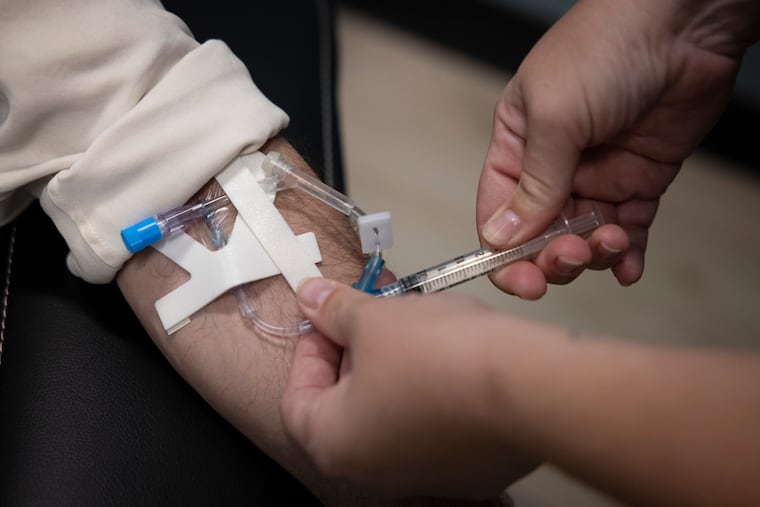
The randomized, double-blind, placebo-controlled trial involved 50 patients with major depression and active suicidal behavior. All of them received one IV infusion of ketamine and two days later they were randomized to receive either an ultra low dose of buprenorphine or placebo for four weeks. They were assessed weekly.
The idea for the treatment grew out of earlier research suggesting a close relationship between physical pain, psychological pain, and suicidality. During a press briefing, study authors Alan F. Schatzberg, a professor of psychiatry and behavioral sciences at Stanford University School of Medicine, and Jason M. Tucciarone, an assistant professor of psychiatry and behavioral sciences at Stanford, pointed to a 2016 Israeli study that helped inspire the approach.
Tucciarone said both the placebo group and the group that received ketamine plus buprenorphine experienced reductions in depressive symptoms, something researchers expected given prior evidence that ketamine can rapidly alleviate depression. But there was no statistically significant difference between the two groups on depression itself — a finding he described as both “peculiar” and “interesting.”
“That’s an ongoing area of investigation that we need further study on,” he said.
After treatment ended, researchers observed some rebound in both depressive symptoms and suicidal thoughts, Tucciarone said, though patients still remained improved compared with before treatment began. Researchers also did not observe signs of withdrawal symptoms.
“We really think that these findings offer a scalable and safe therapeutic option for folks at risk of suicide,” he said.
If you or someone you know needs help, visit 988lifeline.org or call or text the Suicide & Crisis Lifeline at 988.