A stroke left this hockey player paralyzed. His determination got him back on the ice.
Jack Smiley, a Bucks County native, overcame a stroke in 2022 and skated one more time this past season during his final year of college hockey.
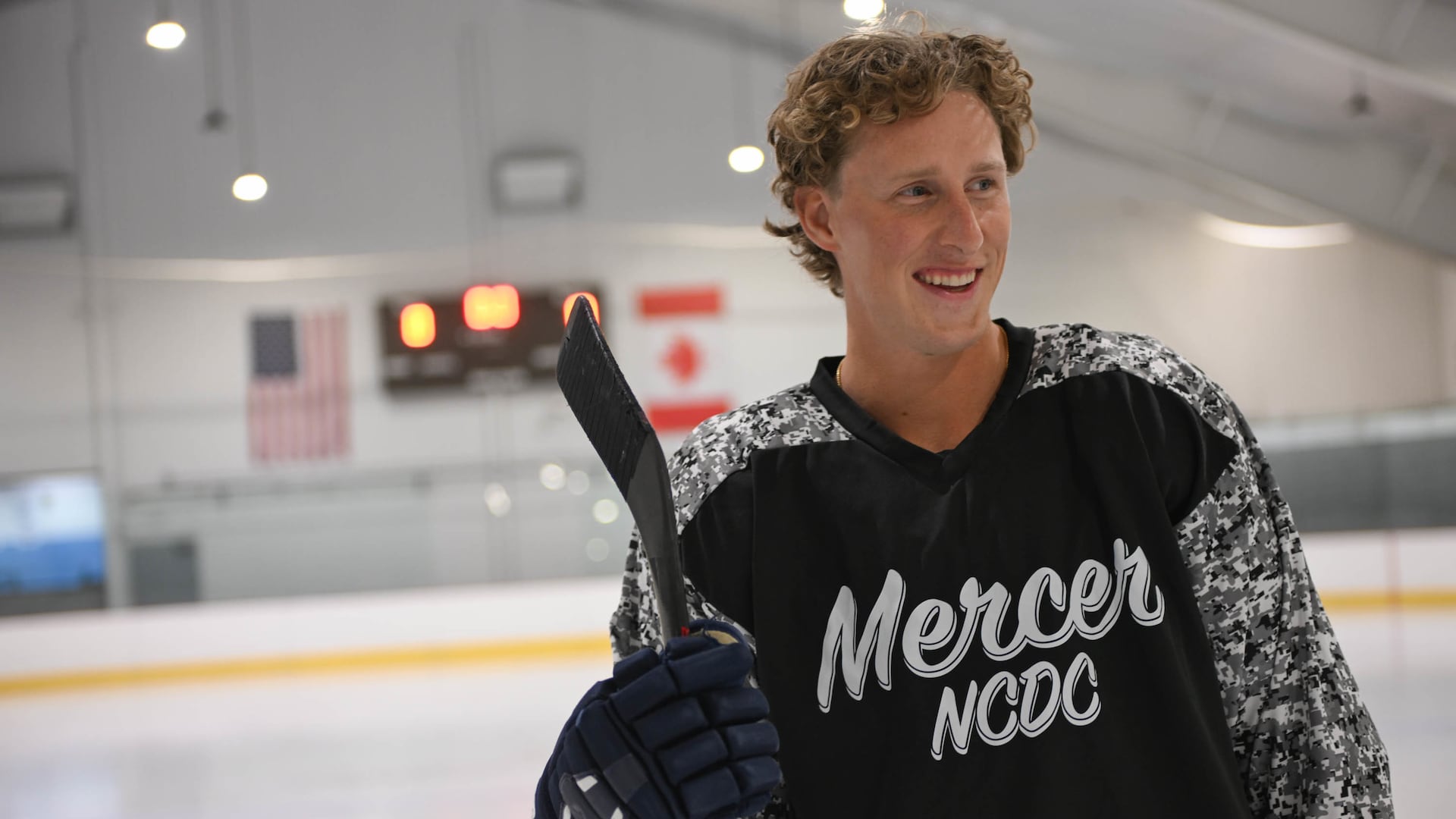
Bucks County native Jack Smiley grew up playing hockey at Ice Land Skating Center in Hamilton Township, N.J. His parents signed him up for skating lessons at age 4, hoping to improve his balance and skiing abilities, but Smiley fell in love with the ice — and never skied again.
The forward played youth ice hockey in the Philadelphia area with the Jr. Flyers and at Holy Ghost Prep. After graduating high school, he played for a few junior hockey teams, including in the NAHL, where he moved to Texas and Maryland to compete.
Smiley decided to continue his academic and athletic careers at Endicott College in Beverly, Mass., at age 21. After having professional aspirations as a child, he decided he wanted to finish his hockey career at Endicott.
But in February 2022, his sophomore year, Smiley suffered a stroke that left the right side of his body paralyzed and changed the trajectory of his life and hockey career. Now, three and a half years later, he graduated from college with an exercise science degree and has a newfound appreciation of life. Smiley shared his story on social media during his recovery process and found it to be an outlet to help himself heal.
“It turned into something that I really saw adding value to other people’s lives, especially others that were going through similar journeys and similar adversities,” Smiley said. “I don’t love social media, but I just love the effect it has, and being able to provide a little motivation.”
The “freak accident,” Smiley said, occurred after a minor collision on the ice with another player two weeks prior. Smiley had a transient ischemic attack, also known as a ministroke that put him in the hospital briefly in early February of his sophomore year. The ministroke caused a blood clot that dissipated and tests came back normal, so he was discharged and went back to school.
However, the next week, his body began shutting down during practice. He noticed his right ankle wasn’t moving normally, and when he took a breather on the bench, his brain became foggy and he lost the ability to speak.
“I immediately started losing function,” Smiley said. “It wasn’t a switch off, it was just gradual, which was weird. It was like it was just slipping away. And I had that same super disoriented feeling [as the ministroke] where I just felt lightheaded out of it to an extreme level, extreme disorientation, extremely out of it.”
‘What went wrong’
Smiley said he’s grateful he was at practice when the blood clot dislodged and traveled to his brain, cutting off blood flow and causing the stroke, because if he hadn’t been around trainers and medical professionals, he would have “probably gone back to [his] dorm and taken a nap.”
An ambulance took him straight to a nearby hospital. Doctors diagnosed him with right-sided hemiparesis — paralysis of the right side of his body — and he spent five days under constant supervision in the neurological intensive care unit, before being deemed stable enough to transfer to Spaulding Rehabilitation Hospital in Boston.
“It was a journey of figuring out what went wrong, how it happened,” Smiley said. “By the time we figured out it was a stroke, by the time I got medical treatment needed, I was completely paralyzed on my right side, couldn’t talk, couldn’t eat, couldn’t do pretty much anything with that right side, all the motor function, the neurological connections to my brain, were gone. Then we started the process of recovery, figuring out what we needed to do to get it back — if it was possible — and how it was going to be possible.”
And it was possible. With limited speech, he told his doctors and physical therapists that he would be back on the ice and playing hockey in three weeks. It ended up taking him three years, but he was able to finish his college career on his own terms.
Medical professionals, Smiley said, thought it would be impossible for him to play in an NCAA hockey game again. He shocked them all.
“I very quickly shaped my mindset to just not really care at all what anyone was saying, professional or not,” he added. “I know I want to do this. … So I’m going to tell myself 100% I’m doing it, and there was no real thought that I would never do it, and that just carried me through the recovery. And by the time I got that [last NCAA] game I hadn’t fully recovered. I still deal with things to this day, so I just wasn’t able to compete with everyone at that level, the same as I had before. But I got that game. I was able to say I retired on my own terms and did what I set out to do initially.”
Defying the odds
Today, Smiley believes he has about 80% brain and body function, and acknowledged that he’ll probably never get the last 20% back.
“I think a big thing that people get misconstrued a lot is that successful people and mentally tough people just have this ability to, 100% of the time, be so driven, so motivated, blocking out any negative emotion,” Smiley said. “I don’t have that belief whatsoever. I had tons of down moments — I still do to this day. Those down moments, I believe, will always be there.
“I had plenty of times where I wanted to quit. I thought, ‘Hey, this might not be possible.’ And it was just all about fully mentally convincing myself that whatever part of my brain was speaking to me that way, it was wrong.”
I had plenty of times where I wanted to quit. I thought, ‘Hey, this might not be possible.’
When Smiley had the stroke, a part of his brain lost oxygen and will be “dead” for the rest of his life. There are areas around that dead spot, however, that shut off as a safety mechanism and were able to be recovered.
He saw the most progress in the first month of recovery, as physical, occupational, and speech therapists helped reactivate the non-affected brain tissue surrounding the dead spot. Doctors prepared Smiley for the typical lengthy timeline of stroke recovery, and that there was a good chance he would never walk again, but he surprised them.
“The next three months, progress slows down a little bit, but you’re still making decent recovery, just because the brain is healing faster in that three month period for some reason, and then nine months is where you kind of hit this cut off, where, after nine months, it’s very gradual, if anything,” Smiley said. “So people tend to stop recovering, or it’s just so gradual to the point they don’t even notice it, and it’s barely any recovery — is what I was told. The cool part of my journey is that people who told me that are now seeing what I’ve done, seeing the timeline of the things I’ve accomplished, and thinking their timeline might not be so true anymore for everyone, and there might be a possibility where you can keep recovering. And at this point, three years out, like I can tell you straight up, from two years to three years, I made a ton of recovery.”
Smiley spent the first five days in the neuro-ICU, then transferred to Spaulding where he did a month of inpatient therapy. He said it was like a full-time job, often starting at 7 a.m. and going until 5 p.m. His parents got one hour of visitation time a day, and he was checked on by nurses constantly.
After that month, he began outpatient therapy at the same hospital. His mother moved to the Boston area to help care for him, and he did three hours of therapy a day for a few more months.
“I stayed there because Endicott was still in session, it was close by, and I could go visit the team and be with the guys, while also doing my therapy,” Smiley said. “And then after a couple months of that, I moved home and continued to be in outpatient care for the better part of a year. I was not in a place where I had the capacity to be in school. It was still very tough to talk, moving around was very difficult. … So I moved home and was out of school for two years, just focusing on therapy for the better part of a year and a half.”
It was hard, he said. Smiley has been active his entire life, and one moment stripped his mobility away. A year into therapy, as he regained muscle movement that allowed him to walk and grip with his right hand, he began playing lower impact sports, like tennis and golf, to work on coordination and reteach his brain to connect to his limbs. Once he could walk without a walker, he started dance lessons with a childhood friend, who’s now an Eagles cheerleader, Ashley Hillis, and eventually began MMA training — which he described as an “aggressive style of dance.”
A teammate and friend of Smiley’s at Endicott, Tyler Hanrahan, shared what happened to Smiley with Hanrahan’s father, Barry, who is the vice president and assistant general manager of the Flyers. After Smiley’s stroke, the Flyers sent him a care package, and once he was at his home in Washington Crossing and doing outpatient therapy, Tyler asked Smiley if he wanted to visit a Flyers practice.
It was a very awesome opportunity, and something I’m very grateful for.
He went to a few practices after that and has worked out occasionally at the Flyers facility in Voorhees. Two summers ago, he reached out to the strength and conditioning trainers about internship opportunities. They agreed.
“It was a very awesome opportunity, and something I’m very grateful for,” Smiley said. “They have an incredible organization and incredible people within it that made it a lot of fun. They’ve always been very gracious toward me. It’s been awesome being able to be a part of it in small moments.”
His last skate
Smiley’s goal was to skate and play hockey again.
Two years into therapy, in 2024, he was comfortable on the ice and planning to play on his senior night, but his coach R.J. Tolan told Smiley that he was going to tell the other team to take it easy. It would have been a ceremonial shift, no real play and no hits. That wasn’t what Smiley wanted.
“I made the decision with him right there in that conversation that I didn’t need it that bad that year. I wanted to play an actual shift,” Smiley said. “That’s what I needed more than anything. … I made the decision to not play that year, and because of my academics (he had another year of courses to catch up on), I knew I would be back for at least one more year. And thankfully, the next year came with a lot of progress, and I was able to get out there in a real way.”
The 2024 and 2025 seasons, he was on the roster like normal — practicing with the team, lifting weights, skating, doing everything except competing in games.
His final college hockey game was on Feb. 15, a week shy of three years after the stroke paralyzed him. He played the first shift in the Gulls’ 4-1 victory over Johnson & Wales University Providence. Smiley said being able to play on senior night was special.
I wish I could go back and relive that moment every single day.
“I wish I could go back and relive that moment every single day,” Smiley said. “It was the best feeling ever. Getting back to your sport and getting something you’ve worked for so long is a lot of fun and something that I’m very grateful I was able to accomplish. It was incredible to be out there, and it’s what I had wanted for three years. So I just tried to let that emotion sink in and live in that moment of being there. It was awesome to just feel normal and not be scared of the gravity of the situation.”