Before he was the governor, Josh Shapiro was ‘The General’ for a high school team that proved it belonged
Akiba Hebrew Academy went 25-3 and won its league championship in 1991 with an offense led by a scrappy point guard. Their bond as underdogs from that unlikely run endures 35 years later.
The team’s win was still seconds away but the real victory was starting as the opposing team intentionally fouled, sending Akiba Hebrew Academy to the foul line.
Before the game, Ami Eden could feel opponents overlooking Akiba, a Jewish day school in Merion Station. Now he stood near the basket while a teammate shot free throws and hoped to make eye contact with an opponent.
The other guys refused to look his way.
“I never felt more chip-on-my-shoulder Jewish than during Akiba games,” Eden said. “Once in a while opposing fans would taunt us, throw pennies, things like that. But most of the time it wasn’t a matter of overt antisemitism, but the bigotry of low expectations. Simply put, many of the other schools didn’t think they had to worry about a Jewish team. And nothing felt better than wiping the collective smirk off their faces and replacing it with a look of, ‘Oh, [expletive], those Jews can play.’”
» READ MORE: They named their boy Chase Utley and hope their baseball-playing teen can be like The Man
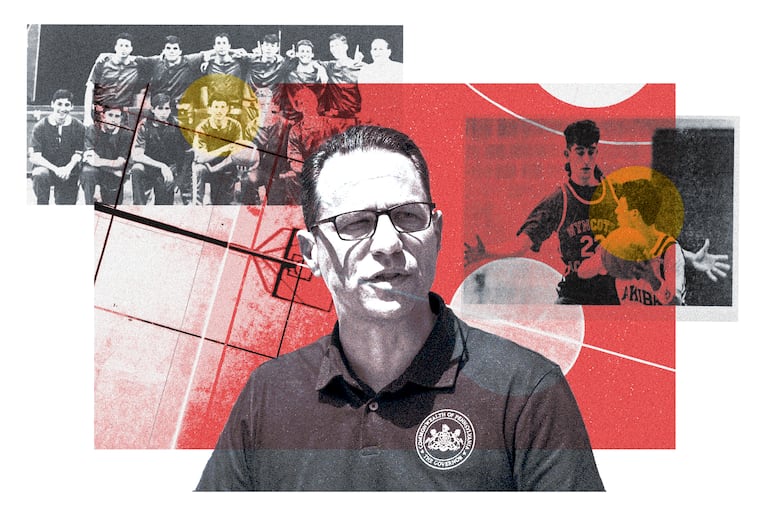
Akiba went 25-3 in 1991 and won its league championship with an offense orchestrated by the future governor of Pennsylvania. Eden played center, Aaron Hahn Tapper was a 6-foot-3 shooting guard after hitting a growth spurt, and Josh Shapiro played point guard.
Today, Shapiro is Pennsylvania’s 48th governor, running for reelection, and rumored to be a presidential contender come 2028. Thirty-five years ago, he ran point for a high school team that loved proving it belonged.
“We would walk into every game as underdogs,” Shapiro said. “I think we were underestimated on every court that we walked on, but because we had a team mentality, we outperformed our individual skills. And we won.”
‘The General’ ran the offense
Akiba, which is now Barrack Hebrew, won the championship game by 19 points, but the players were not quite prepared to celebrate. They didn’t have a ladder to cut down the net so they lifted Shapiro, who scored 16 points, like a cheerleader as he took scissors to the twine. Finally, a ladder appeared and everyone cheered.
Most of the boys had played together for years at the small school with a graduating class of just 44 students. They didn’t play games on the Sabbath and their principal banned them from the state playoffs because there could be games on Saturdays.
The boys came from all over as Akiba was one of the only Jewish high schools near Philadelphia.
Shapiro was from Montgomery County, Eden was from Center City, Hahn Tapper split his childhood between South Philly and Lower Merion, and Jeff Katchen lived in Oxford Circle. They were a tight-knit group of kids who came to Akiba in seventh grade.
Eden once defeated Shapiro in a student-body election. It’s the only race Shapiro said he ever lost, and Eden won by promising to install an ice cream vending machine in the cafeteria.
“Promises made, promises kept,” Eden said.
» READ MORE: Not even cancer can stop Bill Koch, Father Judge’s 76-year-old basketball coach
It would have been hard to imagine them cutting down nets a year earlier when they struggled through a one-season tour in the Bicentennial League.
”It was like what do you do," Eden said. “When every single player is an inch or two bigger than you, 20 pounds heavier, and playing the same game as you?”
“We had a size limitation. I was a Jewish center. If I was 6-foot-11, we could’ve competed with anyone. But I was 6-3. So that puts a cap on it.”
Akiba returned the next season to the Tri-County League — “maybe the worst league in the city,” Eden said — and rattled off a 21-game winning streak that also included some non-league wins. Akiba played its home games at a tiny gym it called the Cougar Dome, and the players wore spandex because their shorts were so short.
“You didn’t want to show your business with the short shorts,” Katchen said.
Their coach, Tom Riley, played with Wilt Chamberlain at Overbrook and his assistant played at Murrell Dobbins Tech with Hank Gathers and Bo Kimble.
“Those guys were playing with me,” Malcolm Trottie said of the younger Gathers and Kimble.
Riley was an old-school coach with a comb-over that seemed to stand up whenever he yelled at the boys. He installed a slow-moving offense of picks and screens that he carried over from his days coaching in the Catholic League. Trottie, who was just 27 years old, helped the boys know when to pick up the pace.
» READ MORE: How Andre Noble, a Boston native, became an all-time Philadelphia high school coach: ‘He got immersed into it’
The Jewish kids were coached by an Irish Catholic and a Black guy from North Philly. It was perfect.
“They taught me a lot about their culture and they kind of showed me that it’s OK to love someone who doesn’t look like you,” Trottie said. “They were human, just like anyone else. I think we learned a lot from each other.”
The governor ran the offense, often feeding the ball to Eden or finding Hahn Tapper on the wing. They called Shapiro “The General” and he could knock down his own shot, too.
“I loved being a ball distributor,” Shapiro said. “I loved the games when I had more assists than I did points. That was my game. I brought the ball up and usually found Ami down low or Aaron for three. We ran a great pick-and-roll. I viewed my job as a distributor. I understood when I needed to speed it up and run a fastbreak or slow it down. And when there was an open midrange jump shot, I took it.”
He was just ‘Shaps’
Shapiro invited his classmates to the Governor’s Residence in Harrisburg earlier this year. It was their first class reunion, and nearly three-quarters of the students made the trip. Eden told Shapiro that they need his political career to keep rising so their high school highlights could go viral.
“It was the perfect balance of Josh and Lori making it a special event without making it a special event that was just about them,” Eden said. “We were there for four hours, and 95% of it was just people talking like a class reunion. This is where we are in the world, but I walked out of there and thought, ‘Wait, is he too nice to be president one day?’”
Shapiro displayed charisma and leadership skills as a teenager, but his teammates did not peg him to be inviting them one day to the state capital. He was just “Shaps.”
“We all thought everyone would be successful,” said Hahn Tapper, whose older brother is CNN anchor Jake Tapper. “But we never would have thought that any of us would become famous or be in the small number of people being considered to run for president of the United States. That’s pretty out there.”
» READ MORE: Philly’s Scott Bandura was teammates for a day with Bryce Harper and Kyle Schwarber. It was ‘surreal.’
Shapiro credits the end of his basketball career with his political rise, as he became student body president at the University of Rochester after failing to walk on to the basketball team. And he credits his time as “The General” with preparing him for a life in politics.
“The way it taught me about teamwork, about discipline, about understanding that when you have a task to do, that if you approach that task with a team mentality where everybody operates at a high level, you can do extraordinary things,” Shapiro said. “I think about teamwork every day in my work as governor.
“If I have a great day and I’m performing well, but my staff is not — which never happens — we’re not going to win the game. We’re not going to win the day. We’re not going to win the issue. Likewise, if they’re doing a great job and I’m not, we’re also going to suffer. We work together, we each have a task to do, and we each have to do it at a high level. And I learned that on the court. I learned that playing high school basketball.”
A dose of perspective
In January 1991 against Morrisville, Riley thought a loss was near and swapped out the starters in the fourth quarter. But the bench players closed the gap and the coach realized the game was much closer than he thought. He rushed back the regular players and Akiba pulled out a one-point win to keep their winning streak alive.
The boys were celebrating on the bus ride home when a news report came over one of the players’ transistor radios: Iraq had shot Scud missiles at Israel during the Gulf War.
“It was pretty jarring,” said Josh Friedman, the team’s manager. “You’re 17, 18 years old. You’re looking at colleges and ending one chapter of your life. Then this real world event happens and it’s like, ‘This is real. This is how the world works.’ That ride home felt pretty long. It put things into perspective.”
Many of the players, including Shapiro and Eden, had spent part of the previous school year in Israel, and some had family there. Riley gave the players off from practice that Sunday to spend time at home.
“We all thought everyone would be successful. But we never would have thought that any of us would become famous or be in the small number of people being considered to run for president of the United States.
Hahn Tapper, inspired by patches he saw college and NBA players wear, designed Israeli and American flags for the Akiba players to wear on their jerseys.
“We made them with like Scotch tape, Magic Marker, and Wite-Out,” Hahn Tapper said. “I made all of them during class. I’m not an artist so you had to take it off before you washed your uniforms. We didn’t know much about politics. We knew whatever we were told. But we wore them for the rest of the season.”
They won the next 16 games.
“They were an easy group to coach,” Trottie said. “Where I come from, everyone wants to be the man. But we could ask them, ‘Who wants to take the last shot?’ And nine times out of 10, it was Tapper. They wanted him to take the shot. That’s the cool thing about it. They were a team.”
Hahn Tapper was a skilled guard who grew three inches between his junior and senior years. He could always shoot and dribble but suddenly had the body of a forward. He could play inside and outside. His friends compared him to Vinny Del Negro, a positionless NBA player in the 1990s before such a thing become a regularity.
Eden was a soccer player and played basketball like a bull. He was a project on the court whom the previous coach often described as having “raw, unadulterated power” as he battled for rebounds.
Eden shot his free throws underhand after his mother watched him go 1-for-8 from the line and told him about the free throw contest she won as a high schooler in Ohio.
“I would shoot the first one and no one was ready for it,” Eden said. “Then people in the crowd would be like, ‘He did it!’ ‘No, he didn’t!’ Then I’d shoot the second one. ‘He did!’ Nothing prepares you to do what you have to do in the face of adversity or embarrassment in your work career like standing at a free throw line at a crowded away high school gym shooting underhand. If you can do that …”
» READ MORE: March Madness was the start of a year when Philadelphia can show why it’s ‘special’
The Akiba players watched Hoosiers the night before the championship game against Wyncote, which had future Temple player Michael Tabb.
“They were overlooked even in the title game,” Trottie said. “They were like, ‘Pfft.’ Then we beat them by like 20.”
The players were charged up and Eden won the tap against the 6-7 Tabb. It was all Akiba from there.
“I remember vividly being so pumped up for the moment we were in,” said Shapiro, whose future wife, Lori, was in the crowd. “On an early fast break, back when fast breaks went for layups instead of pulling up for three, I jumped so high that the tip of my finger touched the rim. It was the highest I’ve ever jumped. I just remember that feeling of energy the entire game. We dominated.”
They didn’t know what to do after they cut the net down. If they went to Lower Merion High, they figured, there would be a big party for them with all the students there. But they went to tiny Akiba. So they slept at Trottie’s apartment at 10th and Spruce and the coach ordered pizza.
“There wasn’t enough pizza,” Trottie said. “I remember Jeff Katchen was eating the leftover steak from my fridge. I was like, ‘This guy.’ But we had a good time.”
The boys woke up the next morning, rushed to the newsstand, and saw their big win didn’t get a headline in the paper. Their point guard was not yet the governor.
Thirty-five years later, they keep in touch with an email chain and act like they’re still in high school whenever they get together. Their 25-3 record is still the best in school history. Sometimes, they talk about it at the governor’s mansion.
Hahn Tapper, a professor at the University of San Francisco, was back in Philly two summers ago and saw Shapiro introduce former Vice President Kamala Harris at a campaign rally at Temple. There was his old point guard, the guy who helped a team of underdogs prove they belonged, who had just been considered for a presidential running mate.
“When I saw him up there, it wasn’t a stretch,” Hahn Tapper said. “Seeing him talk and seeing him with charisma, he had that as a high school kid. Obviously, it’s on another level now.
“I emailed him after and said, ‘Shaps, that was amazing.’ I call him ‘Shaps’ and I’m ‘Taps.’ He responded and said, ‘Thanks, Taps.’ A lot of people when they get to that stratosphere aren’t as down-to-earth as he is. He doesn’t put on airs. In many ways, he’s still the solid kid from back in the day.”