Lower Merion and Harriton High Schools may merge their football programs after all
The Lower Merion school board on Monday voted to approve a cooperative between the district's two football programs following months of activism by parents and players.
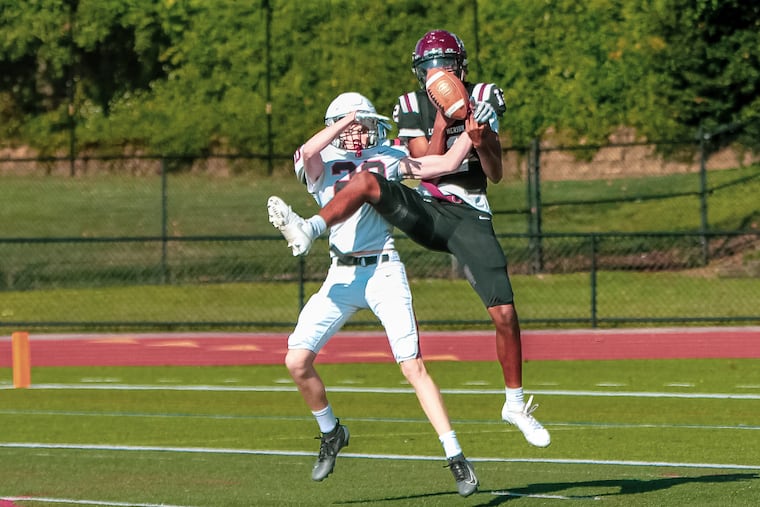
Lower Merion and Harriton High Schools are one step closer to merging their football teams.
Lower Merion School District’s board voted Monday night to approve a cooperative between the two schools’ football programs for the 2026-27 school year — the first step in a long-anticipated effort to create a districtwide football program. The cooperative will now have to be approved by the Pennsylvania Interscholastic Athletic Association (PIAA).
The school board’s approval came after months of activism by parents and players who say dwindling participation and under-rostered teams have led to a dip in morale and growing safety risks for players. It also marked a reversal for the school district. In November, Superintendent Frank Ranelli recommended the district not merge the two football programs, saying Lower Merion High School’s team should not have to “give up their team identity … and playoff chances” to merge with Harriton. At the time, Ranelli called Harriton’s dwindling player numbers “a problem that [Lower Merion High School does] not need to solve.”
Pressure continued to build following Ranelli’s November recommendation, though the board declined to vote on the issue at a February meeting, citing complicating factors and a rushed process.
The district hosted a community meeting on the potential merger late last month before announcing Monday’s special school board meeting.
School board president Kerry Sautner on Monday said that as the community wanted the district to “move it forward and move it forward fast,” when it came to the merger, the district had to go through “an amazing amount of legal review” to craft the policies and safety guidelines “in the right way.”
“We slowed things down, and there was a lot of people that were upset about it,” Sautner said. “… That was really hard, and [Ranelli was] brand-new, and it’s hard to do the right things when you’re brand-new, because you just want to start to build those bonds of trust.”
Ranelli became Lower Merion’s superintendent last spring.
School board members said Monday that many of the specifics are still up in the air when it comes to merging the football programs, including where a unified team would practice and how tryouts would work.
The early-stage vote allows the district to secure PIAA approval before it gets the ball rolling on the details, board member Anna Shurak said.
“There will be a lot of work down the road,” she said. “All of the details of that work are not figured out. So questions of how this will operationalize, all the way down to tryouts, everything else, we’re not at a place to answer that.”
Under PIAA policy, schools are allowed to merge sports teams under a set of specific conditions, including low student enrollment, a demonstrated “lack of success” or lack of participation in a specific sport, or an agreement to forfeit postseason competition.
While Lower Merion and Harriton exceed the enrollment numbers that allow for a merger, both schools’ football teams have struggled in recent years. Due to low player numbers, neither school has been able to field a full freshman or junior varsity team in recent seasons.
Chris McCloud, one of the parents who has advocated for the merger in recent months, said the vote to form a cooperative was “a great representation of the school board, the superintendent, and the community all coming together to really do what we all feel is best.”
“It’s a huge step in the right direction,” McCloud said.
Speaking during public comment on Monday, Joe Augustine, Lower Merion’s head football coach, encouraged the school board to “think of the ‘why.’”
“There are a million things to figure out, and when the ‘why’ is big enough, those parts can be figured out,” he said.

Inquirer Lower Merion
This suburban content is produced with support from the Leslie Miller and Richard Worley Foundation and The Lenfest Institute for Journalism. Editorial content is created independently of the project donors. Gifts to support The Inquirer’s high-impact journalism can be made at inquirer.com/donate. A list of Lenfest Institute donors can be found at lenfestinstitute.org/supporters.