Trump may hope for a redo of the 1876 World’s Fair—but even that expo revealed a nation in crisis
In 1876, like 2026, Americans were divided, economically stratified, and uncertain about the future ahead.
From the end of June to early July, the Trump administration will host what it is calling “The Great American State Fair,” a weeks-long event to help mark the nation’s 250th birthday. The White House is promoting the fair as “a master-planned celebration” in and around the nation’s capital. They note that it will feature “pavilions, designed in the beaux-arts style [sic]” that will “highlight national pillars,” such as “Arts & Culture,” “Land & Expansion,” “The Arts & Innovation,” “Technology & Progress,” and “Horsepower” to “ignite a spirit of adventure and innovation to help our nation succeed for the next 250 years.”
These grand pronouncements call to mind a classical world’s fair exhibition, even if the administration hasn’t put in the work to pull it off. By contrast, the first major world’s fair held in the United States 150 years ago, the 1876 Philadelphia Centennial Exposition, was ten years in the making, spanned six months, attracted more than 10 million visitors, and featured the work of over 30,000 exhibitors, including Alexander Graham Bell and Thomas Edison. Today, the White House is fighting poor publicity, scrambling to find respectable entertainers to perform, and floating a plan to cancel its fair altogether.
Yet, we can find echoes of the Philly Expo in today’s slapdash 250th celebration. History reveals that America in 1876 was, as it is now, in turmoil, gripped by a growing economic crisis and mounting unemployment, politically torn apart, debating the impact of new technology, and reeling from the cost of war. In the familiar context of extreme uncertainty, the glorious Exposition also drew sharp criticism and, more poignantly, highlighted the nation’s fragility.
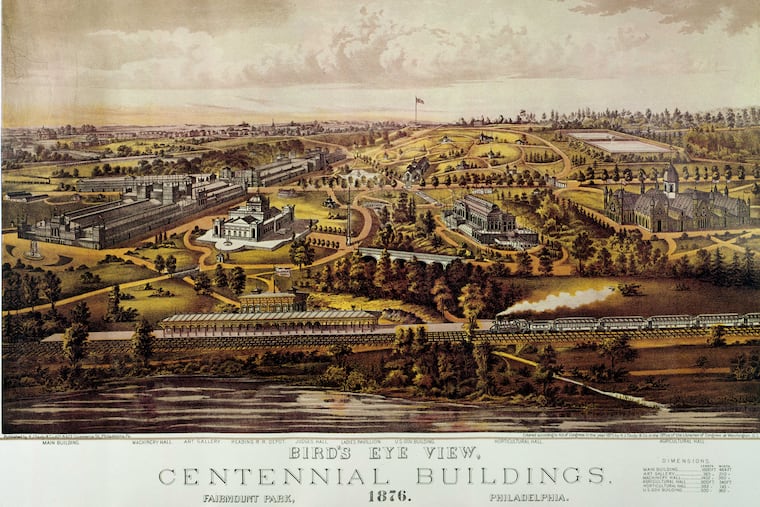
In 1876, from May to November, Philadelphia was the site of the biggest public event in the nation’s history up to that point – the International Exhibition of Arts, Manufactures, and Products of the Soil and Mine, or more simply, the Centennial Exposition. This was a world’s fair, a unique event in which the host nation spent lavishly to build elaborate fairgrounds, exhibition halls, courtyards, and gardens to grab the global spotlight and celebrate progress. In the 19th century, amid the industrial revolution, a world’s fair commonly featured thousands of displays promising a peek into the future. Visitors could glimpse the cutting edge in science and technology, advances in the arts, new discoveries in medicine, innovations in transportation, and the latest consumer products.
The stakes were terribly high for the United States as it planned to host its own world’s fair in 1876, the first held in the U.S. since the Civil War. Although the war had been devastating, and the work of reconstructing the South still threatened the lives of freed Black people and the American two-party political system, the preserved republic was pursuing new projects, including building a continent-crossing railroad and rapidly expanding the industrial economy. Both fueled the growth of cities and a new diversified workforce thanks to emancipation, immigration, and the rise of the middle class. In the midst of big changes, the world’s fair in Philadelphia was an opportunity for America to present itself to the nation and the world as a stable and culturally advanced industrial giant with a bright future.
Covering 450 acres of Philadelphia’s vast and bucolic Fairmount Park—celebrated at the time as one of the world’s most beautiful public parks in one of its greatest cities—the exposition grounds included dozens of grand buildings surrounded by riverbanks and tree groves. The event site was also linked to eight streetcar lines that connected the fairgrounds to the Pennsylvania and Reading Railroads.
For six months, visitors from all over the country and abroad poured in to see tens of thousands of exhibits, many of them astonishing firsts: incandescent light bulbs, the typewriter, a dishwasher, Alexander Graham Bell’s first prototype for the telephone, and a new fireproofing material called “asbestos.”
In addition, farmers put several agricultural wonders on display including new types of citrus trees that could thrive in the American West, and bananas, considered an expensive delicacy and priced at $2 each (about $60 today). At the center of the Machinery Hall exposition building was one of the fair’s main attractions: a hulking, 1400 horsepower steam engine, 45 feet tall, and weighing 650 tons. This Corliss engine was the biggest of its kind and, in size and power, signaled America’s industrial might. For 50 cents ($15 today), visitors could climb to the top of a towering hand and torch structure called “Liberty Enlightening the World”—a portion of what would eventually become the Statue of Liberty.
The Philadelphia Centennial seemed to say that, yes, the United States may have been, in a global context, a young country. But that fact only reinforced all that it had accomplished in one short century.
The timing for such a vainglorious celebration wasn’t optimal. The year of the Exposition came at the height of the so-called “Terrible Seventies,” an era of disastrous economic news that began with the financial panic of 1873 and continued through the decade with bank closures, business failures, railroad bankruptcies, mass layoffs, and inept government leadership. Indeed, the crisis forced fair planners to resort to penny pinching in the final stages of construction, leaving some exhibition buildings unfinished after opening day.
The era of the Philadelphia World’s Fair was also a time when a handful of capitalists accumulated extreme wealth and tightened their grip over the nation’s resources while workers began to lose control over their own conditions of labor. In growing cities like Philadelphia, where industrial wage workers, including Black laborers and new immigrants, were concentrated, poverty spread quickly. Outside of urban centers, small farmers lost ground to commercial agriculture and worried about sustaining their rural way of life and simply making ends meet. At a time when the average laborer made around $1.25 a day and people in the skilled trades made little more, the 50 cent fair entry fee was an extravagance reserved for only those with expendable time and income.
Some fairgoers left ambivalent about the future and puzzled by how disconnected the consumer-focused displays seemed to be from current economic realities. One visitor from Connecticut complained to the Hartford Christian Secretary that the fair seemed to be little more than “a scramble for the Almighty dollar” at a time when terrific economic fear “pervades the country.” Another wrote with dismay to Ohio’s Worthington Advance that the grandiose festivities focused on consumer abundance proceeded, even as a “great army of men and women out of employment is on the increase.”
The Terrible Seventies revealed a tough truth: America had survived war, embraced modernity, and proved more than capable of industrial might. But it remained fragile. The awe and grandeur of Philadelphia’s sprawling Centennial Exposition paradoxically reminded the nation of the challenges – both predictable and unpredictable – that lay ahead. It turned out, great progress and great problems would be inseparable.
Trump’s Freedom 250 events aren’t likely to be successful as a showcase of national advancement. Still, as with the 1876 Philly Expo, some Americans will find meaning and pride in the fact that this year’s Great American State Fair will take place on the National Mall near the White House, where Trump has asserted his power. Its location and its brazen host will be enough to elevate Make America Great Again spirits, even at a time when they’ve been shaken by rising costs, an unpopular war with Iran, and declining global power.
For many other Americans and for the world watching, this fair will not be a glorious reminder of the nation’s birth. Instead, in the midst of economic crisis, political animosity and corruption, and fears that American principles won’t survive, the commemoration of the nation’s founding will likely reinforce uncertainty ahead— just as was the case a century and a half ago.
Felicia Angeja Viator is an associate professor of history at San Francisco State University, a pop culture writer, and editor for Made By History.
Made by History takes readers beyond the headlines with articles written and edited by professional historians. Opinions expressed do not necessarily reflect the views of The Inquirer.