Betsy Ross’ great-great-great-great grandson donates her original sewing table to Philadelphia’s Betsy Ross House
On Flag Day, June 14, the Betsy Ross House in Old City will receive a donation of Ross’ original sewing table from one of her descendants.
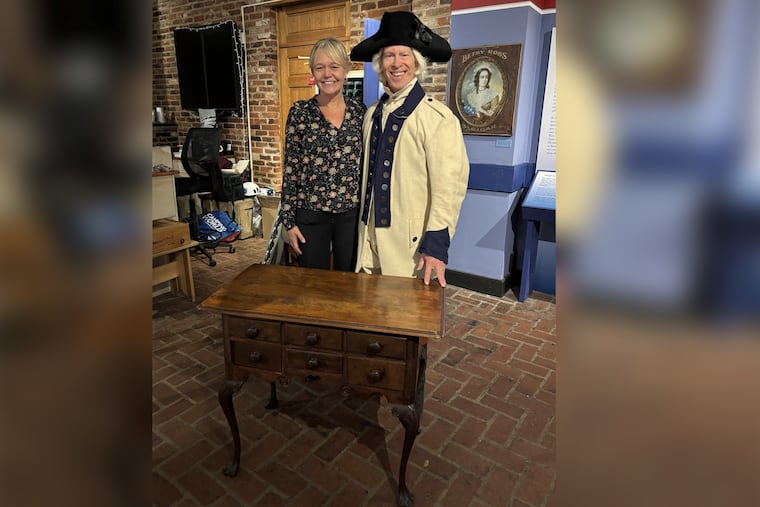
For more than five years, all Lisa Acker Moulder had was a petticoat, a silver snuffbox, and a dream — a dream of a modest wooden table with six rectangular drawers and four curly feet that stretched along the floor with a flourish.
Moulder, the longtime director of Old City’s Betsy Ross House — an immersive museum inside Ross’ Philadelphia home, complete with artifacts, period-specific furniture, and a rotation of nine Betsy Ross reenactors — had heard tell of the table. It was said to be Ross’ original sewing table where she stored her thread, needle, and fabric. It also may have been the surface on which Ross stitched the United States of America’s very first flag. If Moulder could secure it for the museum, it would become the crown jewel in the house’s collection.
But she had no idea where it was.
Meanwhile, about 50 miles southwest of Philadelphia, along the northern stretch of Maryland’s Eastern Shore, the table sat in Eric Conrad’s home. Conrad, Ross’s great-great-great-great grandson, had it situated near the kitchen with a piece of glass on top to prevent water stains. His wife usually put a bouquet of freshly picked flowers from their garden on top of it.
The table has been in the family’s collection for generations, Conrad said, and in his personal possession for about 14 years.
When Conrad was in elementary school, he’d go to his great-uncle’s Maryland farmhouse and dig through National Geographic issues stored in the drawers. It birthed his love of travel.
In the 1970s, when his great-uncle died, his mom received the table. She placed it near the kitchen and hung a painting she’d done of the Betsy Ross House above it. When the table became his, after his mom died, he placed only one thing in the drawers: a newspaper clipping of an interview his mother did.
The table bore witness to family reunions, meals, and children growing into adults.
“It was always a piece of my family,” Conrad said.
Which is why Moulder was shocked last spring when she got a call from Conrad. He was thinking about donating the table to the museum on Flag Day, June 14, in 2026 in honor of America’s Semiquincentennial.
“The 250th — it’s something special,” Conrad said.
His extended family had donated pieces of their collection to the house over the years, including a cane from Ross’ third husband, John Claypoole. Conrad played with the cane as a child and admired how well Moulder took care of it as he watched the museum’s activities from afar on YouTube. To him, there seemed no better guardian for the table than Moulder.
Conrad’s call was “completely unexpected,” Moulder said. “I was absolutely excited beyond words.”
Then the nerves kicked in. Moulder had heard of Conrad from other Ross relatives. She’d heard he was rather private; she knew the table had been in his family for generations and feared she’d say something to inadvertently offend him or make him reconsider.
Conrad visited the house soon after on Flag Day 2025 and Moulder gave him a tour. By the end, he’d committed to donating the table.
“I guess we impressed him,” Moulder said.
Conrad wrapped the table up, secured it in his van, and drove it to the house in the fall. He explained to Moulder that one of the original drawers was missing and had been replaced.
Family legend has it that Ross would take out a drawer filled with her sewing things when she traveled, said Marla Miller, a historian and author of Betsy Ross and the Making of America.
So Moulder sent the table off to a conservator to restore it and replace the drawer with a more accurate reconstruction. During the process, she learned the table dated to before 1776, reaffirming the theory that Ross could have sewn the first American flag at the table.
Between June 14 (Flag Day) and July 4, Moulder said the museum will display the table alongside its other most prized original artifacts — Ross’ snuffbox, petticoat, spectacles, and Bible in a facility near the Betsy Ross House called Flagmakers’ Hall. After that, they’ll display the table in Ross’ bedroom, which is believed to be where she stitched the first American flag, possibly on that very table, the implements and fabric hidden in the drawers.
Sewing the flag under British rule would have been an act of treason at the time, Moulder said, and Ross’ room is the one place that loyalist neighbors and customers likely wouldn’t have been able to see inside.
Did Betsy Ross actually sew the flag?
There’s still dispute over whether Ross made the first flag, primarily due to a lack of documentation. However, a recent discovery at Virginia’s Mount Vernon of a receipt George Washington paid to Ross and her husband for bed hangings in 1774 adds a new level of veracity to the lore as it indicates Washington knew her and liked her work.
For Miller, who spent her career researching early American craftspeople, she’s still unsure if Ross made the flag or not. The answer, like most origin stories, seems more complicated than maybe Americans want to believe it is. But that doesn’t undercut the importance of Ross’ story, she said.
The life Ross lived in Pennsylvania in the late 1700s and early 1800s included a cross-section of hardships and acts of bravery that reflect the experiences of many American women who lived around that time. Ross lost two husbands in the war effort and cared for and financially supported her third husband, who was disabled in combat. She stitched flags, a key wartime tool, and even made munitions for the Schuylkill Arsenal, Miller said. She symbolizes both the plight and the patriotism of many women who existed during the nation’s early days.
“She stands for hundreds of Philadelphia women,” Miller said.
Those early American women are often overlooked in the retelling of the nation’s founding. Her name and story ensure they’re remembered.
“Her historical celebrity opens the door on stories about labor history, about the revolution, about the occupation of Philadelphia, about women in the war machine … It opens the window on the founding of the Republic,” Miller said. “I always kind of think, ‘Come for the flag, stay for the history.’”
And, besides, Miller said, “who knows what’s still to be discovered?”