Autistic students who make it through college face a bigger challenge: Getting jobs
Colleges now offer career readiness classes and one-on-one coaching for students with autism.
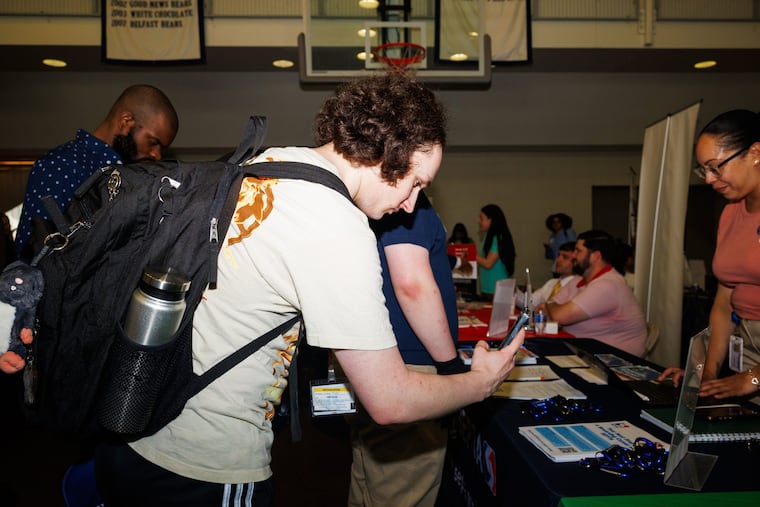
The college gym is packed with employers offering work opportunities, but Jimmy Myers, a freshman at Drexel University, has come to the career fair to speak with just one of them: the Southeastern Pennsylvania Transportation Authority.
A self-described “train nerd,” Myers has been closely tracking progress on the railway’s trolley modernization project. And he’s eager to share his expertise with the SEPTA recruiter.
But the recruiter is late, so Myers paces the crowded, noisy gym, checking the time on his Swiss Railways watch — a wrist-sized replica of the clocks in Swiss train stations. For a few minutes, he waits at a table that Drexel’s Center for Autism and Neurodiversity has set up in a back corner of the gym as a haven from the sensory overload.
Today’s college graduates are entering one of the tightest job markets in years, as companies scale back entry-level hiring amid economic uncertainty and the explosion of artificial intelligence. Just under a third of 2025 graduates have found full-time employment related to their education, according to one recent report.
The market is even tougher for young adults with autism. Even before the hiring slowdown, more than 30% of autistic college graduates were unemployed, and about a quarter of those who did have jobs were in office- and administration-support roles, one study found.
One key reason: Autistic students often have trouble navigating traditional hiring processes, including interviews, which favor neurotypical candidates.
To help autistic students like Myers land jobs, Drexel and other colleges are offering career-readiness classes and one-on-one career coaching; some are also working with employers to make their hiring and employment practices more inclusive. Some major corporations have also formed partnerships with colleges to recruit neurodivergent students for internships and jobs.
Still, only around 150 colleges — out of close to 4,000 degree-granting institutions in the U.S. — have autism support programs, according to the College Autism Network’s database, and only a subset of them provide job preparation.
It’s difficult to say how many students with autism are enrolled in college, in part because many students choose not to disclose their diagnosis to campus disability services — a prerequisite to receiving accommodations. The best estimate is that there are somewhere between 135,400 and 286,254 autistic college students, according to research by Bradley E. Cox, founder of the College Autism Network and an associate professor of higher, adult, and lifelong education at Michigan State University.
While roughly a third of autistic youth also have an intellectual disability, most autistic college students have average or above-average IQs, experts say. But many have social and emotional challenges that can make the college journey harder — such as heightened, or suppressed, sensory systems; anxiety; and difficulty with executive functioning skills like time management, organizing, planning, and emotional regulation.
Those who persist to graduation have shown they are not only capable, but also resilient, advocates say. And some common traits — an attention to detail, an ability to pick out patterns others might miss, and unconventional ways of approaching problems — can make autistic people valuable employees.
“I can generate connections that others might not see and come up with cool and interesting ways to solve a task,” said Eli Werbach, a fifth-year engineering technology major at Drexel who is autistic.
Recognizing these strengths, some major companies — including tech giants SAP and Microsoft, and financial institutions Wells Fargo and JP Morgan Chase — began building neurodiverse hiring programs roughly a decade ago.
Those efforts have yielded significant revenue for companies, some of them say, with EY, one of the big four accounting firms, reporting in 2023 that its neurodiverse employees have generated nearly $1 billion in business value.
But even as employers have become more willing — even eager — to hire graduates on the autism spectrum, their hiring practices continue to shut many qualified candidates out.
The biggest barrier is the interview process, according to Zoe Gross, director of advocacy for the Autistic Self Advocacy Network. She said that, on a subconscious level, recruiters prefer candidates who make regular eye contact, laugh at their jokes, and mirror their body language — behaviors that don’t always come naturally to autistic people.
“Without realizing it, employers are putting a lot of weight on the social competence of the person, rather than whether they’re qualified for the job,” Gross said.
And AI tools can make it harder for autistic individuals to even get an interview. One study found that AI-enabled resume screeners ranked resumes lower if they included disability-related awards or memberships.
To prepare autistic students for the interview process, colleges such as Drexel and Rowan University often conduct mock interviews.
On a recent weekday, Chiara Latimer, director of Rowan’s Center for Neurodiversity, sat down with Anthony Ung, a graduate student in computer science who was preparing for an interview with a major defense contractor.
In their last meeting, Ung had been speaking too fast. This time, Latimer handed Ung a selection of “grounding stickers” he might use to remind himself to speak more slowly. He chose a pink heart with a reminder to “breathe in, breathe out.”
Latimer then launched into a series of common interview questions, starting with the classic: “Tell me about a time you worked on a team to achieve a goal, and what was the outcome?”
Ung responded with a detailed but succinct story about a time he worked as team leader on a class project building a web application for a medical setting. The outcome, he said, was that “the instructor was impressed.”
When Rowan started its Autism PATH (Preparation and Achievement in the Transition to Hire) seven years ago, only 40% of participants found work within a few months of graduating. Now, with most students spending four years getting academic and career coaching in the program, that rate has climbed to 66%, Latimer said.
Along with reviewing resumes and conducting mock interviews, college autism-support programs help students weigh the pros and cons of disclosing their diagnosis to a prospective employer.
Both options carry risks. Candidates who disclose may be viewed differently by employers, or be subject to discrimination. Those who don’t may face criticism if a problem arises in the workplace and they bring it up then.
Hiding one’s autistic traits — known as “masking” — can also take an emotional toll, leading to depression and anxiety, Gross of the self-advocacy network said.
Back at the career fair, the recruiter finally arrived. Myers rushed to greet her, complimenting the SEPTA button she was wearing (“the best transit logo”) and the train sticker on her laptop. He then peppered her with questions about Philadelphia’s trolley modernization project.
“When are the new trains going to enter service? Will they redesign the stations to accommodate them? Are there plans to separate car traffic from trolley traffic? Will they keep the legacy trains?”
“You are ahead of the game!” the recruiter exclaimed, seemingly impressed by his knowledge of the project.
When the conversation was over, Myers said the exchange gave him hope.
“If I can demonstrate my expertise like I just did, I think I can get a co-op,” he said.
This story about young adults with autism was produced by The Hechinger Report, a nonprofit, independent news organization focused on inequality and innovation in education. Sign up for the Hechinger newsletter.