Boston thinks its Revolutionary history might be better than Philly’s. We think that’s pretty cute.
An objective and scientific look at the historical "rivalry" between two great American cities.
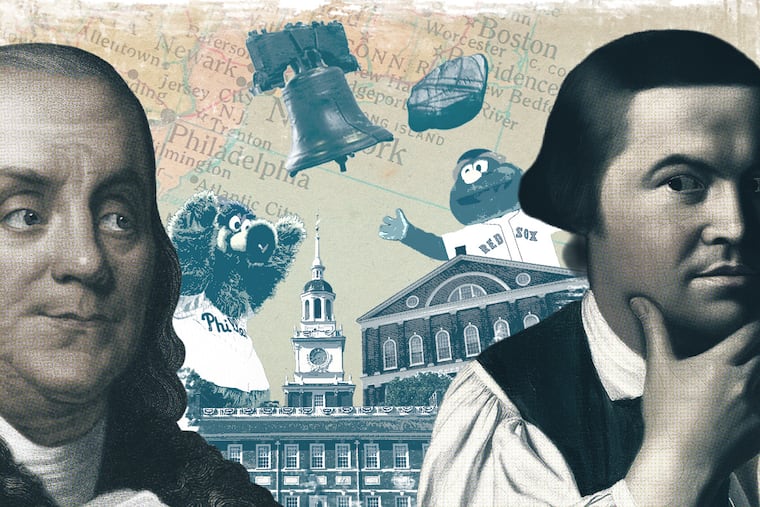
BOSTON — Not long ago, the folks over at the Boston Globe turned their spotlight on, of all places, Philadelphia. With the nation’s 250th birthday fast approaching, the newspaper dispatched a reporter to our fair city to determine how it stacks up, historically speaking, to Boston.
The story revealed that — despite being primarily known for bad weather and baked beans — Boston apparently fancies itself a city with a robust and impressive history. In fact, some seemed to be of the opinion that Boston’s Revolutionary history might even be better than Philadelphia’s.
“As the old saw goes,” one Massachusetts historian told the paper, “Boston did the hard work of making the Revolution, while Philadelphia did the paperwork.”
Admittedly, this came as a bit of a surprise to us here at The Inquirer. What we had assumed is that when your city lays claim to the Liberty Bell, the Declaration of Independence, the U.S. Constitution, and a starring role in the 2004 Nicolas Cage film National Treasure, any debate over historical prominence is bound to be a little one-sided.
Having myself once lived in Boston, I, too, was a bit miffed, as it had always been my understanding that the city’s history amounted to little more than drunken shenanigans and historical fan-fiction — a bizarre collection of half-truths and falsehoods.
But like the Founding Fathers themselves (at least five of whom are buried at Philadelphia’s Christ Church, though who’s counting?), I remain open to new ideas.
And so I set off recently for that little New England burg to the north, eager to experience firsthand the rich and vibrant history that we Philadelphians had apparently been missing out on.
A trail of freedom and fabrication
It was mid-June when I arrived in Boston, which meant that winter would be wrapping up in just a few short weeks, and the city was abuzz.
Hollywood might have you believe that Boston is a grim, gray place where residents spend all their time robbing banks and inquiring about one another’s fondness for fruit, but in truth, the city is a lively hub of art, education, technology, and — as I’d recently learned — history.
And how better to delve into that history than by joining a walking tour of Boston’s famed Freedom Trail, a 2.5-mile path featuring several of the city’s most significant historical landmarks?
As a dozen or so of us set off with our guide, Kenneth — a friendly fellow dressed in authentic Revolutionary garb consisting of a polo shirt that said “Boston History Company” — it was hard not to feel a swell of patriotic pride.
What quickly became apparent, however, is that — when it comes to its history — Boston has spent the past 250 years playing a little loose and fast with the facts.
Take Paul Revere, arguably the city’s best-known historical figure.
You might recall Revere from his famous “midnight ride,” detailed in Henry Wadsworth Longfellow’s iconic poem, during which Revere successfully alerts fellow colonists of a coming British invasion.
In reality, Kenneth explained, Revere had pulled on his boots, set off on horseback into the New England night — and been promptly captured by British soldiers.
In fact, of the three riders sent out that night, our guide said, Revere was the only one who’d failed to complete the mission.
There was also the matter of the city’s most famous Revolutionary battle, the Battle of Bunker Hill — namely, that it was fought not on Bunker Hill but at a completely different location, called Breed’s Hill.
Rather than correct the record, Boston in 1843 built a massive 221-foot monument atop Breed’s Hill, labeled it “The Bunker Hill Monument,” and marketed it as a major civic attraction — though, luckily, there was a perfectly reasonable explanation for this bit of misdirection:
“[Bunker Hill’s] got the better name,” Kenneth explained. “So that’s what we went with.”
But a city’s history, of course, is about more than just names and dates and stories — it’s about monetizing those stories through a carefully curated local tourism industry.
The tourist experience
Proponents will tell you that, much like Philadelphia, Boston has done a terrific job preserving the city’s historical aesthetic, and this certainly seemed to be the case.
For instance, if you ignored the Chipotle, the CVS, the Walgreens, the Sweetgreen, the TJ Maxx, the Shake Shack, the cell phone repair shop, the Falafel King, and the 47 or so Dunkin’ locations lining the Freedom Trail, it was pretty much impossible not to feel like you’d been transported right back to the 1700s.
The crown jewel of the city’s historical district is the bustling Faneuil Hall Markeplace — which once served as a prominent meetinghouse for the Sons of Liberty and today is a very good place to get, say, a $23 bowl of chowder and a key chain with a shamrock on it.
Like Philadelphia’s Independence Hall, which remains a meticulously maintained ode to Philadelphia’s Revolutionary history, Boston’s Faneuil Hall — and nearby Quincy Market — is also a site that shows great reverence to the city’s past.
For instance, when you walk past the Sephora and take a left at Jimmy Buffett’s Margaritaville — if you reach the Sunglass Hut, you’ve gone too far — you will eventually arrive at a small shop selling tasteful tributes to the city’s storied history, such as:
A T-shirt featuring three cartoon men in wigs, chugging beers below the words, “The ‘Pounding’ Fathers.”
A T-shirt featuring an image of Benjamin Franklin wearing sunglasses and holding a red Solo cup, along with the words, “Ben Dranklin.”
Despite such thoughtful offerings, it turns out that Boston’s quest to attract history-focused tourists in the lead-up to America’s 250th birthday hasn’t always been easy.
“Philadelphia’s been cleaning our clock in terms of getting people to come to Philadelphia to see history,” says Robert Allison, president of the Colonial Society of Massachusetts and co-chair of Revolution 250, a consortium of New England organizations dedicated to honoring the nation’s Semiquincentennial.
But back to Ben Dranklin for a moment...
The Franklin conundrum
One issue that tends to get a little sticky between Boston and Philly is which city possesses a stronger claim to Benjamin Franklin, the wacky, kite-flying Founding Father.
Franklin’s story is a tale as old as time: Child is born in a small town (Boston), longs for something more, and, as a teen, eventually works up the courage to set off for the big city (Philadelphia), whereby, suddenly surrounded by other brilliant minds, he blossoms.
Despite this, Bostonians have struggled to relinquish their ties to Franklin, whose name and likeness are plastered across the city.
One afternoon, for instance, I found myself at the Mount Auburn Cemetery in nearby Cambridge, staring up at an enormous monument marking Franklin’s burial spot.
This was notable only in the sense that Franklin is very much buried 300 miles away, at the Christ Church Burial Ground in Philadelphia.
During our tour, Kenneth, the guide, had shared an improbable story. Apparently, an eccentric rich man named Thomas Dowse — in an effort to get more people to visit Dowse’s own grave site — had arranged to have a false burial monument to Franklin constructed nearby.
“A psych-out,” Kenneth called it.
Certain Kenneth must be mistaken — that not even in Massachusetts could someone be so arrogant and status-obsessed as to erect a fake burial monument — I called the cemetery in question and sheepishly recounted the story I’d heard.
“That’s absolutely true,” replied Meg Winslow, the senior curator of historical collections and archives at Mount Auburn — and a Philly native.
“It’s pretty big,” she added of the monument. “In the cemetery world, we call it a ‘cenotaph’ — which is a memorial without a body.”
As my first day in Boston drew to a close, I tried to take stock of what I’d learned. In truth, after 24 hours in the city, I’d yet to uncover the kind of historical magic I’d hoped to find.
But maybe, I realized, I’d been setting my sights too narrow.
To fully appreciate the local history, maybe I needed to go a bit further back in time.
Plymouth Crock
The next morning, I awoke early and — with a renewed sense of optimism — headed south on I-93, toward the one historical landmark that was guaranteed to impress: Plymouth Rock.
Like every American child, I’d grown up learning about this vaunted slab of stone — the very rock where the Mayflower Pilgrims had made landfall back in 1620.
Today, the rock is featured in a prominent seaside park 30 miles outside of Boston, and though some Yelp reviews have been lukewarm — “This rock is smaller than my dog’s bed.” ... “How can a rock be so famous and [yet] such a let down at the same time?” ... “I am so glad I am dying of a terminal disease so I don’t have to ever visit here again.” — I was not going to let a few naysayers dampen my spirit.
While it’s true that the rock is on the smaller side, and that the vast majority of tourists who’d made the pilgrimage did not immediately appear blown away (“Corny-ass rock,” grumbled one teenager in headphones), none of that took away from the rock’s significance — or the sense of awe I felt while gazing upon it.
This — right here in front of me — was the actual rock that the Pilgrims first set foot upon when they disembarked from the Mayflower more than 400 years ago.
“Actually, that’s a little bit of a myth,” explained a nearby park ranger, a skinny fellow with a wily white beard. “They arrived in winter, so there was snow and ice. No one’s stepping onto rocks with snow and ice.”
OK. But still: This — right here in front of me — was the very spot where the Mayflower had come ashore...
“The Mayflower didn’t come in,” corrected the ranger. “It was anchored a mile and a half out. A smaller vessel came in.”
Fine. But what was indisputable was that the town of Plymouth — the town in which I now stood, the town that has staked its entire identity to Plymouth Rock — was absolutely, positively the very first place the Mayflower Pilgrims landed when they arrived...
I looked at the ranger.
“They stopped first at the tip of [Cape Cod],” he said, “in a place called Provincetown.”
The verdict
Back in Boston later that day, it was hard not to feel a bit dejected.
I’d arrived in the city two days earlier with high hopes and an open mind, ready to immerse myself in its history; now, it seemed I’d be leaving with little more than some blisters and moderate-to-severe sun damage.
On my last afternoon in town, I was wandering glumly through the city’s streets, wondering if the trip had been for naught, when I stumbled upon an old business.
The Bell In Hand Tavern, a sign out front read. Oldest Tavern in America.
I walked in and took a seat at the bar.
Maybe it was the cool breeze flowing in from the open windows. Maybe it was the middle-aged finance guys flirting unsuccessfully with their server at a nearby table.
But sitting there, in the oldest tavern in America — trying to decide, like so many great patriots before me, between the loaded nachos and the steak-and-cheese spring rolls — I suddenly realized that I’d been looking at things all wrong.
In the end, history isn’t some gaudy competition. We all play a role in this great nation. Sometimes, as in the case of Philadelphia, that role includes having the Liberty Bell, the U.S. Constitution, the Declaration of Independence, and being the literal birthplace of democracy. And sometimes, as in the case of Boston, it means erecting fake burial monuments and celebrating small rocks of dubious historical significance.
Does that make one city “better” than the other?
Yes.
Obviously.
But the point is, it all matters.
For the first time since my arrival, I felt a pang of appreciation for this scrappy New England city, with its cute little history tours and incorrectly placed monuments.
And though my train back to Philadelphia would soon be departing, I was overcome by the urge to mark this moment in the only way that seemed right.
“Excuse me,” I called to the bartender, brimming with a newfound sense of patriotism. “I’ll have a Samuel Adams lager.”
“Unfortunately,” came the reply, “we’re out.”