He’s 102 years old. During World War II, he helped predict the weather.
Cyrus Bloom still remembers the code names, weather maps, and bomber crews from his time as an Army Air Corps meteorologist.
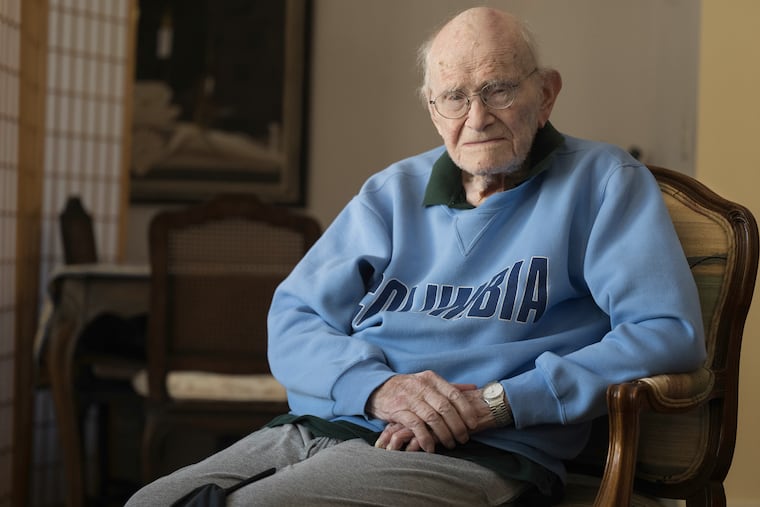
At 102, Cyrus Bloom does not pretend that old age is pleasant.
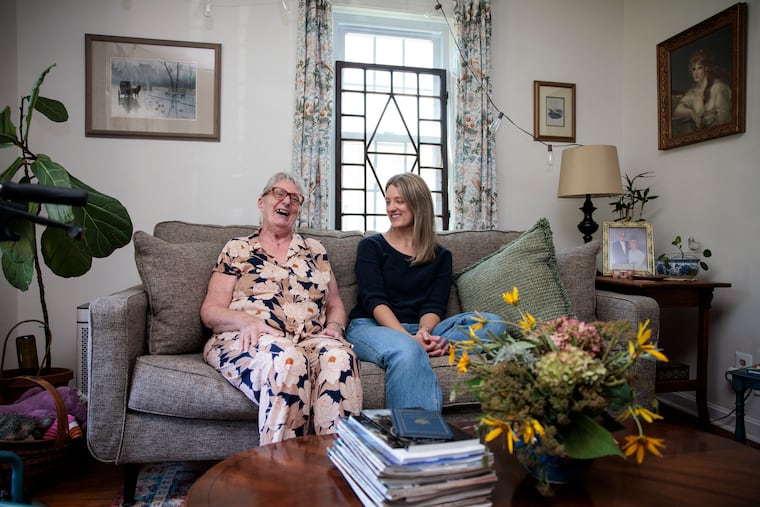
“It’s hard,” he said during a recent interview at his Center City apartment. He can barely walk, even with a walker, and he lives with the constant fear of falling. His short-term memory is shot, too. Walking into a room to get something, only to forget what he went there for, is an everyday occurrence. “It’s terrible,” he said matter-of-factly.
But his long-term memory? That’s a different story.
Bloom can still recall names, places, and details from more than 80 years ago, when he was one of the 16.4 million Americans who served in World War II. He can rattle off the details of his first assignment as a meteorologist with the Army Air Corps and the names of the bomber bases that dotted the coast of England where he was stationed. He remembers everything about “the very big war,” as he called it, even though he spent most of his life not talking about it.
Bloom, who was born in Newark, N.J., was a sophomore at Columbia University when he enlisted with the Army Air Corps and began training as a meteorologist. It was March 1943. He received his commission as a second lieutenant on June 6, 1944, the same day the Allied forces landed on the beaches of Normandy.
The invasion, Bloom noted, had originally been scheduled for June 5. But bad weather over the English Channel prompted Gen. Dwight D. Eisenhower to postpone it for a day. Bloom had no role in that decision; he had only just completed his training. But the delay demonstrated how heavily the Allied war effort depended on accurate weather forecasts.
Bloom’s first assignment took him to Bergstrom Air Force Base in Austin, Texas. There, he and the other meteorologists gathered reports on temperature, wind, and air pressure from weather stations across the country. They plotted the information on maps and drew isobars — lines connecting places with the same air pressure — by hand. Those lines revealed high- and low-pressure systems and helped meteorologists predict how the weather would move.
In September 1944, the Army sent Bloom overseas. Like so many young soldiers, he had never been abroad before. Today, he remembers every step of the journey. He left Washington on a military transport plane bound for Europe. The first stop was Goose Bay, Labrador, in northeastern Canada, where the plane refueled.
“It was just wilderness,” Bloom recalled, “very rugged country.”
From there, he flew across the Atlantic to Prestwick, Scotland, then continued south to London. The Army later sent him to the Cotswolds for additional training in British forecasting procedures. He remembers the region for its thatched-roof houses.
His final assignment took him to East Anglia, on England’s eastern coast. The countryside was crowded with airfields used by the U.S. Eighth Air Force, which carried out bombing missions over Germany. Bloom was stationed at Bovingdon, code-named Earl’s Court. His job was to brief bomber crews on the weather they could expect en route to Germany. His briefings were based on forecasts prepared at Eighth Air Force headquarters, which was called Pinetree.
“Everything had a code name,” Bloom said.
That world of code names, weather maps, and high-stakes forecasts is the subject of Pressure, a new film about the meteorologists who advised Eisenhower in the tense days before D-Day. In the film, a meteorologist stands at the center of a decision that could determine the fate of the war. But Bloom describes his own wartime work in much plainer terms. Asked whether it felt consequential, he said he did not think about it that way.
“I was simply doing what I was supposed to do,” he said.
After the war, Bloom returned to college and then attended Columbia Law School. His college roommate was also a veteran. So was almost everyone in his law school class. But none of them talked about the war. Bloom and his roommate didn’t even know what the other one did in the war.
“Everybody knew that they had served,” Bloom said, “but nobody knew how they served.”
The silence continued as Bloom built a life after the war. He became a litigator and, in 1962, married Nanette, who is 13 years younger. They raised two sons in South Orange, N.J. But Bloom rarely spoke to his family about his service. His son Josh said they didn’t hear much about it until Bloom was around 90, and they interviewed him about it.
“It’s funny,” Bloom said of the veterans he knew. “They had the biggest experiences of their lives having been at war, but nobody talked about it.”
For most of his own life, neither did he. And yet, when asked to name the biggest experience of his century-long life, a period that included the moon landing and the collapse of the Soviet Union, Bloom didn’t hesitate.
“World War II, of course,” he said.