How to get the best haircut, according to Philly barbers
If you've ever gotten a bad haircut and wondered why, Philly barbers say that it mostly has to do with communication. Most men don't know how to ask for the haircut they want. Here's how to do it.
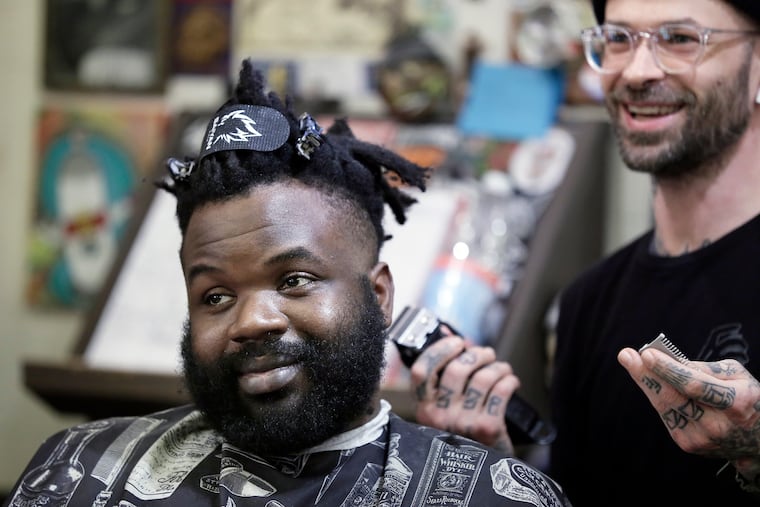
When Daniel Gardner sits down in his barber’s chair, he’s comfortable. This isn’t new for him. He knows what he wants and is confident he’ll get it.
His barber, Anthony Enochs, pins Gardner’s dreadlocks to the top of his head, exposing the sides and back of his scalp. Enochs spins the chair away from his mirror in the corner of Center City’s Groom Barbershop, picks up his clippers, and gets to work.
Enochs has only been cutting hair professionally at Groom for about a year, but he’s been Gardner’s barber for a little longer than that and has been giving haircuts for 15 years. “I would always cut my friends’ hair on days when I couldn’t ride my skateboard,” he says. He left his job as an electrician about five years ago to pursue his side hustle full-time.
Not every guy has the relationship with his barber that Gardner does. The pair says their routine came with time, trust, and communication.
If you’re new to a shop or a barber, however, you begin with a conversation about the haircut you want. But few guys really know how to properly ask for that, Philly barbers say. Which is why knowing how to talk to a barber can make or break a haircut. We talked to the pros about what they wish clients knew before they sit in their chairs.
Leave technical terms to the pros
Joe Mezicco, owner of Gents in Old City and Fishtown, has been cutting hair for a decade. “I haven’t had too many clients that gave me the right words that let me know what to do with their haircut,” he says.
Say you want a fade and you ask for it. Do you know what that actually means? Turns out, most people don’t.
“A lot of times people are asking for a fade when they really want a taper," Enochs says, describing the difference between the two styles. “A taper is something where it’s kinda short at the bottom and works its way up. It’s not the job of the client to know these terms. I feel like it’s my job to second-guess or question what’s in their mind.”
Will Mack agrees. The 51-year-old has been cutting hair for half his life.
“Sometimes they may not explain the haircut the right way,” says Mack, who works at South Street Barbers in Hawthorne. “You get people from different parts using different terminology. They might say ‘Brooklyn fade.’ Well, what’s a Brooklyn fade?”
Even terms you might think are universal, like clipper lengths (a No. 5, say), vary from barber to barber — plastic and metal clipper guards result in different outcomes, for example. And even measured lengths aren’t truly standardized.
“My inch is different than another guy’s inch, and that’s different than the client’s inch," says Amir Amzovski of Fitler Square’s Barber on 24th.
Instead, go with something a little less scientific. Amzovski prefers to judge length by finger thickness. Mezicco likes descriptions as simple as “short,” “medium,” and “long.” While those guidelines are subjective, if you tell your barber when your last haircut was, they say they can tell what “short” means to you.
Some barbers may also leave a section of your hair longer than you asked for; remember, you can always ask to go shorter.
Take a selfie
“You’re going to get a really good haircut at one point in your life," Enochs says. “Take a selfie. I know selfies are lame if you’re a grown-ass man and all, but that selfie could save you a lot of time and maybe two haircuts.”
Be it a selfie, Instagram post, or a Google images search, a picture is probably the best way to show desired hair length and style, according to barbers.
Pictures provide a safety net for barbers — it’s a chance to check what their clients mean when they use technical terms and to question or steer clients in different directions.
But this advice comes with an important caveat: Barber’s can’t re-create exactly what you see in a photo of, for instance, a young Leonardo DiCaprio.
Barbers know your hair better than you do. Listen to them.
“Not everybody’s hair is the same," Amzovski says. Thinning hair presents different challenges than curly hair. And textured hair is different than shiny hair, which is different than thick hair.
Even if men think they know what type of hair they have, barbers recommend letting the pros offer their feedback. That’s another reason why the opening conversation is important. Focus on the hair first, then spill your hot takes about last night’s Sixers game.
Beyond hair, barbers are experts on shampoos, conditioners, and other products. They want to give you the best haircut possible. Once you learn the best way to ask for what you want, be open to their suggestions. And be willing to accept that barbers know your hair better than you do.
In short, there’s no need to hairsplain.
“You’re coming in here to trust me,” Amzovski says. “You’re not watching the bartender mix your cocktail.”