Pear trees may be the reason Philly smells so bad lately
The tree was once believed to be sterile. But now it's prolific in Pennsylvania, which has added the Bradford pear to its noxious weed list.
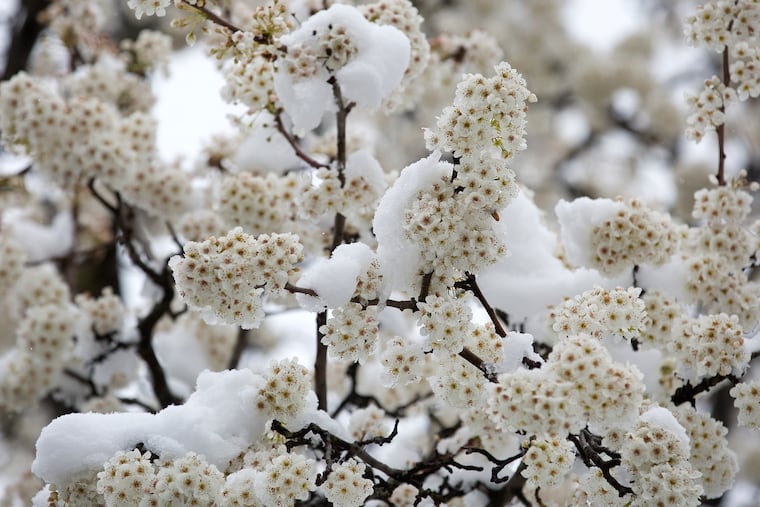
That ammonia-like scent in the air might be linked to a tree that was once believed to be sterile trying to maintain its family line.
In late March and early April, Bradford pear trees don’t just adorn Philly sidewalks with their ornamental green leaves and white flowers. They also develop quite a stink.
“People describe it as a rotting fish smell or urine,” said Pamela Morris Olshefski, plant collections manager at the Morris Arboretum & Gardens of the University of Pennsylvania. “They give off these smells to attract the flies and beetles that help pollinate them.”
Wait, how does a tree introduced to the city as sterile end up making neighborhoods smelly for about two weeks a year while trying to reproduce?
Additional cultivars and cross-pollination, said Morris Olshefski.
Callery pear trees (also known as Bradford pears) were brought to the United States from Asia in the early 1900s, according to the U.S. Department of Agriculture, to help trees with edible pears create resistance to fire blight — a bacteria that damages trees and makes leaves look burned.
In the process, cultivars like the Bradford pear —which does not produce fruit edible for humans — came to be. Its leaves, flowers, and a fast-growing rootstock popularized it as a landscaping tree.
After testing, the Bradford pear tree became highly commercial, Morris Olshefski said.
“It’s a very diverse tree because it can withstand high elevations, wet situations, be fine in a parking lot area where it’s really hot and lots of pavement,” she said. “Everyone was planting them in their yards in the ’60s.”
Bradford pear trees were supposed to be genetically identical. No matter how many of them were on the same block, they wouldn’t be able to produce fruit by themselves.
That changed once someone unintentionally made a different cultivar, mixing a piece of a Bradford pear tree with another tree. That cultivar was able to cross-pollinate with nearby Bradford pear trees, making them capable of producing fruit.
It started happening everywhere.
“It was an unintended consequence; no one was trying for that to happen,” Morris Olshefski said. “People thought they had this perfect sterile tree, until another genetically different tree got close enough, and now they have pollinated, and none of them were sterile any longer.”
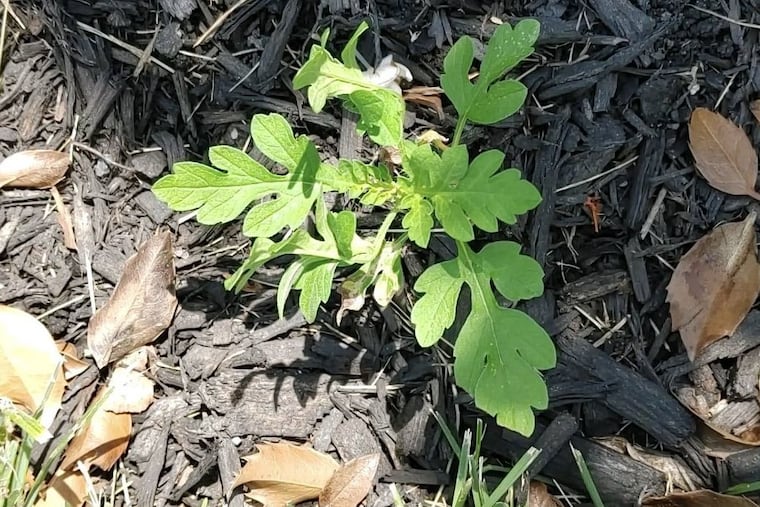
By the late 1980s and early ’90s, the scent began overwhelming Philly noses. Once flies or beetles pollinate them, the trees yield clusters of fruit that look like hard, tiny green apples. Birds ate the seeds.
As birds spread the seeds, the sidewalks and backyards were no longer the Bradford pear trees’ only home. Soon, people managing natural lands and wild areas began seeing Bradford pear trees popping up.
Not only that, the once-favored, fast-growing rootstocks turned out to be a double-edged sword. By growing so quickly, their weak wood can’t withstand big windstorms or heavy snowstorms, easily falling apart.
In 2021, Pennsylvania added the Callery pear trees to its noxious weed list, saying it was “widely established in Pennsylvania and cannot feasibly be eradicated.”
By 2024, the state was one of more than a dozen that banned plantings of Callery pear trees.
It’s hard to know exactly how many Bradford pear trees inhabit Pennsylvania. But the tree is so resistant that as long as seeds are in an area, they will reinvade, according to Penn State’s Department of Agricultural Science.
Pennsylvania has a new initiative set to start this spring to encourage owners to replace their invasive trees, including the Callery pear.
The program will offer property owners a free native tree and shrubs in return for the removal of invasive plants from their yard, garden, or landscape.
For those who no longer want their Bradford pear trees, Morris Olshefski recommends cutting them down if you own them.
“The intentions were good in terms of trying to provide a preflowering tree, but now that we know better, we should do better,” Morris Olshefski said.