This Bucks County psychologist wants to be Peloton’s ‘first fat bike instructor’ — and change fitness culture
Rachel Millner, a Bucks County psychologist and advocate for fat liberation, has launched a campaign to become Peloton’s first fat cycling instructor — and to make fitness more inclusive.
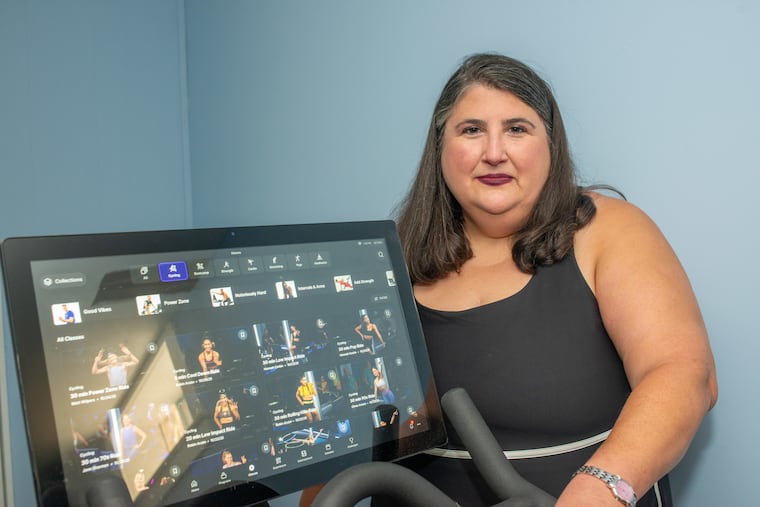
Like many restless Americans during COVID-19 lockdown, Rachel Millner of Bucks County bought a Peloton bike.
“I was honestly not expecting to like it,” Millner said. “I’ve never been someone who does spinning, but I ended up liking it more than I thought I would.”
As a young woman, Millner — a psychologist who worked at Children’s Hospital of Philadelphia before starting her own private practice focused on healing from eating disorders — had an eating disorder herself.
“For many years, any kind of movement was just, ‘How many calories am I gonna burn?’” she said. To heal, she had to take a long break from the types of exercise she’d done during her eating disorder to shrink her body. “But Peloton was totally different.”
Doing regular Peloton rides helped Millner feel stronger, keep up with her dogs on walks, and cope with stress. “I really like that feeling of being so tired at the end of the ride,” she said, “and if I was tired in the morning, getting on the bike gave me energy.”
She also appreciated the accessibility of having the bike in her home, the ability of participants to “high five” each other, the practicality of rides as short as five minutes, and Peloton’s fun, inclusive themes — like Broadway show tunes and a Rosh Hashanah celebration ride.
The only problem? Like many Americans — 73.6% are medically classified as overweight or obese, according to the most recent National Health and Nutrition Examination Survey — Millner is fat, a term she and many others use intentionally and without shame. She quickly found that Peloton was not welcoming to her body.
Instructors would say things like, “Make sure your knees are tracking straight forward,” Millner said. “And I would be like, but I can’t, because my thighs are here.” Or, “They’d have you lean forward on the bike, but I couldn’t because my belly was in the way.”
Millner tried many different instructors to find ones that worked better for her but soon noticed that all the Peloton bike instructors were thin.
Peloton employs instructors from a wide variety of ethnic backgrounds and even pregnant instructors to teach prenatal classes, but only one instructor across all of Peloton identifies as plus size — and she specializes in rowing. While Peloton bikes are adjustable across a wide range of heights, they are only tested up to 297 pounds, according to a Peloton spokesperson.
So, for the past two years, Millner has been on a quest to become Peloton’s first fat bike instructor.
She has reached out to Peloton corporate to inquire about hiring and even met with their chief content officer, Jen Cotter.
“We’re really proud of the diversity of our instructors and we love the passion that Rachel has for us,” said Cotter, who also notes that the company hasn’t hired a new bike instructor in four years. “But the predominant things we’re looking for is fitness expertise and on-camera experience.”
“One of Peloton’s core values is about inclusivity and access,” Millner said. “But as fat people, we just get left out of that conversation. I think the company has been cognizant about trying not to focus on weight loss, but at the same time when you’ve got instructors who only look a certain way, then you are selling the idea that if you use our product, you’re going to look that way, too. But a lot of people don’t want to change their bodies, they just want to feel good.”
Millner isn’t giving up. Since 2019, she has built a 20,000-follower Instagram audience by posting chatty and insightful videos about weight stigma and fat liberation from a Health at Every Size perspective — the idea that people can be healthy and active at any weight without aiming to lose it. Her recent video about the need for folding chairs with higher weight capacities at public events went viral, drawing more than 12 million views.
She also makes videos about her love of Peloton and has posted sample videos directed at Peloton showing how she would coach clients if she were hired.
“I’ve talked to so many people who are like, ‘I would buy a Peloton if there was a fat instructor,’ or, ‘Yeah, I have a Peloton and it’s been so frustrating to not have that representation,’” Millner said. “I think hiring me would be a good business decision for them because it opens up a whole new market. People want instructors who look like them and who they can trust.”
Recent news reports paint a portrait of Peloton as a company in financial trouble, forced to raise its already expensive equipment and subscription prices. “Peloton has been trying to restore demand for its equipment and subscriptions after a boost in popularity early in the pandemic proved short-lived,” reported the Wall Street Journal.
“It would definitely be a risk for Peloton to hire me, but they’ve been at the forefront of innovation and inclusivity before,” Millner said.
Millner’s campaign has expanded beyond Instagram and into the Philadelphia area, where she routinely gives talks on fat liberation and weight stigma, including teaching an annual course for doctoral students in psychology about how to talk responsibly to obese patients and those recovering from eating disorders. She is also speaking at the third annual Philadelphia Fat Con, the only conference on the East Coast focused on fat liberation, taking place Nov. 1-2 at CYTO PHL in University City.
Ultimately, her quest isn’t just about getting a job. It’s about changing how the fitness industry sees fat bodies and giving others permission to advocate for more inclusion in activities that make them feel good.
“Fat people are being excluded from so many joyful and important things,” Millner said. “And in this one way, I am trying to be a bridge.”