Matcha lattes, tote bags, and half-read Jane Austen: Penn students crown Philly’s most ‘performative male’
More than 100 onlookers turned out to watch the competition organized by 34th Street Magazine, where competitors were asked to answer trivia about the female experience. Not everyone excelled.

Seeking: A man with a tangled wired headphones, a Labubu toy, and an unread copy of Pride and Prejudice who will manipulate me.
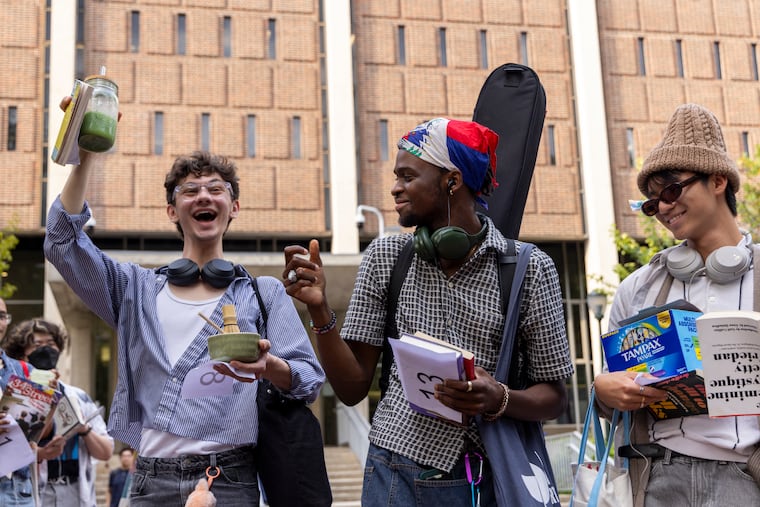
Those were just some of the criteria for Friday evening’s “performative male” competition, where more than 100 University of Pennsylvania students gathered in front of the Split Button sculpture to watch 14 contenders out-cringe one another.
The “performative male” is Gen Z’s version of the poser. It’s a pejorative for a man who curates his style and hobbies based on what he believes progressive women will find attractive, despite not having an earnest interest in any of it. Performative males pretend to read between sets at the gym, women say, or sit on a park bench to read some bell hooks without ever turning a page. They’re also anywhere you can order an iced matcha latte.
Videos tagged #performativemale have accumulated over 28 million views on TikTok, where users poke fun at what it’s like to date a performative man or spot one in the real world. The stereotype encapsulates the fraught nature of online dating in 2025, where shadow networks of women jaded by Tinder Swindlers and men who lie about their politics (and their height) work to overanalyze every aspect of a first impression.
» READ MORE: From 2024: Inside the network of Facebook groups helping Philly millennials fall in love
“The phrase has gotten so much traction because there are men who are sort of [not] genuine in their interests in feminine-coded things … They’re performing a sense of identity just to get some,” said Norah Rami, the editor-in-chief of Penn’s arts and culture magazine 34th Street, which organized the competition.
Rami isn’t the first to plan a performative male competition, which started popping up in Sydney, Toronto, and Jakarta over the summer before taking over college campuses. In San Francisco, an artificial intelligence model judged dozens of men based on how many virtue signals it could spot, while judges in Chicago swiped left and right on contestants. And just last week on Temple University’s campus, a performative male contest raised money for Women Against Abuse, a domestic violence prevention organization.
Penn’s competition took contestants through a gauntlet of performativity, asking contestants to name their favorite women before quizzing them on trivia about the female experience and asking them to unveil the contents of their tote bags. Points were docked for sipping hot matcha lattes and arguing with the panel of female judges.
The crowd roared when winner Matthew Quitoriano, a freshman from San Diego, answered what was one of the hardest questions of the night: How do women pee with a tampon in?
“I respect women,” Quitoriano shouted through a bullhorn while carrying a box of Tampax as a prop. “They use different holes.”
He went home with a copy of The Whole Woman by Germaine Greer, who is considered a pioneer of second wave feminism. It is unclear if Quitoriano plans to actually read it.
“I kept telling all my friends that I would lose,” Quitoriano, 17, said. “I can’t wait to tell them that I won. And my mom.”
Rami said the contest drew inspiration from the celebrity look-alike competition craze started by influencer Anthony Potero, who was fined by the New York Police Department while searching for Timothée Chalamet’s twin. Philly’s contests were far tamer, with crowds gathering to see who would emerge as Miles Teller‘s or Jalen Hurts' doppelgänger.
“This genre of contest is about community building,” said Rami, 21, a senior English major from Sugar Land, Texas. “It’s about taking social media, bringing it into the real world, and turning it into an excuse for people to gather.”
» READ MORE: Looking like Jalen Hurts ‘doesn’t hurt,’ says contest winner
Are ‘performative males’ really so bad?
Fortunately, Philly is not teeming with performative males, said Rami. But they do have their spaces.
“If you go to the Clark Park farmer’s market, that’s where they very much congregate,” Rami said. “And Knockbox Cafe. Or Chapterhouse [Cafe and Gallery] in the Italian Market.”
Some performative males, however, are made by teams of women.
Contestant Jasper Platt said he consulted five women on how to build his ensemble for the competition: Adidas Sambas, baggy Japanese selvedge denim jeans, a bandanna, a frothy iced matcha latte from Starbucks, and a tattered copy of The Creation of Feminist Consciousness. His pièce de résistance was a shirt that said “Men I Trust.”
“It’s because I’m a man you can trust,” said the 18-year-old freshman from Reading, who was booted from the competition after struggling to name a woman beyond Britney Spears.
Second-place champion NuAmen Audena said the performative male is “low-key me,” though he doesn’t necessarily view the stereotype as a negative. The 20-year-old mechanical engineering major owns all of the things he thought set him over the edge at the contest, including a bass, a floor-length slouchy denim skirt, and the CD player Audena pulled out of his tote.
“It’s really hard to be your genuine self sometimes, because there’s a real disdain for people who necessarily conform to masculinity as it’s seen in society,” Audena said. “But at the same time, there are lot of men who put on this act just to get close to women.”








The performative male stereotype emerged amid debates over the identity of Gen Z men, who shifted to the right politically during the 2024 presidential election, with some embracing rigid gender roles. Just beyond the world of performative men is a starkly different corner of the internet, where influencers such as Andrew Tate and Adin Ross rake in millions of views as they teach audiences how to secure — and dominate — a so-called "high-value woman."
Winner Quitoriano‘s friends were quick to say he didn’t differ much from the performative male stereotype. He was quicker to say that’s probably a good thing.
“Out of anything a young male can be in today’s society — out of all the other stereotypes a young guy can fall into — I think this is probably one of the least harmful," Quitoriano said. “I would much rather have a son that does this on a Friday afternoon.”