Alexander Hamilton is ‘cocky.’ George Washington ‘owns the room.’ Blind and low-vision visitors decode 1787 using their hands in a new tactile tour.
A new Philly Touch tour in Signers' Hall lets visitors pick up on the founders’ age, status, and demeanor through touch.
You can tell a lot about someone from their posture.
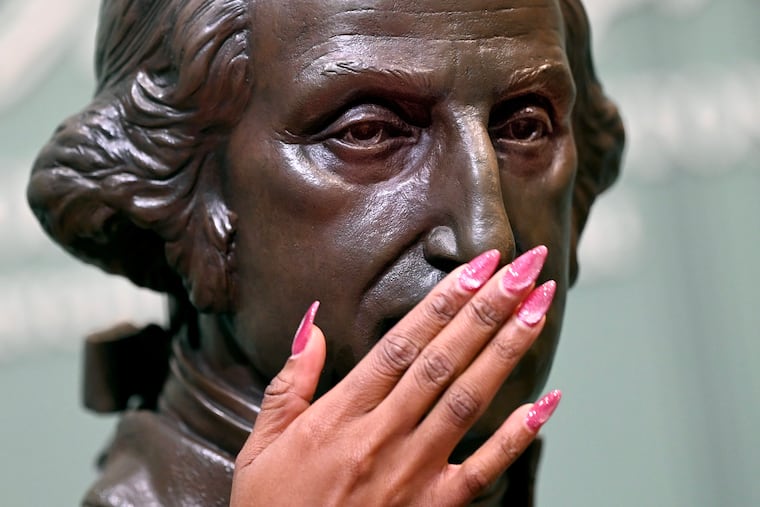
“He seems confident,” Kosi Asabere said, placing her hands on the bronze statue in front of her. She ran her hands over the figure’s hands, noting where they were placed and how they were positioned. Then she stepped into the pose herself to get a feel for how the man was standing: his hands gripping the lapels of his long coat, his shoulders pulled back, his left foot forward. “I feel like his body language shows he is a man of status,” Asabere, who is in her early 30s, said.
Asabere was standing in Signers’ Hall at the National Constitution Center, surrounded by statues of men she could not see but could read through touch.
Benjamin Franklin, who was 81 at the time of the Constitutional Convention, which the statue depicts, felt old to her; the fine lines on his forehead gave it away. Alexander Hamilton, with his puffed-out chest, came across as a little cocky. As for the man in front of her, Virginia delegate George Mason, Asabere ran her hand along the sleeve of his coat one more time and considered him again.
“He’s self-assured,” she said.
Originally from Philadelphia, Asabere was one of several blind and low-vision visitors taking part in a new program launched by the National Constitution Center and Philly Touch Tours, the accessibility organization that has been designing tactile tours of museums and cultural spaces for blind and visually impaired visitors since 2014.
A year in the making, the program will now run four to six times a year on Sunday mornings before the museum opens to the public, giving visitors time to move slowly through Signers’ Hall and take in the room through touch.
While Philly Touch Tours has led programs everywhere from the Mütter Museum to the Philadelphia Flower Show, few settings have lent themselves to touch as naturally as Signers’ Hall. “I’ve been on a lot of tours,” said Philly Touch Tours program director Katherine Allen. “It’s like these statues were conceived for a touch tour.”
The National Constitution Center’s interim president, Vince Stango, saw the same potential. “Our goal is to make all of our programming more accessible to more audiences,” he said. “Because of the way the statues are created, the texture and the features, Signers’ Hall is a great way to start.”
It helped, too, that the delegates were not standing in stiff, ceremonial poses. “These are like action photos,” said Cory Lloyd, a 36-year-old tour participant from Philadelphia. “You can tell the people are in the middle of discussions — not posing, per se.”
At the far end of the hall, a young man in his mid-20s named Simon Bonenfant was posing like one of the dissenters, Elbridge Gerry. His tour guide positioned his hands at his sides to mirror Gerry’s and asked him what he felt.
“Obstinate,” Bonenfant, who is from Drexel Hill, said.
That exchange got at what made the tour so effective. Visitors were not just being told who the delegates were. They were being given the time and guidance to notice how those men carried themselves — the set of a shoulder, the placement of a hand, the stance of a dissenter making his case.
Bonenfant, a cultural accessibility consultant for Philly Touch Tours, helped train the Constitution Center’s staff for the program. He worked with them on disability awareness, guiding blind visitors, verbal description, and the practical mechanics of leading a tactile tour. He also helped oversee trial runs to determine how best to move through the crowded room and how long groups should spend at each statue.
The slower the tour moved, the more the statues revealed. A few steps away, Jasmin Sethi was working through the detailing on a different Virginia delegate’s shirt. Her tour guide had already told her that the delegate was a wealthy man who enslaved people, but “actually feeling the fancy buttons on the shirt,” the 40-year-old said, “made it more memorable.”
Jeff Boudwin, 35, who lost his sight to a brain tumor when he was four months old, had visited the Constitution Center before. But on this tour, as he moved his hand down the back of a delegate’s head, he found something he did not expect: a bow tying off the man’s powdered queue.
“I’ve been here before,” he said. “But I never noticed that.”