Independence (the eagle) is coming to Philadelphia
A bald eagle will be traveling Auburn University to Philadelphia for July 4th.
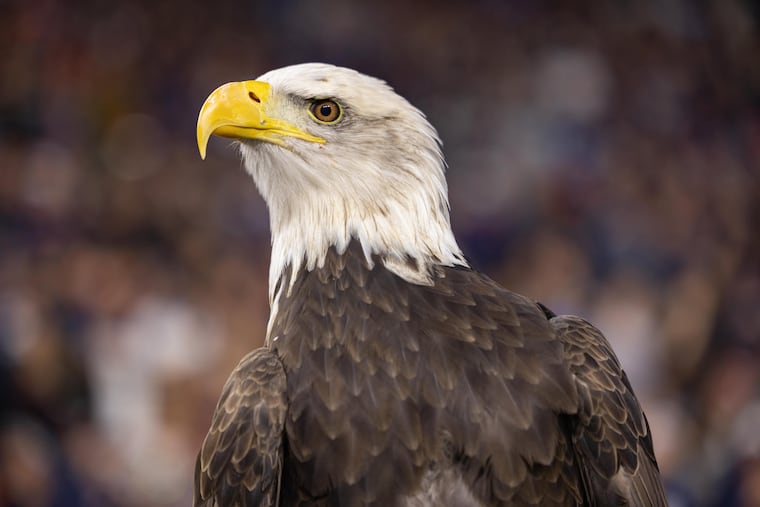
In Philadelphia, the Independence Day spectacle will include a bald eagle named Independence at Independence Hall.
The eagle, known as Indy, is scheduled to appear at the burial of America’s Time Capsule, part of the country’s 250th anniversary celebration. Visitors will be able to meet and take pictures with her.
Since 1782, when the bald eagle was placed on the Great Seal of the United States, the bird has stood for American sovereignty and power, holding arrows in one talon and an olive branch in the other. Long before that, eagles had been used as symbols of empire, authority and military strength, including in ancient Rome.
What merits does the bird have to have been attributed such strong symbolism — with appeal at events from Saturday’s time-capsule burial to flights at Lincoln Financial Field?
From a distance, the eagle looks formidable, with a six-foot wingspan. Indy is sometimes released to fly freely during Auburn football games, said Robyn Miller, Indy’s handler and the director of the Auburn University Raptor Center.
On the rare occasion that one sees eye-level with the bird — such as in Indy’s various TV appearances — the eagle has an intense and almost disconcerting gaze. Her feet are bound or shackled to contain her but she occasionally gives out a squawk and shuffles around. The bird squawks as humans might laugh; they tilt their head back and can either let out a loud cry or many chirps, as Indy tends to do when she is inside.
The bird will travel to Philly from Auburn on a Delta flight with Miller and three other handlers. Her carrier will be strapped into two coach seats. Miller expects that she will be comfortable in her carrier but notes that she may let out the occasional squawk.
Indy, now 10, came to the Auburn University Raptor Center in 2018 after suffering a wing injury as a young bird. Although the injury healed, she had imprinted on humans during rehabilitation, meaning she could not be released into the wild. Now, she serves as an ambassador bird, teaching people about raptors, conservation, and the ecosystems that sustain them. Her appearances have included a flight at the Linc for an Eagles’ game.
Miller makes a distinction between captivity and care. “All of our raptors come to us with life-threatening disabilities,” Miller said.
The eagle is now used to human socialization and depends on human care. And yet the irony is hard to avoid. What draws people to Indy is precisely the quality that cannot be caged: the wildness she can embody, even if she can no longer live it.
“Folks can’t help but be fond of her when they meet her,” Robyn said. “Be fond of her wildness.” She added, “We wish these birds could still remain in the wild.”