A Delco homeless shelter has a $500,000 hole to fill after county budget cuts, worrying advocates
If the homeless shelter doesn't fill a $500,000 hole in its operating budget by next year, it will have to close. It depended on funding from the county.
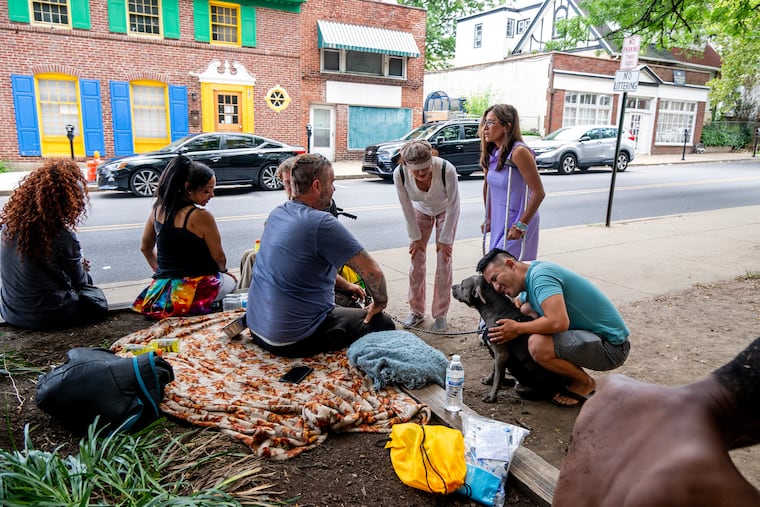
Breaking Bread Community, a homeless shelter in Upper Darby, has until May to fill a more than $500,000 hole in its operating budget or it will have to close, according to its leaders.
Delaware County quietly informed its homeless service providers of a “standardization” of its funding model in May, which meant a 70% cut in Breaking Bread’s operating budget. According to Luke Stivala, co-executive director of the shelter, staff have already cut operating hours, leadership pay, and twice-daily meal service.
“We’re heavily reducing our operations just to stay alive,” Stivala said. “I’m working around the clock with private donors and small grants, but it’s so competitive because everyone else is already there as well.”
County spokesperson Michael Connolly said limited funding led to a $1 million budget cut in the county’s adult and family services agency, which contracts with providers. Three emergency shelters, including Breaking Bread, were affected by the cuts. Connolly said the reductions are a response to federal funding uncertainty and the loss of Crozer Health System.
“The loss of behavioral health services has required the County to use other available funding to support these areas, which does reduce the resources available to support our unhoused residents,” Connolly said in a statement.
Officials, he said, are working with shelters and community partners to “support them in their planning cycles and operations.”
Some of the county’s homeless and housing advocates warn that services for these vulnerable populations are already stretched thin and that the loss of yet another resource could exacerbate an existing crisis.
“I would have nowhere to go,” said Aron Koalenberder, 42, who is staying at Breaking Bread and has a deteriorating spine compounded by seizures.
“It’s not like I can just pack it up in trash bags and be outside.”
A welcome resource arrives in Upper Darby
Breaking Bread Community opened its 17-bed building in December 2022 as the second overnight shelter in Upper Darby, spearheaded by longtime advocate for the homeless Stephanie Sena. The goal was to eventually expand to a 38-bed shelter serving men and women once the rest of the three-story building was renovated and operational.
From the start, Sena and staff tried to be a low-barrier option in the homeless shelter system. The space was wheelchair accessible, accepted pets, and adopted less strict rules overall. For Sena, it was important not to “make staff homeless,” paying them above minimum wage for their work. Sena also thought it was important to create a space where even those going through hard times could maintain a sense of dignity. The exterior of the building has brightly painted door frames and windows, while the inside has a common area where people can mingle.
The shelter was at capacity a month in, reflecting a growing need.
That same year, Delco had the fourth-highest eviction rate in Pennsylvania, at 11.5%, according to a study by PolicyLink and Community Legal Services of Philadelphia.
By January 2024, Delco officials and dozens of other stakeholders were convening to find ways to help the more than 300 people already facing homelessness and the 100 families on wait lists for shelters in the county, as well as all those in danger of losing housing.
Funding was identified as one of the biggest challenges to helping residents in need of stable housing.
The U.S. Department of Housing and Urban Development reduced key funding for Delaware County by 10% in the 2011-12 federal budget, and it has remained flat since, according to the county, failing to keep pace with inflation.
Further changes to HUD under President Donald Trump could make it harder to help low-income families at risk of becoming homeless.
A recent New York University study found that a proposal to limit rental assistance programs to two years, with few exceptions, could lead to 1.4 million households losing their housing subsidies nationwide.
Service providers like Breaking Bread hope philanthropy can fill gaps, though they worry grants will be even more competitive as organizations across the country deal with the same fallout of federal cuts. What’s more, some advocates worry philanthropic dollars will only go so far.
Joanne Craig, chief impact officer of the Foundation of Delaware County, said federal funding is needed to address homeless and housing needs.
“The state can’t compensate,” she said. “Philanthropy cannot compensate. … There isn’t the capacity to make up for it.”
When one service disappears, other providers feel it
Homeless shelter providers and advocates in Delaware County describe a safety net so thin that it’s nearly impossible not to feel the ripple effects when one resource disappears. Should Breaking Bread close, other shelters cannot easily take on the people it was serving.
The Salvation Army’s shelter in Chester, for example, is already navigating the loss of another community resource.
James Stephenson leads the 40-person shelter, a short walk from the now-closed Crozer-Chester Medical Center, which was the county’s only 24-7 crisis center for mental and behavioral health. While Stephenson said county budget cuts have not led to a loss of services at his facility, he has his hands full trying to fill the gaps left by his former neighbor.
“We want to make sure residents have access to the care they need,” Stephenson said, adding the shelter is about to embark on a five-year comprehensive capital campaign with the goal of raising $8 million.
Proposals for a freestanding mental health crisis center are under review, according to the county, but it is unclear when the facility would be completed.
Another blow to the county came at the end of June when St. Joseph’s Family Hope Center closed after the Borough of Brookhaven terminated the shelter’s lease. The building was one of two family shelters in the county.
James Roberts, executive director of the shelter, lamented the vanishing resources for those most in need.
“There’s already a crisis in the county with fewer resources,” he said. “There’s not going to be places for them to go.”
Working with what’s available
In addition to cuts in operating hours, leaders of Breaking Bread are tapping into its network of supporters.
Upper Darby Mayor Edward Brown said he is committed to “ensuring that there is no interruption in the delivery of emergency housing services” and is working with the county to “identify sustainable solutions.”
Breaking Bread has also secured two months of free rent from Philadelphia-area developer Ken Weinstein for a building it is using across the street with air-conditioning. The temporary move helped provide shelter for 24 people while renovations took place at the Breaking Bread building.
“Instead of putting a few more dollars in our pockets, in the form of tax cuts, we need to start caring more for each other,” Weinstein said. “And that starts locally!”
Still, some of the people who have come to rely on the shelter are bracing for the worst.
When the shelter returns to its original building in the fall, it will be able to serve only eight people.
For Stuart Keslinger, 56, a paring down of Breaking Bread’s services could mean living on the streets of Haverford Township again.
While he feels more fortunate than others because he gets enough in Supplemental Security Income to help purchase food, it’s not nearly enough for housing. Without family or friends, he said, he is left to figure out housing on his own.
“It’s already really terrible in the street,” he said. “If you take the people out of Breaking Bread here, it’s going to be a catastrophe.”
