Bucks County agrees to pay nearly $1 million to a woman who was pepper-sprayed and restrained in jail
More than five years after their daughter was detained, Kimberly Stringer’s parents hope the settlement leads to better treatment for people living with mental illness.
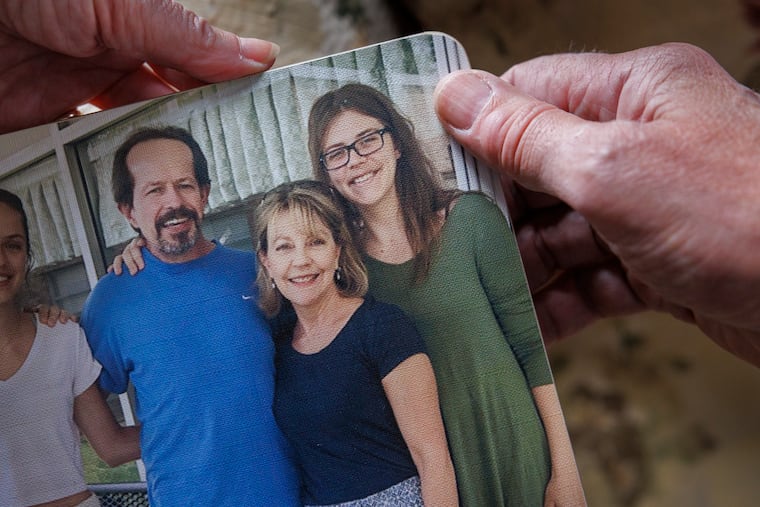
Bucks County has agreed to pay $950,000 to a woman with a serious mental illness who was pepper-sprayed and left strapped for hours in a chair while at Bucks County Correctional Facility over five years ago.
Kimberly Stringer’s parents hope the settlement draws attention to the country’s ongoing mental health crisis, and the need for alternatives to arresting and jailing people who need psychiatric care.
Martha and Paul Stringer of Lower Makefield Township sued Bucks County prison guards and officials in 2022, asserting that their daughter’s civil rights were violated while she was jailed for 64 days during the spring and summer of 2020.
Martha Stringer has since become an advocate for programs to keep people with serious mental illnesses out of jails. She said that, along with the settlement, the county agreed to work to implement one such program. Known as assisted outpatient treatment, it involves regular court appearances and close supervision for people with a history of hospitalizations who struggle to follow treatment plans.
“My only hope would be that this story resonates beyond Bucks County,” because county jails all around the country are frequently where people with mental health issues end up, she said.
By April 2020, her 27-year old daughter already had been diagnosed with bipolar disorder with psychotic features and had been involuntarily committed twice, Martha Stringer said.
“She was well known, particularly in Falls Township, where she was arrested,” Martha Stringer said.
It was then, while in the midst of a rapidly worsening mental health crisis, that Kimberly Stringer struck and threatened her neighbor, according to the Stringers’ attorney, David Inscho. She was arrested and taken to Bucks County Correctional Facility, where, as a pretrial detainee, she was pepper-sprayed twice by prison guards, Inscho said.
Stringer was also placed in a “restraint chair,” which prohibits movement, several times, for as long as four hours, Inscho said. At no point did she pose a threat to guards, and her inability to comply with orders was because she was “in a state of catatonia.”
“In that state she was not able to process and comply with the rules of that correctional facility — and that led to uses of force" by prison guards, Inscho said.
The settlement agreement between the Stringers and Bucks County, which was reached Dec. 17, includes a requirement that video footage of the incidents recorded by prison guards be destroyed. The agreement notes one remaining copy of the videos may be kept in a password-protected file for 10 years and then deleted.
“The videos were difficult to watch,” Inscho said. “It was clear that Kim was in a mental health crisis. The tools available to the guards were clearly not the tools Kim needed.”
Bucks County Commissioner Diane Ellis-Marseglia said she believes prison guards were trying to keep Stringer safe, but she shouldn’t have been in jail to begin with.
“She and the millions of Americans who likewise struggle with mental illness deserve access to high-quality, intensive treatment, with intervention that begins long before they are misdirected to the criminal justice system,” Ellis-Marseglia said in a statement.
Ellis-Marseglia said that Bucks County has made strides in helping people with serious mental illness. In 2023, the board of commissioners voted unanimously to fund a behavioral health center in Doylestown, the Lenape Valley Foundation’s Bright Path Center, Ellis-Marseglia noted. Last August, commissioners voted to add $5 million more to fund the facility, a county spokesperson said.
Bucks County in 2023 also voted to build a Diversion Assessment Restoration and Treatment Center at the jail, which is set to open this year, the spokesperson said, and in 2021, it added a separate housing area for women and a mental health unit in the jail.
“These programs and facilities will help bridge critical gaps in mental health services and move us in the direction of improving the mental health treatment environment,” Ellis-Marseglia said.
The Stringers applauded these changes, which they attributed in part to the public outcry over their daughter’s mistreatment. Their daughter’s story became public after several inmates notified the media of Kimberly Stringer’s condition in jail; days later, the county relocated her to a state mental institution.
Still, Martha Stringer said, most of Bucks County’s new interventions are for people who have already been arrested.
“And that’s where we’re going to come to the table with Bucks, to see if we can implement assisted outpatient treatment,” Martha Stringer said.
The money from the settlement will go into a special needs trust that the parents set up years ago, Paul Stringer said. The trust has strict rules on what money can be spent on, and is designed to provide for their daughter even after he and his wife, both in their 60s, have died.
“She’s doing quite well,” Paul Stringer said. “But she requires, probably, a lifetime of supports.”
Their now-33-year-old daughter is living in Brooke Glen Behavioral Hospital under a long-term involuntary commitment, Martha Stringer said. Their hope is that she’ll be able to move to a less-restrictive setting and gain more independence, while still getting the support she needs.
“These past five years, she’s missed a lot,” Martha Stringer said. “She’s missed her sister’s wedding. Recently she’s become an aunt. She’s missed a lot. We struggled with that.”
One thing that’s given some comfort, she added, is that people often reach out for advice on how they can help their children, who are in similar situations.
“I learned so much the hard way, that I felt like, if I could give families a better understanding of what we learned, then I could help them.”