Congress has four weeks to dodge another shutdown
Lawmakers are back in Washington this week for a four-week sprint to finish funding the government before the current spending law runs out on Jan. 30.
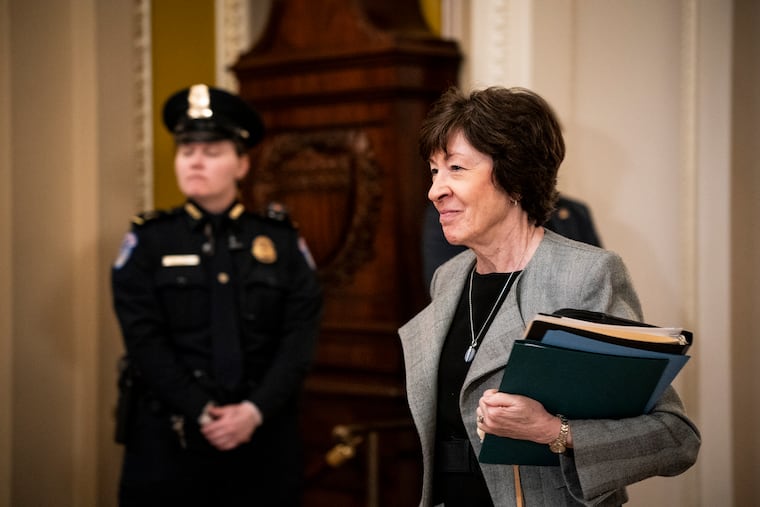
Lawmakers are back in Washington this week for a four-week sprint to finish funding the government before the current spending law runs out on Jan. 30.
If they fail, they will need to pass another short-term extension or spark another government shutdown just two and a half months after the last one, the longest funding lapse in U.S. history.
Funding the government usually requires passing 12 individual bills. Lawmakers approved three as part of a deal to end last fall’s shutdown, and they also extended current funding levels for the rest of the government into January. Those levels were last set in March 2024.
But it will be challenging to finalize the remaining bills, which have not yet been formally negotiated between the House and the Senate or approved by congressional leaders.
The two Appropriations Committee chairs, Rep. Tom Cole (R., Okla.) and Sen. Susan Collins (R., Maine), announced in late December that they had finally reached an agreement on the total spending level they’ll shoot for in the remaining bills. They did not reveal the overall cost, but Cole said it is lower than the amount if Congress were to pass another funding extension, known as a continuing resolution.
“This pathway forward aligns with President [Donald] Trump’s clear direction to rein in runaway, beltway-driven spending,” Cole said in a statement. “We will now begin expeditiously drafting the remaining nine full-year bills to ensure we are ready to complete our work in January.”
From there, appropriators must navigate political pressures from their right and left: Fiscal hawks, including many in the conservative House Freedom Caucus, insist that funding levels for most agencies should not be higher than the last fiscal year.
“I believe that we should begin to control our federal deficit and runaway federal debt by keeping this year’s discretionary spending level at or below last year’s level,” said House Freedom Caucus chairman and senior Appropriations Committee member Rep. Andy Harris (R., Md.) in a statement.
But Democrats must approve any funding agreement, which has to receive at least 60 votes in the Senate to bypass the filibuster. Republicans control the upper chamber 53-47.
Sen. Patty Murray of Washington, the top Democrat on the Senate Appropriations Committee, slammed the chamber’s newly released Homeland Security spending bill in December, calling it “partisan” and pledging to fight for accountability in Trump’s “out-of-control” DHS.
The Senate has spent weeks attempting to pass a five-bill appropriations package that had only been negotiated in that chamber. The bill needed consent from all 100 senators to advance, and several conservative senators held up action for weeks over billions of dollars in earmarks tucked into the bills. (The House proposals also include billions in earmarks.)
Those senators eventually relented, and the chamber was poised to vote on the package right before leaving town for the winter break, but two Democratic senators blocked it — demanding funding be reinstated for the National Center for Atmospheric Research, a Colorado-based research organization that Trump has moved to eliminate.
The Senate package would tie together two major government funding bills — covering defense, labor, education, and health and human services agencies — with three other bills to fund the departments of Interior, Transportation, Housing and Urban Development, Commerce, Justice, and science-related agencies.
It would appropriate $1.3 trillion, making up the vast majority of discretionary federal government spending.
Cole has said that the Senate’s five-bill package would be too big to pass the lower chamber. He suggested passing the remaining nine appropriations bills in three separate three-bill packages in January when lawmakers return, beginning with bills covering the Commerce and Justice Departments, the Interior Department and agencies covering energy and water.
The political minefield ahead may mean lawmakers once again turn to a funding extension rather than face another shutdown.
“I don’t want another CR, I don’t think Mr. Cole wants another CR,” said Rep. Rosa DeLauro of Connecticut, the top Democrat on the House Appropriations Committee. “Let’s go. Let’s get the bills done.”
Congress is supposed to pass all 12 appropriations bills before government funding runs out at the end of each fiscal year on Sept. 30.
But lawmakers’ inability to adhere to that process is not new: Congress has only passed all its spending bills before the deadline four times in recent decades. Instead, most spending bills in modern history have been approved in one big package known as an “omnibus” right before the holiday break.
House Speaker Mike Johnson (R., La.) pledged to stop that practice. The political complications of passing all 12 bills separately, however, has made that difficult to achieve. Instead, lawmakers have extended funding levels first approved under President Joe Biden multiple times, and Republicans have passed supplemental spending for their immigration and defense priorities through a party-line tax and spending bill.