At Croft Farm in Cherry Hill, these archaeologists are searching for artifacts from the Underground Railroad
Croft Farm was once a stop for Black people seeking freedom from slavery. Now, a fresh archaeological expedition seeks to learn more about its role in that era.
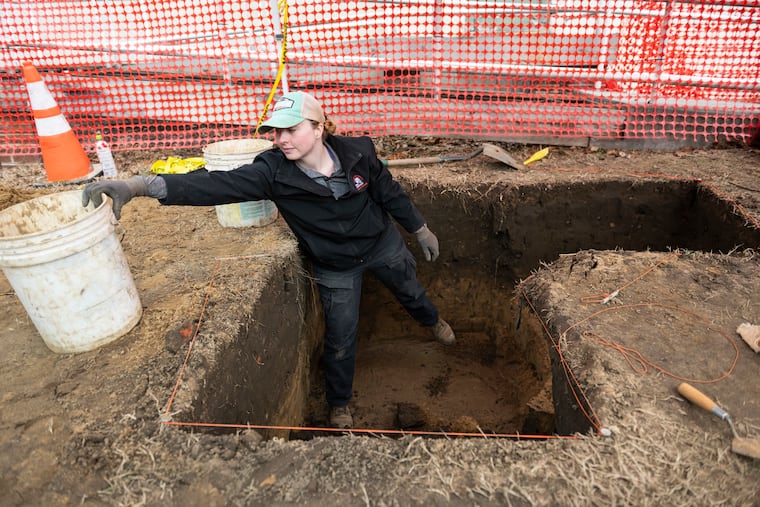
To the casual observer, it’s just an L-shaped hole in the ground, about 40 inches deep, showing two distinct layers of dirt.
But to the archaeologists who dug the hole, it’s a portal into the past going back thousands of years.
Croft Farm is a national historic site. Its owners during the mid-1800s helped Black people escape from slavery. The farmhouse, outbuildings, and 80 acres of the farm are now owned by Cherry Hill Township, part of a recreational and educational space for the public.
The darker brown top layer of “silty sand” contains artifacts from the last 300 years, an era when both enslavers and those dedicated to emancipation lived on the site, according to Matt Kraemer, 27, an archaeologist from Summit, N.J.
Below it, the lighter-colored layer has revealed artifacts from a time when the Lenni-Lenape Indigenous people lived on the land along the Cooper River, in what is now Cherry Hill.
“It’s a very significant site for the fact that it has a Native American component, plus everything the Evans family left behind,” Kraemer said Saturday.
The Evans family was part of the Quaker religious movement, and like many area Quakers of the time, owners Thomas Evans and his son Josiah were part of the New Jersey Abolition Society, “a group that advocated an end to slavery and also helped to maintain the Underground Railroad,” according to a history of Croft Farm provided by Cherry Hill Township.
The farm’s historical significance presents a great learning opportunity, said Matthew Tomaso, the archaeologist leading the project for PS&S, an architecture and engineering firm with a location in Warren Township.
A year ago, PS&S was brought in to oversee cultural resource management as the township sought to stop groundwater from entering the basement of the brick house on the property, Tomaso said.
That gave Tomaso and his team a chance to see what they might find that would shine a light on the property’s role as a station on the Underground Railroad.
Animal bones, pieces of pottery, and other artifacts help tell that story, Tomaso said, by showing the dietary patterns, habits, and traditions of the people living there at the time.
That includes previously enslaved people known to have lived there, such as Joshua Sadler, as well as others who worked and lived on the farm, he said. Sadler went on to found nearby Sadlertown, a Black settlement located in what is now Haddon Township.
What they learn could be especially important since the Underground Railroad was not well documented at the time it was in operation, due to the need to maintain secrecy, Tomaso said.
Mostly, though, they have found bones, said Chelsea Carriere, 29, an archaeologist who called herself “the bone lady.”
Carriere explained that she was looking closely at cow, pig, and bird bone fragments — and the ways the animals were butchered nearly 200 years ago.
To her, the rough cuts on the bones show that these animals likely were raised on the farm or hunted, and were likely butchered on-site, rather than through a butcher shop.
“They were doing it themselves, and that suggests lower socioeconomic status,” Carriere said. Her team is still in the early stages of examining the artifacts.
To her, some of the most amazing finds so far were discovered deeper down in the dirt and would date back 2,000 or more years. These include a piece of argillite that she surmised was a spear point, and a basalt biface, an ancient tool that would have been used for cutting.
“This is a really good site,” Carriere said.
It was also a great experience Saturday for learners of all ages who listened to demonstrations and, with archaeologists’ guidance, used a sifter to search for artifacts in the dirt.
“I love to know what people were doing hundreds of years ago,” said Cherry Hill resident Debbie Kilderry, 71, as she watched children sift the soil.
She came to the site with two artifacts she had obtained — a small porcelain container and a stone — hoping that the archaeologists might have insights into their origins. Tomaso’s professional analysis: She had a real arrowhead, likely from the American West, and a cup once used for coffee cream.
To Kilderry, it is exciting to connect with those who came before her.
“I’m excited to see what they were doing, because they were people just like us — just with different inconveniences."

Inquirer Cherry Hill