2026 Men’s World Cup won’t use FDR Park fields for practice
The decision, made without fanfare last fall, was driven by FIFA’s preference for consistency and new scheduling demands — it’s hosting another tournament in the city this summer.
Men’s World Cup teams will not use any of South Philadelphia’s FDR Park athletic fields for practice in 2026, with FIFA opting to use Rhodes Field at the University of Pennsylvania.
The decision, made without fanfare last fall and coming to light only in recent days, was driven by FIFA’s preference for consistency and new scheduling demands — it’s hosting another tournament in the city this summer. Still, the move is likely to please park users who bristled at the idea of reserving one or two public fields for private use for anywhere from two to eight weeks.
“As FDR Park remains under construction through the summer, Rhodes Field at the University of Pennsylvania will serve as the primary [venue-specific training site] for teams playing in Philadelphia during 2025 and 2026, while the NovaCare Complex will provide a secondary option as needed,” said the nonprofit Philadelphia Soccer 2026, the host committee responsible for planning World Cup activities.
Other practice sites under consideration included the Philadelphia Union’s Subaru Park in Chester, as well as Drexel and Temple Universities.
Though world soccer’s governing body picked Philadelphia as one of its host cities for the 2026 World Cup three years ago, FIFA did not select Lincoln Financial Field as a stadium site for the 2025 Club World Cup until last fall.
FDR Park emerged as a potential practice site in 2020 as it embarked on a major and often divisive renovation, which is slated to include a dozen sorely needed but controversial athletic fields that use artificial turf. If chosen, FDR Park would have gained one or two upgraded natural grass fields that met international soccer standards due to FIFA requirements, as well as a locker room, which city officials said could have been repurposed for local use later.
» READ MORE: Amid a battle over turf plans for FDR Park, experts say claims of PFAS-free fake grass are misleading
In a 2022 post on its website, the Fairmount Park Conservancy, the fundraising arm of the renovation, said it hoped to “gain funding momentum, working with Philadelphia Soccer 2026, and help propel more pieces of the project forward.”
Though no FIFA-fueled upgrade is coming, the conservancy said the plan to build multipurpose athletic fields is moving forward.
“Fairmount Park Conservancy and Philadelphia Parks and Recreation remain completely committed to implementation of the historic FDR Park Plan, including the construction of accessible, high-quality playing fields which are desperately needed for our city’s youth,” the conservancy said in a statement Wednesday.
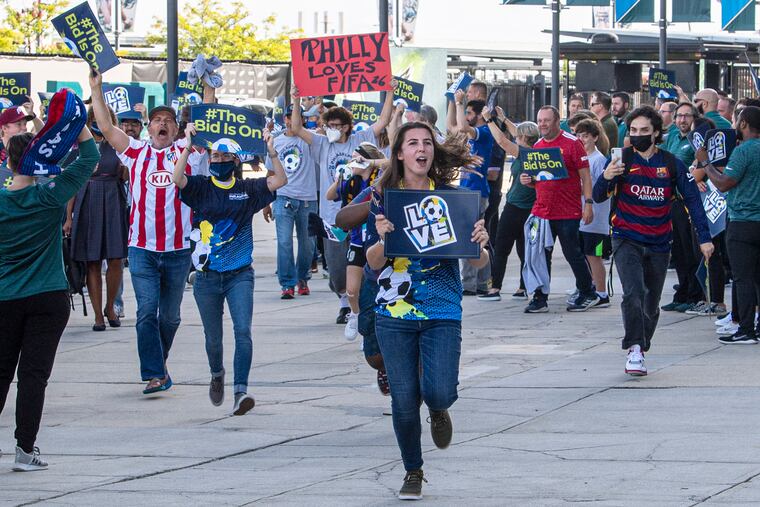
Philadelphia will host eight matches for the 2025 Club World Cup from June 16 to Independence Day. It will serve as a dry run for the 2026 World Cup, for which the city, along with the Convention and Visitors Bureau and PHL Sports, began a yearslong bid in 2017. Philadelphia Soccer 2026 was later created to help with the process.
The agencies pitched the city as the place to be in summer 2026, already slated to celebrate the country’s 250th birthday, and holding the distinction of being the nation’s first World Heritage City.
The bid made sure to tout Lincoln Financial Field’s ability to host more than 69,000 soccer fans, as well as the city’s walkability, popularity with tourists, and public transit, as reasons Philadelphia should host.
But there is a chance public transit will look much different by the 2026 World Cup unless SEPTA garners additional state subsidies. Without any intervention, the transit agency is set to begin steep service cuts by the end of August and then again in the new year to address its fiscal crisis.
Staff writer Jake Blumgart contributed to this article.