She held a dying pilot’s hand while rescuers raced to the crash site of two helicopters in N.J.
The Hammonton Police chief called it one of the worst aviation crashes in recent memory, killing pilots Kenneth Kirsch, 65, and Michael Greenberg, 71.
Caitlyn Collins thought the grinding metal sounds and subsequent bang outside her Hammonton home Sunday were coming from her heater.
It would take a moment to realize the loud crash came from a helicopter that had landed just beyond her backyard around 11:25 a.m., minutes after taking off from Hammonton Municipal Airport. Unable to get through to 911 — many people were already calling to report the crash— she, her husband, and a neighbor drove past a “giant fireball” in her backyard to the open field and took in the grim scene.
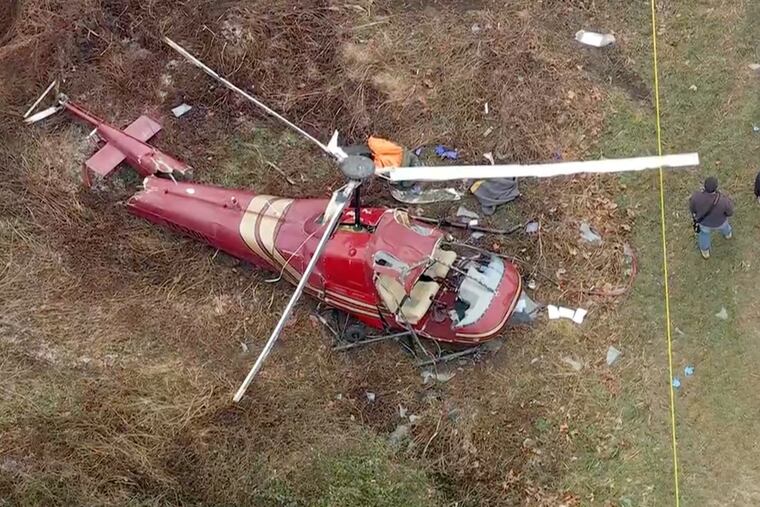
A trail of mechanical parts, which federal investigators said spanned about the length of a football field, was scattered in the open space.
Collins later learned the fireball was actually another helicopter, which video captured engulfed in flames and spinning out of control before it crashed in her backyard.
“It was unidentifiable as anything at that point,” she said. “It never even crossed our minds that that could have been a whole other vessel.”
The Hammonton police chief called it one of the worst aviation crashes in recent memory, killing pilots Kenneth Kirsch, a 65-year-old from Carneys Point, Salem County, and Michael Greenberg, a 71-year-old resident of Sewell, Gloucester County.
As federal authorities continue their investigation into what could have led to the crash, a South Jersey town has begun to process the harrowing scene and tragic deaths of two pilots who were described as good friends known for making an effort to fly every few weeks.
Collins takes some comfort in knowing she and her husband did everything they could to help.
“He actually was running paramedics back and forth on our golf cart because it was so muddy back there that cars were getting stuck,” she said.
Collins, meanwhile, stayed by the second helicopter, a red Enstrom model F-28A. It was on its side with Kirsch still held by his seat belt, but his body partly on the grass.
Collins, who is not a medical professional, did the only thing she could think of at the moment. She held Kirsch’s hand and offered lighthearted conversation. She asked him if he could hear the sirens, explaining they were the first responders on their way to help. Collins even tried to joke with Kirsch, saying this is probably not how either of them envisioned spending their Sunday.
“I wanted to make sure he knew that he was not alone, that he wasn’t in the middle of a field by himself, or in the woods or anything,” she said.
Police would show up within minutes.
Greenberg, who was in an Enstrom model 280C, was pronounced dead at the scene.
Hammonton Police Chief Kevin Friel, who has been in the department for 33 years, said he’s responded to about five air collisions during his tenure, Sunday’s crash being among the worst.
In addition to Hammonton police and the Hammonton Volunteer Fire Department, various neighboring first responders and partner agencies rushed to the scene or remained on standby, including AtlantiCare EMS, Waterford Township Fire Department, and Collings Lakes Fire Department.
The New Jersey Forest Fire Service was there in case a fire broke out in the nearby tree line and the New Jersey Department of Transportation helped reroute traffic.
The parcel of land where the helicopters crashed was close to U.S. Routes 30 and 206.
Friel said first responders worked quickly to secure both crash sites, which is of the essence when compromised aircraft are involved. First responders were worried the helicopter, which was already ablaze, could lead to an explosion. Meanwhile, there was a concern the helicopter Kirsch was in could catch fire.
Neither of those scenarios panned out.
Firefighters extinguished the helicopter in Collins’ backyard and EMS was able to get Kirsch out of the helicopter and airlift him to Cooper University Hospital. He would later die from his injuries.
The Federal Aviation Administration and the National Transportation Safety Board continue investigating. The NTSB said the helicopters were slated to be taken from the crash site to a secure location Tuesday. A preliminary report is expected to be made available in about 30 days.
For now, Friel continues to check in with people who were on the scene. That same night, personnel who were part of the initial response held a debriefing.
“It helps people to deal with the traumas and things that they see, instead of compartmentalizing it and stuffing it down and having them become either physically or mentally ill from dealing with the traumas,” he said.
Collins was devastated to learn Kirsch died. She remembers the corners of his mouth turning upward after she told her joke.
“I thought he was going to be a miracle,” she said. “There was no doubt in my mind that he was a fighter, that this was going to be just one of those stories that he could tell again and again and again.”