Trump officials move to screen visa applicants’ posts for ‘anti-American’ speech
The Trump administration is widening efforts to screen visa applicants for online speech considered dangerous and “anti-American” as the government moves to restrict legal migration.
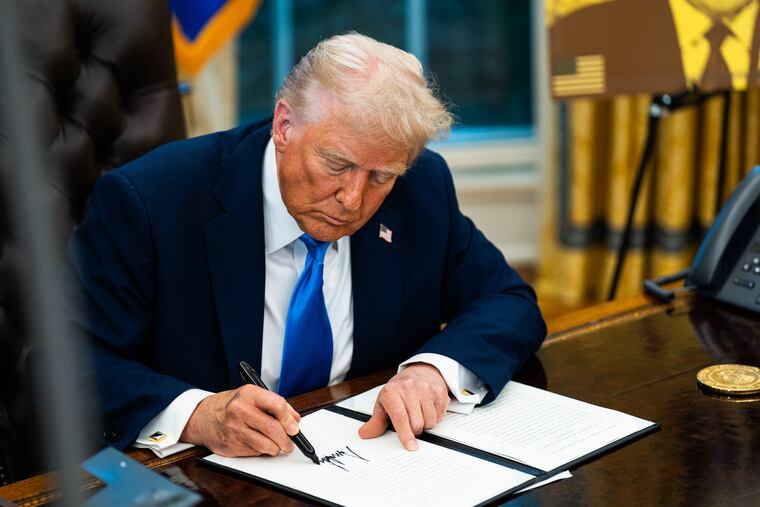
The Trump administration is widening efforts to screen visa applicants for online speech considered dangerous and “anti-American” as the government moves to restrict legal migration and remove people from places the president has called “garbage.”
The State Department earlier this month expanded new regulations requiring foreign students and people on academic and cultural exchange programs to disclose five years of their social media histories and make all of their posts public. All applicants for H-1B employment visas and their dependents will now also be subject to the more rigorous online review.
“A U.S. visa is a privilege, not a right,” officials said in announcing the expansion.
The administration is also considering a similar rule for visitors from countries whose citizens are allowed to enter the United States for up to 90 days without a visa, including France, Germany, the United Kingdom and Japan.
The increased online screening began with the administration’s crackdown on antisemitism on college campuses and has accelerated in a way that immigrant rights advocates say is chilling public discourse. In September, authorities announced plans to review more than 55 million U.S. visa holders for potential violations that could lead to deportations, raising concerns that the government is leveraging speech for visa approval or denial.
“You never think you would have this here” in the United States, said Suresh Naidu, an economics professor at Columbia University. He said he reduced his own public profile while applying to become a naturalized citizen this year. “The idea that this country would start to think of its visa systems as a privilege that could be revoked arbitrarily — this is supposed to be a democracy.”
Despite a federal judge’s ruling in September that immigrants in the country lawfully are protected by the First Amendment, federal authorities have continued to revoke visas from foreign visitors over statements the administration has called dangerous and un-American. They included six foreigners who the administration said “celebrated” the fatal shooting in September of conservative activist Charlie Kirk and a British news commentator critical of Israel’s war in Gaza whose visa was revoked in late October.
In October, several major labor unions — the United Auto Workers (UAW), the American Federation of Teachers (AFT), and the Communications Workers of America — filed a lawsuit alleging the government is deploying a “vast surveillance apparatus” powered by artificial intelligence and other emerging technology that has stifled participation in public life among noncitizens.
Union members who fear adverse immigration actions have chosen to refrain from expressing “views remotely related to the topics the government disfavors,” according to the lawsuit, which said unions are experiencing a reduction in online organizing activity. The unions cited internal surveys that found many noncitizens have taken steps to reduce their online speech, including erasing posts, hiding their identities and eliminating social media accounts.
“We’re trying to make sure that people still have the right to speak and to engage and to do what America’s known for, which is freedom,” AFT President Randi Weingarten said in an interview.
Trump administration officials said they are acting to protect public safety against terrorist sympathizers and those who wish harm upon Americans. In a statement, Department of Homeland Security assistant secretary Tricia McLaughlin disputed the suggestion that the administration is stifling free speech.
“DHS takes its role in addressing threats to the public and our communities seriously, and the idea that enforcing federal law in that regard constitutes some kind of prior restraint on speech is laughable,” she said.
A federal judge disagreed. In September, U.S. District Judge William G. Young of Massachusetts ruled that the Trump administration had misused its sweeping powers in a manner “that continues unconstitutionally to chill freedom of speech to this day.”
That case centers on claims by the American Association of University Professors that the targeting of pro-Palestinian campus organizers in the spring left noncitizen students and faculty fearful of attending protests, posting on social media and voicing opinions in class. Young has set a hearing for January to determine remedial measures.
The plaintiffs are asking Young to enjoin the administration from revoking more visas or making “coercive threats” based on pro-Palestinian advocacy; set aside the administration’s policy of arresting and detaining noncitizens “based on pro-Palestinian or anti-Israel speech or association”; and require the State Department to notify individuals if visa revocations are based in part on speech- or protest-related activity.
“Since the start of this litigation, the government has vigorously maintained a willful ability to deport noncitizens over their political expression, and they have doubled down on their legal claims since the court ruling,” said Ramya Krishnan, a lawyer for the plaintiffs who serves as a senior staff attorney at the Knight First Amendment Institute at Columbia University.
She pointed to the 18-day detention of British commentator Sami Hamdi, a target of far-right Trump supporters for his criticism of Israel. His nonimmigrant visa was revoked by the State Department on Oct. 26 while he was on a U.S. speaking tour.
In a phone interview from his home in London, Hamdi said he entered the country on a 10-year business and tourism visa that he had obtained in 2018. After speaking at a Council on American-Islamic Relations gala in Sacramento, he said, he was detained by federal immigration officers at San Francisco International Airport. They told him he had overstayed his visa, which had been canceled two days earlier, unbeknownst to him.
On their social media accounts, the State Department and DHS accused Hamdi — who maintains that Israel committed genocide in Gaza — of supporting terrorism and “undermining the safety of Americans.” But he was not charged with any crime, such as abetting terrorism, before striking an agreement with the State Department to return home, Hamdi’s lawyers said.
Hamdi believes he was arrested because of pressure from far-right activists, including prominent Trump supporters Dinesh D’Souza, who called him a “Muslim Brotherhood jihadi,” and Laura Loomer and Amy Mek, who posted on social media demanding his removal and celebrating his arrest.
“I did nothing illegal in the U.S.,” said Hamdi, who was released by Immigration and Customs Enforcement on Nov. 13 after he voluntarily agreed to return to London. “My visa was revoked because of my advocacy for Palestine. It was revoked because an extremist group went to the State Department and leveraged whatever influence it had to specifically target me.”
The State Department declined to comment.
McLaughlin called Hamdi an “illegal alien and terrorist sympathizer” who requested voluntary departure. She said that Homeland Security Secretary Kristi L. Noem “has made it clear that anyone who thinks they can come to America and hide behind the First Amendment to advocate for anti-American and anti-Semitic violence and terrorism — think again.”
Trump signed an executive action in January aimed at combating antisemitism on college campuses, but free speech advocates say the campaign is rapidly expanding into broader surveillance.
In August, U.S. Citizenship and Immigration Services said immigrants seeking to become naturalized U.S. citizens would be subject to a “good moral character” review that includes an assessment of their “behavior, adherence to societal norms, and positive contributions.” Also that month, that agency said it would begin considering “anti-American” views in determining whether to provide immigrants benefits.
“People are free to make whatever statements they want on social media or anywhere else, and anyone who does not support the same candidate that I support, that’s not what we’re talking about here,” the agency’s director, Joseph Edlow, told CBS News in October. “We’re talking about beyond the pale. We’re talking about people actively supporting the violent overthrow of this country or otherwise providing material support to terrorist organizations across the world.”
Edlow spoke a day after the State Department revoked the visas of a half-dozen foreign nationals — from Argentina, Brazil, Germany, Mexico, Paraguay, and South Africa — who purportedly “celebrated” Kirk’s death. The department said that “the United States has no obligation to host foreigners who wish death on Americans.”
Nhlamulo Baloyi, a South African music executive, was among them. He wrote on X that “Charlie Kirk won’t be remembered as a hero” and said Kirk led a “movement of white nationalist trailer trash.”
Baloyi, 35, who once worked for a Sony Music subsidiary based in New York, has been outspoken online about anti-Black racism and his country’s history of racial apartheid. In a phone interview, he said right-wing Afrikaners have flagged and reported his posts in an effort to get him banned from X and other social media platforms.
Baloyi suggested that noncitizens in the United States must seriously “consider holding their tongues” or risk being expelled and losing their right to live and work in this country. But he also pointed to virulent online criticism from U.S. citizens aimed at former vice president Dick Cheney after his death this month and suggested foreigners are being held to a double standard.
“I don’t think anything I might have said about Charlie Kirk is remotely equated to the attacks Dick Cheney has faced,” Baloyi said.
Naidu, the Columbia professor, is from Canada and is married to an American. He had been active on X, sharing his thoughts on a range of economic and political topics with more than 16,000 followers. He deleted his account after Trump was elected last year over concerns that discussing political issues could adversely affect his citizenship application. It was approved in July, but he has not rejoined X.
“I’m less nervous about it. But just overall being at Columbia and Columbia being in the crosshairs — my content would not be the most offensive to the administration, but why risk it?” Naidu said.
Nicole M. Bennett, a researcher at Indiana University who studies the federal government’s approach to data governance and digital technologies, called social media the “new front line” in immigration enforcement — one that is expanding into around-the-clock monitoring. Powered by artificial intelligence, new search tools have the potential to vastly expand investigations beyond an immediate target and surveil people around them who had not been suspected of wrongdoing, including family members, friends or co-workers, she said.
“If you’re in a video, you could be pulled into that dragnet, and maybe they find something because they are looking,” Bennett said. “The biggest change is that instead of an investigation being based on evidence, the investigation is based on correlated data.”
Hamdi said his agreement with the State Department to leave the country voluntarily does not prohibit him from applying for reentry to the United States, and he is determined to give it a try. But he acknowledged that other foreigners might think twice. Pointing to soccer’s World Cup in U.S. cities next summer, Hamdi expressed concern for fans who come to root for their teams.
“What happens if a fan waves a Palestinian flag at a stadium — does that mean they will have their visa revoked?” he said. “And if their visa is revoked without notifying the individual, does that mean they could wind up in detention, too?”