


PAYING A PREMIUM
Arlene Blackston remembers the short white man who came to her grandmother’s North Philadelphia door at the same time every few weeks to collect her $5 life insurance premium. “Sometimes he would sit down and have a cup of coffee,” she said. Most of the time, the transaction took no longer than 10 minutes. Her grandmother always paid in cash. The man would take the money, write a few words in his notebook, and be on his way. That was the routine for some 35 years until Blackston’s grandmother, Mary Ann Young, passed away at 84 years old in 1992.
The policy Young had paid into for more than three decades added up to $5,000. It barely paid for her burial.
“There was nothing left over,” Blackston, a retired Verizon IT project manager, recalled.
Blackston, 76, learned from that experience. She purchased two policies, one through her job and one on her own, with the intent to leave her three sons a financial legacy. “I want them to have more than enough to bury me.”

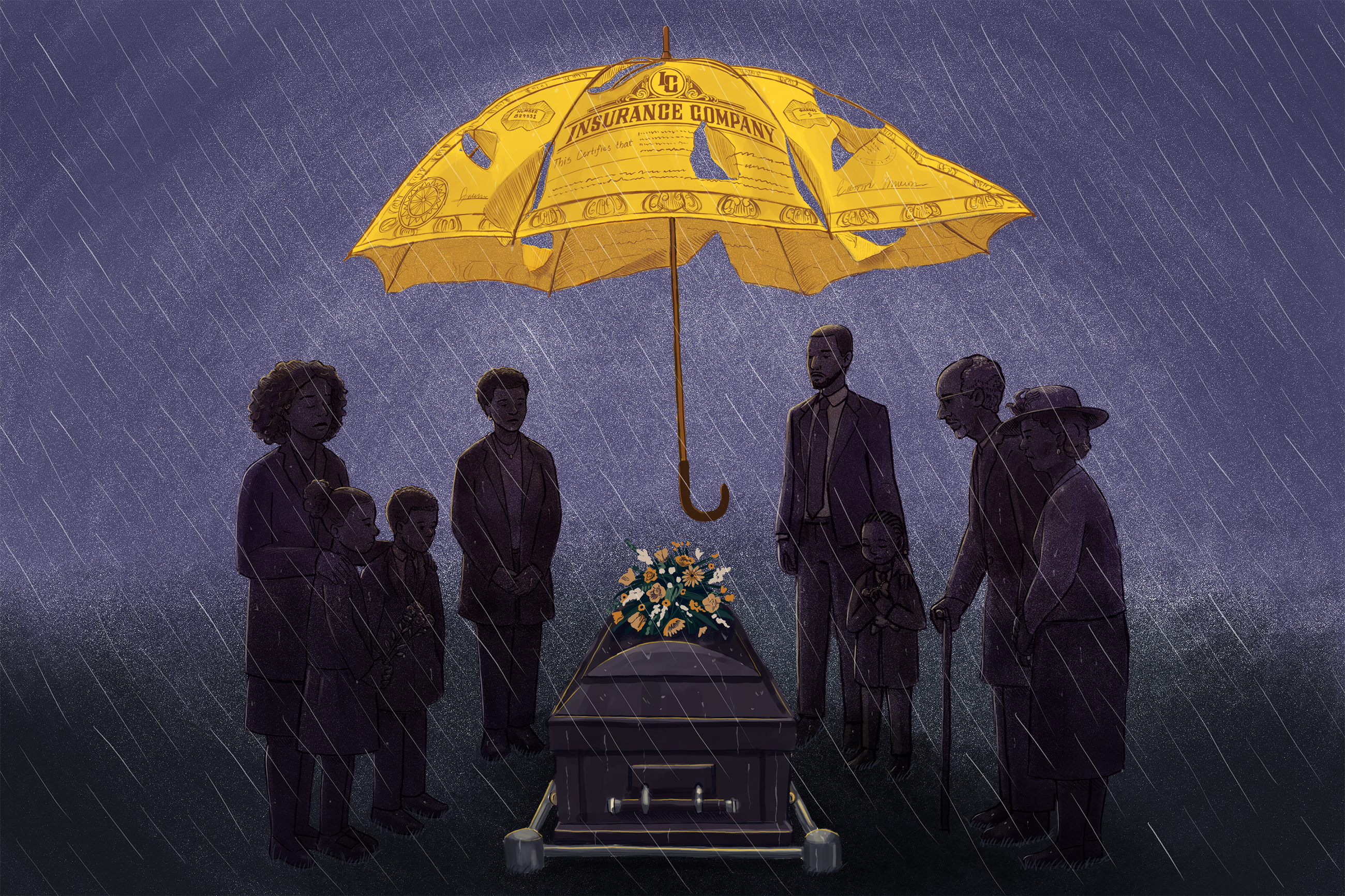
Today, African Americans are more likely than their white counterparts to look to life insurance to cover their final expenses, yet white families have significantly larger policies than their Black counterparts, even when income levels are the same.
Patricia Wheatley was surprised last spring when her mother, Sylvia Franklin, unexpectedly died of COVID-19 and Wheatley discovered her mother’s insurance policy didn’t extend much beyond covering her final expenses.
Wheatley described her mother as a brilliant woman who had several degrees in social work. She was one of the first on the front line of the HIV/AIDS epidemic in the early 1980s refusing to shun patients. Yet the two never spoke of her finances and her mother didn’t talk much about money in general. It turned out her mother’s policy was a type of whole life insurance disproportionately marketed to African Americans.
“Small policies … that people paid on forever,” Tawana Ford Sabbath, co-owner of Sabbath Funeral Home in West Oak Lane, said as she reflected on the plight of substandard insurance she sees among her clientele of African American families.
It is a disparity that the industry can’t explain except to point to its history, which began in 1809 with the founding of America’s first life insurance company in Philadelphia.
Life insurance would become an American institution, a financial service sold as a means to safeguard prosperity and protect loved ones. But it did not protect equally nor serve as an equitable engine of intergenerational wealth.
Make More Possible
Show your support and help our journalists continue to make important work like A More Perfect Union possible with a tax-deductible gift.
Support Independent Journalism
To support more accountability journalism, consider subscribing today.
Today, the industry’s impact touches all corners of our lives. Our economy runs on big data and algorithms, successors to the actuarial science first developed to set life insurance rates. Research shows these formulas institutionalized racism in the mortgage industry, consumer banking, and in the criminal justice system.
Black lives, white profits
America’s life insurance industry began in 1809 at a tavern turned coffee house on the northwest corner of Second and Walnut Street. There, Philadelphia businessmen founded the Pennsylvania Company for Insurances on Lives and Granting Annuities, the nation’s first such company. The city then served as a financial nerve center for the country. America’s first companies insuring buildings against fire and ships against disaster had sprung up in the cobblestoned streets off the Delaware River ports, alongside the first banks and stock exchange. And while Pennsylvania was the first state to agree to the gradual abolition of slavery, these financial institutions quietly profited both directly and indirectly off slave-produced commodities and, sometimes, even the lives of the enslaved themselves in the underwriting of the cargo ships that carried shackled African people to the auction blocks.

By 1836 when the Girard Life Insurance, Annuity & Trust Co. opened its first headquarters at 159 Chestnut St., insurance salespeople had newfound ways to benefit from slavery. Charles E. Beynroth, a farmer and merchant based in Louisville, Ky., sold fire, marine, and life insurance policies through the Philadelphia-based company but in 1853 began marketing policies advertised as “Insurance on Negroes.”
By 1854, the new agent in town, James W. Breden, branching out from work as a real estate broker, took out an ad in the local paper that he was “fully prepared to insure the lives of slaves” as a contracted agent for Girard Life.

These policies would not become large money-makers— though not for want of effort. The brutality of slavery frequently killed enslaved people, making the risk of payout high for insurance companies. One company, New York Life (then Nautilus Life Insurance Co.), ended up paying out nearly as much in death claims as it received in annual payments.
After the Civil War, as cities expanded and industry boomed, the life insurance industry shifted to meet a growing class of working-class people with some income to safeguard and families to support.

By 1875 companies like Prudential in Newark, N.J., were selling low-cost policies known as industrial life insurance to both white and Black workers. Promised as a means to cover a funeral and burial and perhaps a few months of living expenses for surviving spouses and children, the policies were sold by salesmen like the one Arlene Blackston remembers. Within a few years, racism would divide and reshape the marketplace. An internal survey conducted in 1881 by Prudential found Black mortality rates were about 50% higher than white mortality rates — a testament to the legacy of slavery and then Jim Crow. The company used the information to justify raising premiums charged to cover Black children and dropping coverage amounts for Black adults by one-third. That same year, MetLife did the same for its coverage of Black adults.
In a statement to The Inquirer, a MetLife spokesperson said the company “deeply regrets any unequal treatment of customers that occurred in our early history.”
Some local offices went even further. In July 1881, Leon Blanchard, the head of Prudential’s Philadelphia office, issued orders that none of his agents were to take more than 20% of their premiums from people of color. Weeks later, Blanchard decided to ban business with Black people entirely, even refunding premiums paid and canceling all life insurance policies previously sold to Black households.
“We do acknowledge past history,” said Salene Hitchcock-Gear, president of Prudential Individual Life Insurance, in an interview with The Inquirer. “We use it, I would say, as motivation ... to have a real insight into how we can do good in the community and do well with the products and services we have. But we fully acknowledge what occurred in the past. There's no two ways about it. It's terrible.”

It took only three years for Julius Caesar Chappelle, a Massachusetts state legislator who was born enslaved, to call for an investigation of racial discrimination among life insurance companies. He introduced the first legislation in 1884 to ban insurers from using race as a factor to determine premiums and coverage.
The industry came out in full force to oppose Chappelle’s bill. “It is possible that in time the American negros will become healthy as the whites, but it is not so now, and until it becomes so it will be difficult to abolish the color line in life insurance without depriving the so-called ‘colored man’ of the benefits of life insurance,” editorialized the Weekly Underwriter, a trade publication. “If any such discrimination is made it is made upon sufficient grounds.”
Despite the opposition, Chappelle’s bill passed. Nine Northern states soon followed. One hundred thirty-eight years later, only 17 states have explicitly banned the use of race as a determinant of insurance premiums and payouts.

In the 19th century, life insurance companies found ways to continue their discriminatory practices. Some companies stopped paying agents any commission for policies sold to African Americans. Other companies paid partial commissions for selling standard industrial life insurance policies to Black people, but still paid full commissions for selling them what became known as “substandard” policies — life insurance plans with higher premiums or lower coverage amounts based on a constantly evolving array of factors such as policyholders’ profession or the neighborhood where they lived.
Substandard policies were sold predominantly to Black communities, commonly marketed as “burial insurance,” like the policy Blackston’s grandmother bought.
Agents who sold the policies benefited from the commissions they got when the policies were first taken out, carriers benefited from the profits earned off the premiums paid over decades, but families often ended up paying nearly as much or in many cases more in premiums over time than the payouts upon losing a loved one.

Selling only substandard policies or burial insurance to Black households became a way for life insurers to minimize their exposure to those they identified and segregated as a high-risk population. Even companies that voluntarily stopped offering two sets of life insurance plans based on race or based on data used as a proxy for race have acquired other insurance companies later and inherited policies that were underwritten using race or race proxies.

But in many African American communities, burial insurance remains the most common policy in use.
“Burial insurance was the only thing the salesman talked about,” Ford Sabbath said. “There was little teaching and giving people information.”
And it didn’t stop there — the actuarial approach of using data-driven justifications to classify Black people as high risk and segregate or exclude them eventually spread far beyond life insurance.
Redlined
Underwriting expert Frederick Babcock was still on 90-day leave from his industry job at Prudential when he compiled the Federal Housing Administration’s infamous underwriting manual codifying racially discriminatory redlining as federal policy. He resigned from Prudential a few days after the manual’s publication in 1936. The FHA promoted him to lead the new agency’s underwriting division charged with investing in U.S. cities along racialized lines based on the actuarial practices of the private insurance industry.

As Babcock’s racist math crept into the mortgage lending maps, the insurance industry he left continued to charge Black people higher premiums than white people for similar amounts of coverage — sometimes as much as 30% higher, according to a 2020 National Association of Insurance Commissioners report.
The process of unraveling this discriminatory system only began in the 1950s and 1960s with organized labor pressing insurance companies to end racist life insurance practices, and notably the 1964 passage of the Civil Rights Act in Washington, which included a ban on race-based insurance policies. But life insurance remains tightly controlled by for-profit companies with records held as proprietary data and most regulation happening on the state level. Enforcing civil rights laws requires investigation and legal action — costly endeavors for many states.
According to Benjamin Wiggins, author of Calculating Race: Racial Discrimination in Risk Assessment, life insurance remains a “two-tiered” system that continues to disadvantage Black people.
Without more transparency from life insurance companies, “I don't think we can know for certain whether racial discrimination still exists or not in life insurance,” Wiggins told The Inquirer. “But I can't imagine that it doesn't, I can't imagine that the effects don't linger. It's nearly impossible to say because there's so many proprietary protections.”

For Arlene Blackston, the meager payout that came from her grandmother’s investment still stings. All those dollars entrusted over so many years for $5,000. It was not enough to create intergenerational wealth or to prevent the greater rates of downward mobility that harm African Americans.
‘Nickel policies’
Elizabeth Otis, a woman with a delightful sense of comic humor, started the serious work of preparing for her end times about 30 years ago, when she was in her early 60s.
First she purchased a life insurance policy in 1991 for $12.20 a month. Then two years later, she took out another policy paying $12.99 a month. Otis, a Black woman, had no idea that her race may have had something to do with the policies sold to her.
The insurance companies changed owners several times. Through the corporate shifts, Otis paid her monthly premiums faithfully, convinced that her death arrangements were financially secure.
The 91-year-old former schoolteacher died this year having paid over $7,000 for her two policies, which totaled a combined face value of $6,750.
The payout Otis had worked to leave her seven children was not enough to cover the cost of her funeral, said Ford Sabbath, whose funeral home officiated her homegoing.
“The family had to pay pretty much the same amount as the insurance companies paid [for the funeral],” Ford Sabbath recalled.
Ford Sabbath and her husband, Walter, opened their funeral home in 1992. Over the decades, they’ve seen scores of life insurance stories play out like Otis’.

An 80-year-old woman remembering her own mother’s paltry policy recalled, “I think they used to call them nickel policies. You could have saved money in a jar and had twice as much.”
These families had unwittingly bought into a system rooted in racial bias.
Racial disparities unchecked
The last time that Pennsylvania’s Department of Insurance took legal action over race-based premiums was 2006, when the state signed onto a suit against an entity known as Western & Southern Life Insurance Co. That lawsuit was one in a wave filed across the country coordinated by the National Association of Insurance Commissioners, a standards-setting body for state insurance regulators founded in 1871.
The NAIC, in 1940, published data that codified higher premiums for African Americans based on higher mortality rates. By the 1960s the NAIC had approved race-integrated rate tables for life insurance, and leading companies had voluntarily stopped explicitly using race for newly issued policies, but many smaller companies continued to use the older, discriminatory tables. At least 16 major cases against insurers were settled between 2000 and 2004 covering 14.8 million policies sold by 90 companies between 1900 and the 1980s, adding up to more than $556 million in settlements.

The resulting consent order from the 2006 Western & Southern lawsuit required the company to audit its existing policies and increase life insurance coverage amounts for those policies that had been underwritten using the policyholders’ race as a factor. Yet citing privacy and record-keeping policies, Pennsylvania state officials can’t say how many policies were adjusted as a result of the lawsuit — symptoms of an accountability gap that continues to be felt today.
In 2020, Haven Life Insurance Agency did a survey and found evidence of a racial gap in coverage. Black households were actually slightly more likely than white households to have life insurance — eight out of 10 Black households had some form of life insurance vs. seven out of 10 for whites. Yet even when incomes were similar, the median amount of life insurance coverage for white households was three times that of Black families — $150,000 vs. $50,000.
After 2020’s racial uprisings, the NAIC formed a committee focused on race and insurance that meets periodically to discuss racial disparities in the industry. A top priority is increasing diversity in the field, which is less diverse than other sectors of the financial services industry. In April, the association announced the creation of a new foundation to support efforts to increase diversity and inclusion among regulators and the industry more broadly.

This summer, the NAIC also launched a new project to coordinate efforts across the industry to identify racial and other biases that exist within algorithms and complex predictive models used in the marketing, underwriting, and handling of claims in insurance. The project hopes to understand how those biases emerge and what are the right steps for regulators to take to weed them out. It’s still too early to say what impact, if any, the initiative might have. In September, during a hearing before the House Financial Services Committee, NAIC president-elect Chlora Lindley-Myers testified, “These issues are complex and far reaching and our work is necessarily measured and deliberative to avoid unintended consequences in the market.”
‘One of few’ in the room
At Duafe Natural Hair Salon, on 22nd Street in North Philly, they know Rodney Stevenson as the insurance guy.
The State Farm insurance agent sits in the barber chair and people ask him about policies. Home. Car. Life.
“Ask me anything, “ he said. “I'm not trying to sell you. I'm just here to educate you.”
Stevenson every day feels the weight of being one of few African Americans in the industry.

“Even going to the meetings that I go to now, I'm one of the few in a room of 100,” he said.
He and his allies in the industry are focused on changing how they communicate with clients and possible clients. Death and money are hard things to talk about, so that makes the work complicated but even more essential.
“Being in the business, you learn people just say they're busy, or everything's good, they’re OK,” Stevenson said. But “we have an obligation to the people that we've sold policies to … to reach out and review those policies or offer a chance to review and update coverages.”
Race-based policies taken out decades ago remain in place because those conversations don’t happen, he explained. He does not sell burial insurance or other forms of substandard coverage.
But not even the most dedicated cohort of insurance salespeople could alone undo the racism embedded deep in their industry. For that reason, Stevenson and others advise clients to do their research and plan to invest.
Ron Alexander, 71, is doing just that.
“My interest in insurance was shaped by what I saw my grandmother do,” he said, referring to his grandmother, Eunice Wilcox. She worked hard to secure her version of the American dream, becoming a beautician, buying a home near Ridge Avenue, and purchasing life insurance, paying dutifully month after month. Alexander recalls. Yet in the end, the life insurance she bought at a time when race-based premiums were the norm covered little more than her burial expenses.
Alexander is insured with a six-figure policy. He plans for his 10-year-old granddaughter to inherit the lion’s share. “I would like her to use it for college.”

A More Perfect Union is a special project from The Inquirer examining the roots of systemic racism through institutions founded in Philadelphia. Read the series →
We Want To Hear From You
Do you have questions about this chapter, or A More Perfect Union? Let us know your thoughts.
Acknowledgement
A More Perfect Union is produced with support from The Lenfest Institute for Journalism, Lisa D. Kabnick and John H. McFadden, Peter and Judy Leone, and Surdna Foundation. Editorial content is created independently of the project’s donors.
Staff Contributors
- Reporters: Oscar Perry Abello and Lynette Hazelton
- Contributing Editor: Errin Haines
- Deputy Editor: Ariella Cohen
- Research Director: Brenna Holland
- Research Assistant: Abby Whitaker
- Managing Editor of Visuals: Danese Kenon
- Creative Direction and Development: Dain Saint
- Art Director: Anton Klusener
- Project Manager: Ann Hughes
- Digital Editor: Patricia Madej
- Audience: Erin Gavle
- Illustration: Gabrielle Patterson
- Copy Editing: Richard Barron