Review: Fire-breathing spectacle from Kiss on the ‘End of the Road’ tour
Over the course of the 20-song set, the band demonstrated that they’ve never been purists in their allegiance to genre.
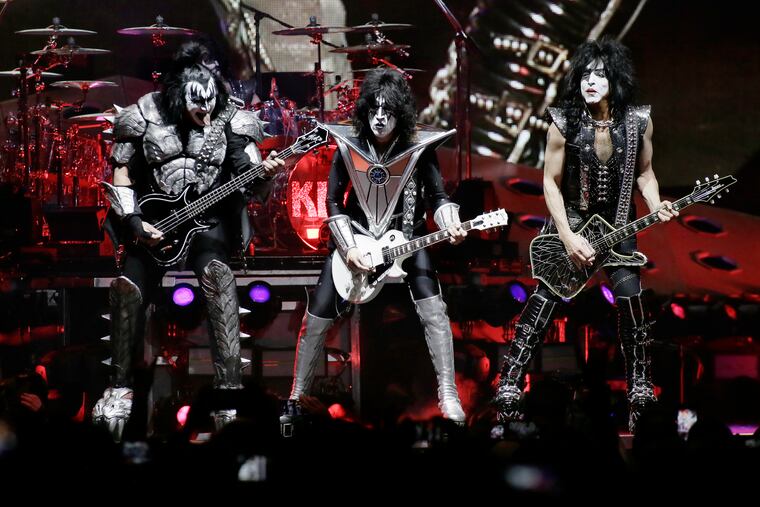
There was a moment in the middle of Friday’s sold-out Kiss concert at the Wells Fargo Center when the band’s alleged farewell-to-Philadelphia performance on its “End of the Road Tour” seemed as if it might depart from a pyrotechnic, platform boot-prancing program of pure rock and roll escapism.
Paul Stanley, the hairy-chested, muscled-up, impressively nimble 67-year-old singer-guitarist with the oddly screechy speaking voice and black star over his right eye -- he’s “The Starchild” -- had already whipped the intergenerational Kiss Army into a frenzy.
After the enduring 1970s-born cartoon hard-rock band had begun its slam-bang 2-hour, 15-minute set with the rugged riffage of “Detroit Rock City,” Stanley wordlessly elicited screams of joy by merely pointing in the direction of various sections of the audience in a kind of kabuki-theater, jazz-hands exercise.
Stanley got the assembled throng, many costumed to look like either him or his bass-playing partner Gene Simmons (a.k.a. “The Demon”) further stoked with simple and direct questions. “Do you feel all right?” “How many people believe in rock and roll?”
But then, after the typically unsubtle “Lick It Up,” the title track from the 1983 “no makeup” album, which included an instrumental interpolation of the Who’s “Won’t Get Fooled Again,” Stanley appeared to get serious.
“We’ve got this climate crisis going on,” said the singer, tip-toeing up to the precipice of making a political statement. “They call it global warming. It’s hot one day, and cold the next.”
A momentary uneasiness coursed through the crowd. Was Stanley about to make a provocative statement, perhaps trying to needle his politically conservative 69-year-old partner known for a contentious media persona, from a 2002 interview with Terry Gross to his frequent appearances on Fox News before getting banned from the channel in 2017?
No, not to worry. All is apparently well between the Starchild and Demon. It was just a song-intro shtick to one of Simmons’ many showcases throughout the over-the-top evening.
Unpredictable changes in the weather are causing many to catch colds, Stanley explained. “And some people are getting a little rock-and-roll pneumonia.” The solution? “We’re going to bring out the doctor,” he said, waving toward his Mephistophelean partner in setting up one of his trademark tunes. “Calling Dr. Love!”
The band has dates scheduled around the globe in what is being billed as its “Final Tour Ever,” even if few fans truly believe that their favorite band will ever go away for good.
Innovators in staging eye-popping spectacles -- a “Psycho Circus,” as they put it in the title song from a 1998 album -- Kiss was also way ahead of the curve in promoting their brand and merchandizing their image. Yes, they have sold everything from Kiss condoms (er, make that “Kiss Kondoms”) to Kiss caskets.
These days, Simmons and Stanley are joined by two non-original members. Guitarist Tommy Thayer replaces Ace Frehley as “The Spaceman,” replicating his solos note for note. And drummer Eric Singer replaces Peter Criss as “The Catman.” He sang lead on 1974’s “Black Diamond,” one of the band’s best, hardest-rocking tunes (later covered by the Replacements) and also on “Beth,” the uncharacteristically soft ballad from 1976 in which he played piano and proved that, as a vocalist, he’s no Peter Criss.
Stanley promised that Kiss would perform songs from all eras of the band’s career, and that plan made for ups and downs in the crowd’s enthusiasm. But still, the audience stood throughout, entertained by more fireballs per minute than I’ve ever felt at a pop concert. I’m a little jumpy as I write this, expecting another explosion in my ear any second.
And what made an impression is that it’s not just the cartoonish, blood-spurting shenanigans and aerodynamic staging that explain Kiss’ enduring populist appeal. It’s also because, fundamentally, they’re really a pop band.
Yes, Kiss makes a big noise, on trudging assaults such as “War Machine,” “God of Thunder” and “I Love It Loud.” And, true, many songs are marked by astonishingly lazy lyric writing, such as this from “Love Gun”: “No more tomorrow, baby, time is today / Girl, I can make you feel OK.” Really? Just OK?
But, over the course of the 20-song set, the band members demonstrated that they’ve never been purists in their allegiance to genre. “Heaven’s on Fire,” which counter-intuitively included no flame throwing in its staging, is an 1984 pop production masquerading as hard rock. And “I Was Made for Lovin’ You,” the 1979 smash Stanley proudly pointed out was the band’s biggest international hit, is essentially a disco song, a demonstration that Kiss has always been willing to give the people what they want, as long as it’s been good for business.