Tourists in Philly feel the shutdown impacts: Closed sites, unanswered phones, confusing updates
Tourists with an appetite for history were left in the lurch as the Liberty Bell, Independence Hall, and the Benjamin Franklin Museum remained closed amid the government shutdown.
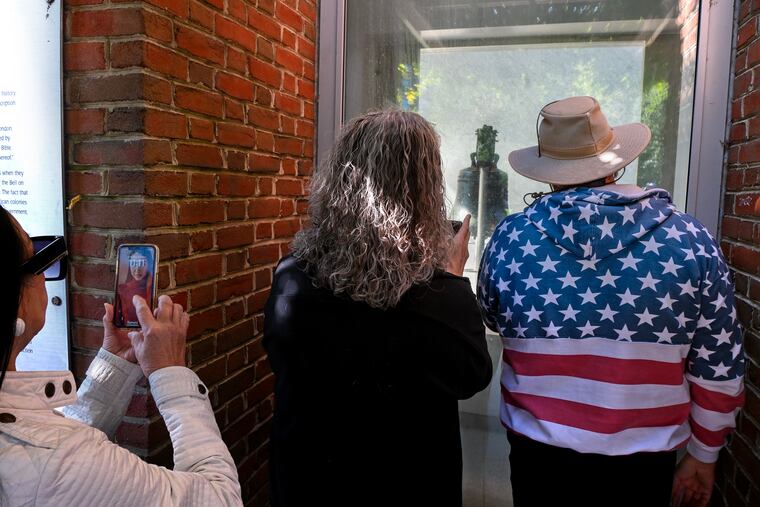
Tourist after tourist, hopeful to get a taste of history on Wednesday, was met with disappointment as they learned of a side effect of the government shutdown.
The birthplace of American democracy was closed.
Independence Hall, where the Declaration of Independence was signed, and the Liberty Bell across the street fall under the purview of the National Park Service, which is affected by the stalemate in Washington.
“Man, this is nothing like National Treasure,” joked one teen in Spanish after taking a peek at the cracked icon from outside the Liberty Bell Center.
Gloria Isaza, 60, a self-described history buff visiting from Colombia, took comfort in being able to see the Liberty Bell through the glass and that she was with a guide who could at least describe the inside of Independence Hall.
“The history is what drew us and the bell is a really big part of that,” she said. “Of course we wanted to go inside to see it.”
Guides were also learning of closures in real time, desperately trying to keep their customers engaged without the benefits of visuals. One guide took his group to the Benjamin Franklin Museum, only to learn that it, too, was closed, along with Franklin Court.
According to the Park Service, Independence National Historical Park drew more than 2.6 million visitors last year.
The Liberty Bell and Independence Hall are seen as such core components of the historical park that during the 35-day government shutdown seven years ago, Visit Philly, the city’s main tourism booster, stepped in for a weekend, covering $32,000 in operating costs to keep the landmarks open.
The shutdown was taking place during peak holiday travel and the tourism agency didn’t want people to cancel arrangements. So far, Visit Philly doesn’t have plans to step in this time, but Angela Val, the agency’s president and CEO, said it might step in on a holiday weekend, such as Thanksgiving, in the case of a prolonged shutdown.
Still, the agency insists that Philadelphia remains a history-rich place to visit, even with the shutdown.
“[Visitors will] find plenty of things to do here that would still include history, such as Elfreth’s Alley, the Betsy Ross House, the Christ Church burial ground, the Museum of American Revolution, and the National Constitution Center,” she said. “They could still take walking tours through the historic district.”
Limited information is adding to the confusion of what is affected by the government shutdown and what isn’t. According to the Department of the Interior’s contingency plan, park roads, lookouts, trails, and open-air memorials will “generally remain” open to visitors. Parks without accessible areas will be closed.
At Valley Forge National Historic Park, the telephone voicemail said calls would not be serviced during the shutdown, its website banner said “national parks remain as accessible as possible,” and its Facebook page warned that “services may be limited” without further details.
The Gettysburg National Military Park Museum & Visitor Center is owned by the Gettysburg Foundation remains open.
Back at Independence Hall on Wednesday, some who were hoping to learn more about the country’s storied founding ended up getting a lesson in bureaucracy and politics instead.
Jess Haddad, 28, and her family hovered over their phones trying to find another nearby landmark they could visit after learning that Independence Hall was out of the question. The trio had planned a day packed with history before heading back to Monmouth County in Central Jersey. But outside of the wrench in plans, Haddad felt bad seeing a gaggle of park rangers milling about the building without pay.
“I think it’s crazy that people are mandated to work when it’s not open,” she said.
For people traveling longer distances, it was harder to go with the flow.
Illinois resident Pat Cawiezel said he and his wife had planned and saved for a year to stay close to the Liberty Bell and Independence Hall and “be ready to go.”
Equipped with a handful of guides for a walkabout that was not meant to be, Cawiezel and his wife laid the shutdown and any subsequent suffering directly on the shoulders of Democrats, who he thought were making unreasonable asks, vowing never to vote for one again.
He bemoaned the votes of U.S. Sens. Tammy Duckworth and Richard Durbin, both Illinois Democrats, who voted against a Republican plan to keep the government running. Cawiezel applauded Sens. John Fetterman, a Democrat, and Dave McCormick, a Republican, for trying to do right by Pennsylvania.
“I don’t have infinite opportunities to come back,” he said, declining to give his age, but pointing out he isn’t young anymore.