Smoke shops outnumber schools: Grand jury probe blasts unregulated hemp market across suburbs
A grand jury probe involving Montgomery, Bucks and Chester counties found smoke shops use “misleading packaging and fraudulent lab reports” to openly sell banned substances – sometimes to children.
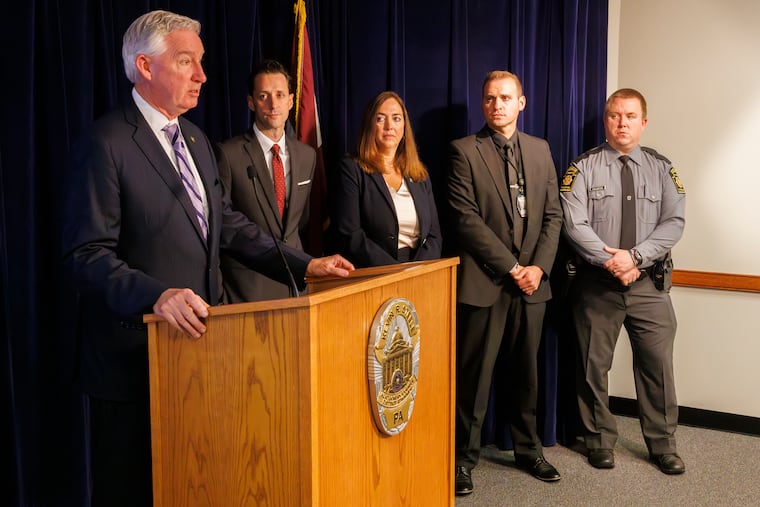
A 10-month grand jury investigation across three suburban counties has found that smoke shops openly sell unsafe and illegal drugs — sometimes to children — and that sweeping reforms are needed.
A 107-page grand jury report, released Thursday, is the product of a 10-month joint investigation by the district attorneys in Montgomery, Bucks, and Chester Counties, and focused primarily on the proliferation of stores peddling supposedly legal hemp products and other substances in all three counties.
The grand jury probe found many stores used “misleading packaging and fraudulent lab reports” to openly sell banned substances.
Speaking at the Montgomery County Detective Bureau on Thursday morning, District Attorney Kevin R. Steele called for extensive reform to cannabis sales — similar to tobacco and alcohol — in the state as a result of the findings.
“They’re unregulated, they’re unsafe, and they’re selling illegal products without oversight and without concern for the health of Pennsylvanians, especially without regard for the health of our children,” Steele said.
The grand jury report, which is the first in Montco since a 2017 report on opioid proliferation, calls for greater enforcement of store operators who “knowingly violate the law.” It also asks lawmakers to establish a statewide licensing system for the sale of THC products, along with rigorous product-testing requirements and age restrictions.
The report repeatedly cites findings from an Inquirer investigation, published in July, that tested hemp-based THC products sold over the counter in shops throughout Philadelphia and the suburbs under the terms of a federal Farm Bill legalizing certain types of low-potency hemp.
Although legal cannabis sales in Pennsylvania are limited to medical cardholders, the Inquirer report found the majority of test samples billed as THCA or Delta-8 hemp were actually powerful black-market cannabis relabeled as a legal product, sometimes using bogus “certificates of authenticity” or doctored lab reports as evidence.
Most of the samples tested by the newspaper were also contaminated with pesticides or other toxins.
The grand jury report mirrored many of these findings, and documented the vast scale of a gray-market industry that has boomed across the state over the last five years.
It found 240 hemp stores in Montgomery County alone — one smoke shop for every 3,662 residents and “nearly one shop every two square miles.” Such stores now outnumber schools across the county, according to the report, which it described as “a public health crisis unfolding in plain sight.”
Throughout the 10-month grand jury probe, undercover law enforcement officers purchased 144 THC products from shops in Montgomery and Chester Counties. Testing results paralleled what The Inquirer found: Nearly 94% of the county’s samples marketed as Farm Bill-compliant “hemp” would be considered regular marijuana under federal law.
The absence of “any law establishing a minimum age for buying THC products” in an unregulated market has “significantly increased youth access,” the report states. While some store owners described self-imposed age restrictions, detectives documented repeat sales to 16- and 17-year-olds, and accidental ingestion of unregulated hemp products by children, including a 1-year-old.
Many suppliers and retailers appeared to be intentionally marketing products to children using brightly colored packaging or by mimicking other products, according to the report.
“You got Cheetos with marijuana leaves on them,” Steele said, showing a photo of THC-infused products that copied popular snack food branding.
These include very high-potency “Krisp Rice Treats” edibles — designed to resemble the popular Rice Krispies Treats snacks — containing 400 milligrams of tetrahydrocannabinol, the active ingredient that creates the “high” associated with cannabis products.
According to the Lower Merion Police Department, one of these products was consumed in its entirety by a 14-year-old, who became “extremely panicked” and vomited, later requiring hospitalization.
The lack of regulation means there are no labeling standards for potency, leaving “consumers vulnerable to accidental overconsumption, severe psychiatric reactions, and hospitalization,” the report states. A medical expert testified that even “experienced users can be caught off guard by the potency of these products.”
These sales, and the ability to market potentially toxic products to children, represent “an urgent need for comprehensive regulatory reform,” the grand jury said.
The report comes after 41 attorneys general, including Pennsylvania’s Dave Sunday, issued a joint statement last week calling on Congress to close the Farm Bill “loophole” that kicked off the explosion of unregulated hemp sales.
However, the Thursday grand jury report calls for the reform and regulation of these products, vs. outright prohibition.
“These results starkly contradict the representations made by retailers and highlight the widespread mislabeling and deceptive marketing practices prevalent in the retail sale of THC product,” the report states. “The evidence underscores the urgent need for robust oversight, accurate labeling, and comprehensive regulation to protect consumers and the community.”
The probe has already led to several enforcement actions, officials said.
Chester County District Attorney Chris de Barrena-Sarobe said state police executed 16 search warrants on smoke shops and seized over $500,000 in cash and illegal products.
“We’re doing everything we can to stop it in its tracks right now,” he said. He added that Pennsylvania’s legislature needs to take action because on-site enforcement will not fix the systemic shortcomings that allow easy access.
“It’s not sustainable,” he said of raiding individual stores.
The report also detailed the emergence of other intoxicating products sold at smoke shops, including kratom and tianeptine, the latter of which is sometimes called “gas station heroin.” Both products were also documented in subsequent Inquirer reporting.
Steele said the detectives involved in the grand jury probe had years of narcotics experience and said they saw similarities between street-level illicit dealers and unregulated smoke shop proprietors.
“Some of these places know exactly what they’re doing, and they’re using these stores as fronts to deal drugs,” he said. “That’s the bottom line: They’re drug dealers.”

The Inquirer’s journalism is supported, in part, by the Lenfest Institute for Journalism and readers like you. News and editorial content are created independently of The Inquirer’s donors. Gifts to support The Inquirer’s high-impact journalism can be made at inquirer.com/donate. A list of Lenfest Institute donors can be found at lenfestinstitute.org/supporters.