Artemis II leaves Earth’s orbit and shoots to the moon
The move puts the astronauts on a trajectory that humans haven’t traveled in more than a half-century.
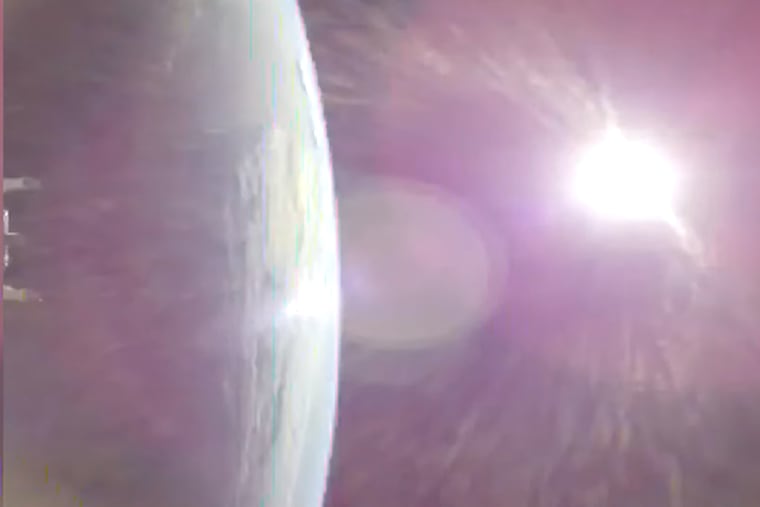
The Artemis II astronauts blasted their main engine Thursday evening to propel the Orion capsule out of Earth’s orbit and on to its next phase — a four-day journey toward the moon.
The six-minute engine burn is a pivotal move that put astronauts Reid Wiseman, Victor Glover, Christina Koch, and Jeremy Hansen on a trajectory that humans haven’t traveled in more than half a century. Going beyond Earth’s orbit comes with a host of risks, such as the sheer distance from home if anything goes awry, and the health effects of exposure to deep-space radiation from solar activity or cosmic rays once the astronauts are beyond the protection of Earth’s magnetic field.
NASA officials gave the OK to the “translunar injection” maneuver Thursday afternoon, after extensive checks of life-support systems and other operations gave them confidence that the spacecraft, which the crew named Integrity, was ready to go.
“When the engine ignites, you embark on humanity’s lunar homecoming arc and set the course to return Integrity and her crew safely home,” said Chris Birch, a NASA astronaut, speaking to the crew from mission control in Houston.
“With this burn to the moon, we do not leave Earth, we choose it,” Koch said in response. The burn not only puts the spacecraft on a trajectory to loop around the moon, but to return by tracing a figure-eight loop back to Earth.
Every day of the 10-day journey aboard the Orion capsule is busy. The astronauts started Thursday at 7:06 a.m., with the team on the ground in Houston playing the song “Sleepyhead” by the band Young and Sick. They ignited the main engine for 43 seconds to position the spacecraft in a stable high Earth orbit, in preparation for departure for the moon. Then, they rested until a second wake-up call — the song “Green Light” by John Legend and Andre 3000.
The astronauts were able to get in some exercise time using the flywheel, a cable-based device for aerobic exercises and resistance workouts. But the big turning point Thursday was the commitment to leave Earth’s orbit for the moon.
“That’s one of the big, big events in the mission,” Jake Bleacher, chief exploration scientist at NASA, said in an interview from Kennedy Space Center hours before the burn. “Really leaving Earth’s orbit … to conduct the rest of the mission … I think that will definitely make a number of people both up on the Orion and here on Earth breathe a little easier.”
At 7:49 p.m., the engines fired for five minutes and 50 seconds, a burst of energy that changed the Orion capsule’s speed by about 1,275 feet per second to position the spacecraft for its journey to the moon. On Monday, it is expected to reach its farthest point from Earth, and astronauts will see the far side of the moon, including parts that astronauts have never seen because the Apollo missions arrived when parts of the moon were shrouded in darkness.
“Depending on the precise timing when they get there, they will probably see some parts of the lunar surface on the far side sunlit that the Apollo astronauts did not have an opportunity to see,” Bleacher said. They will also be there for an eclipse, when the moon blocks the sun, allowing them to observe the enigmatic outermost layer of the sun’s atmosphere, the corona.
The astronauts will also test science operations on the far side of the moon, helping NASA understand how human crews at the moon can collaborate with science teams on Earth, Bleacher said.
Orion will slingshot around the moon and return on a trajectory that takes advantage of the gravitational pull of the Earth, without requiring propulsion. That will bring the crew to one of the most hair-raising parts of the mission: the reentry into Earth’s atmosphere, ending with splashdown in the Pacific Ocean next Friday.