Spike in border wall spending goes mostly to 2 firms with GOP, White House ties
The Trump administration contracts in his second term are the largest in the project’s history even though illegal crossings have plummeted.
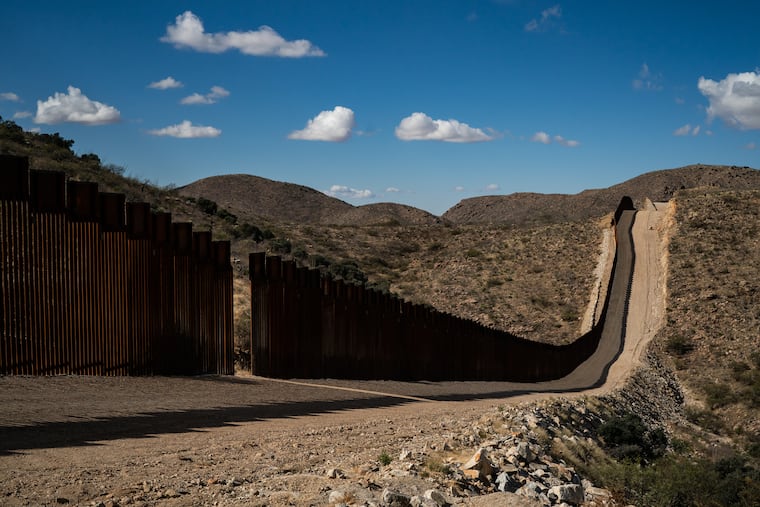
The Trump administration has sharply accelerated spending on border wall construction, issuing billion-dollar contracts that are the largest in the project’s history and potentially putting the president on track to fulfill his vision of a nearly complete land and water barrier with Mexico by the end of his second term.
The Department of Homeland Security has awarded more than $19.4 billion in contracts in the past six months — compared with $2.1 billion from 2016 to 2024. Most of it has gone to two firms that have ties to the White House and the Republican Party, according to a Washington Post analysis. The most recent contract, a $2.6 billion project, was issued Wednesday.
They and a small contingent of other firms have been cleared in advance by DHS to do the work, in a process that is widely regarded as more efficient but less transparent than standard contracting procedures. What information is available shows that in some cases costs have already ballooned significantly.
Kristi L. Noem, then the homeland security secretary, paved the way for a fivefold increase in border-barrier-related contracts after waiving dozens of environmental and contracting rules to fast-track border security projects with funds from the One Big Beautiful Bill. She did so using powers granted to her under Trump’s proclamation declaring that there was a national emergency at the southern border. For years, the government awarded, on average, fewer than 10 border wall contracts annually, but in 2025, that number spiked to 52.
Nearly 93% of all border wall spending over the past decade happened in 2025 and 2026.
“It means that we are going to have something resembling the Great Wall of China in length, demarcating between us and Mexico, even in the most completely remote areas,” said Adam Isacson, a scholar at the Washington Office on Latin America, a human rights advocacy organization.
Construction crews are erecting 5 miles of wall a week, according to Customs and Border Protection officials, introducing barriers in parts of Texas that did not previously have them and installing a second wall across much of California, Arizona, and New Mexico to further deter illegal immigration. Some of the new infrastructure consists of steel bollards, but workers are also putting up lights, paving access roads for Border Patrol, and bringing in river buoys, sensors, cameras, and other surveillance technology as part of the “Smart Wall” project.
A relatively small number of companies are obtaining a lion’s share of the most lucrative contracts. Fisher Sand & Gravel has won more than $7.8 billion in border-wall-related contracts since December, including the recent $2.6 billion award. The company is followed by Barnard Construction, which has been awarded $4.5 billion since late last year. The two companies also received sizable contracts in 2025, with Fisher Sand & Gravel winning $3.2 billion in awards and a joint venture between Barnard and Spencer Construction receiving another $633.6 million.
Both companies have extensive experience building border wall and developed novel techniques to quickly install a barrier, CBP officials have said. Neither Barnard Construction nor Fisher Sand & Gravel replied to a request for comment on the border wall contracts.
Five other companies have received contracts valued at $1 billion or higher. In a statement, the House Homeland Security Committee chairperson said lawmakers are reviewing how Big Beautiful Bill funds are appropriated.
“Government contracting must be conducted in a fiscally responsible manner and serve the public interest, as required by law,” Rep. Andrew R. Garbarino (R., N.Y.) said. “Any allegations concerning alleged violations of these practices are taken seriously.”
Concerns about transparency
The federal government has waived regulations that critics say would have instilled more checks and balances on the project.
Instead of a regular open bidding process, officials are awarding contracts to a pool of prequalified firms that bid against each other for pieces of the project. Contracting experts said that approach is legal and can allow work to start faster and at a lower cost, but it results in less transparency.
In a standard procurement process “the public has more insights into the type of work that’s being done and how it’s being evaluated, to hold contractors and government accountable,” said Em Knepp, an independent procurement researcher tracking federal contracts with Project Salt Box.
The original contracts and the names of the companies chosen to bid are public information that the government posts online, but documents explaining details like why a firm was chosen or whether any modifications to the original contract were made can only be obtained through a public records request.
New York-based construction company Posillico Civil sued the Trump administration in May and is alleging that contracts are not being awarded fairly. The company was among 11 pre-vetted firms that were invited to bid on contracts. Posillico alleges that nearly three-fourths went to two companies, Fisher Sand & Gravel and Barnard Construction, and is raising doubts about the competitiveness of the process.
Representatives for Posillico declined to comment.
In a statement, CBP broadly rejected accusations that border wall contracts have not been fairly awarded, saying all decisions are “based on the contractor’s qualifications to perform the work in a timely manner and at prices deemed fair and reasonable.”
Fisher was the biggest winner of border wall contracts during Trump’s first term, securing over $2 billion, though the company faced legal issues and environmental concerns.
Trump himself urged the military to hire the North Dakota-based company, four administration officials told the Post at the time. The firm’s president and CEO is Tommy Fisher, a well-known GOP donor. The Pentagon’s inspector general ordered an audit of a $400 million contract that Fisher’s company was issued in 2019 to build a span of new barrier across an Arizona wildlife refuge but later found no evidence of improper political interference.
The family-owned construction company was embroiled in scandal after the nonprofit We Build the Wall, led in part by Stephen K. Bannon, contracted Fisher in 2019 to build a private border wall in South Texas. Bannon later pleaded guilty to charges that he defrauded donors.
Those charges did not involve Fisher, but the Justice Department sued and settled with the construction company after it allegedly failed to comply with a treaty with Mexico during the construction of a 3.5-mile bollard barrier in a Rio Grande flood plain. Engineers also found that the wall installed was at risk of falling. The company denied violating the treaty and has defended its work.
Campaign donation records show that Timothy Barnard, the chairperson of Montana-based Barnard Construction, is also a major Trump donor. He and his wife, Mary, gave a combined $1.1 million to the Trump 47 Committee, a joint fundraising committee for Trump’s 2024 presidential campaign. They have also donated generously to groups supporting conservative candidates and the Republican National Committee.
Corporate heads routinely donate to political parties and candidates that they believe are better for their businesses.
CBP defended its process for awarding construction contracts in a statement and said it had chosen Fisher Sand & Gravel for some of the most expensive contracts after determining its proposal offered the highest value to the government.
Millions in unexpected expenses
The Post’s analysis also shows that companies are charging the government hundreds of millions more than their initial contracted amount after making modifications to the original plans that end up costing more.
Fisher Sand & Gravel won a contract last December for border construction valued at $574 million. New access roads and vertical barriers were later added to the project, and the total cost grew by $629 million. A month later, in January, Fisher won a $1.68 billion contract for border wall construction in New Mexico. The price ballooned by $108.3 million three weeks later as a result of a modification for additional steel.
Large construction projects often go beyond the original budgeted amount, and changes are frequently permitted, with the federal government’s approval. But typically officials are required to solicit proposals for additional work that goes significantly beyond the original scope of the project, and the amount and scale of the changes being requested is unusual, said Charles Tiefer, a former federal attorney and University of Baltimore professor with expertise in government contract law.
Tiefer and other contracting experts said the large number of modifications raises questions about whether the guardrails that exist in the traditional bidding process are being ignored to achieve the administration’s border wall ambitions.
“We’ve seen far too many cases over the years in which rapidly accelerated spending or pressure to execute has resulted in bad contracting practice,” said Stan Soloway, president and CEO of Celero Strategies and a former Clinton administration official who spearheaded reform in federal procurement processes.
CBP declined to comment on the contract modifications but said they are “a standard part of the federal contracting process, and CBP evaluates all pricing for modifications to ensure it’s reasonable.”
The increased work on the border wall has taken residents by surprise in communities where trucks and steel are arriving.
In far West Texas, some residents said they are bewildered over the scale of the contracts. One $1.2 billion contract awarded to Fisher calls for erecting border wall near Presidio, Texas, while another $1.7 billion contract to Southwest Valley Constructors would install 4- to 6-foot posts and vehicle barriers in Big Bend National Park.
“So that’s just two of the sections in Big Bend, and that’s $2.9 billion,” said Cary Dupuy, Texas regional director for the National Parks Conservation Association. “That’s the amount of money that was in the operating budget for the national park system for fiscal year 2026 to support all of the 433 park sites.”
Javier Sanchez has watched heavy equipment clear land for a 500-person camp that he said will disturb the tranquility of his home in Culberson County, Texas, about 25 miles from the Rio Grande.
“I don’t understand the reason for this waste of taxpayer money,” said Sanchez, noting that illegal immigration has plummeted. “I came here to have a beautiful life, and this is destroying it.”