Boris Johnson faces another possible rebellion as Parliament debates Brexit delay
Lawmakers seemed almost certain to defy Britain's new prime minister by passing legislation to avoid a no-deal Brexit next month and then rejecting his call for an early general election.
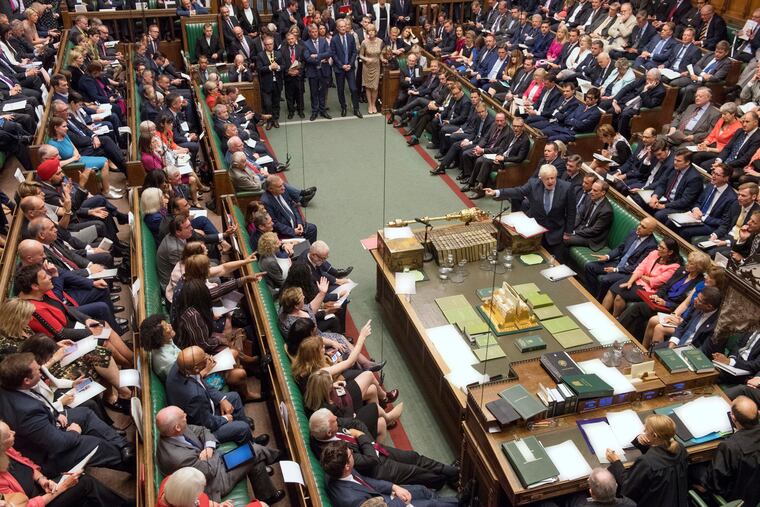
LONDON - A day after suffering one devastating defeat in Parliament, Prime Minister Boris Johnson faced the prospect of two more in the House of Commons on Wednesday as he tried to salvage his Brexit plans or force a general election next month.
Lawmakers seemed almost certain to defy Johnson by passing legislation to avoid a no-deal Brexit next month and then rejecting his call for an early general election. Those blows would be crippling for a prime minister just six weeks into his term, who has staked his job on his ability to deliver results on Brexit.
"It's the shortest honeymoon in British political history," said Jon Tonge, a politics professor at the University of Liverpool, who said Johnson is essentially in government, but not in power. "Boris Johnson is in a terrible mess."
A defiant Johnson led his first "Prime Minister's Questions" session in Parliament on Wednesday and demanded, "Let's get Brexit done."
Johnson portrayed himself as a "sensible, moderate and Conservative" leader who wanted to deliver Brexit by an Oct. 31 deadline, and he accused his opponents of "dither, delay and confusion" that would guarantee more years of debate and uncertainty about Brexit.
"What we want to do in this government is deliver the mandate of the people," he said, calling an opposition bill to delay Brexit by three months a "wretched surrender bill."
He called for a vote on that bill and, if it passes as expected, to "put it to the will of the people in the form of a general election" - meaning polls for all 650 seats in the House of Commons three years earlier than previously scheduled.
It was a fiery performance by a prime minister facing a growing rebellion in his Conservative Party and opposition leaders emboldened by their newfound leverage. Johnson risks seeing his bold moves to realize an Oct. 31 Brexit fall into the same quagmire that sunk his predecessor, Theresa May.
Johnson said neither he nor the British people want another general election, which would be the third in five years.
But his position rang hollow to many observers. On Tuesday morning he had a slim working majority, by only one seat, in the House of Commons. But by Wednesday, after defections, he was 43 seats short of a working majority, making it nearly impossible for him to pass any legislation, even on non-Brexit bills.
So an election may be inevitable - although maybe not on Johnson's terms.
Johnson has excommunicated from his party the 21 rebels who voted against him on Tuesday and would hope for their replacement in the next election by candidates more loyal to him. But the banned lawmakers include some of the most respected figures in the party, including two former chancellors of the exchequer, or finance ministers: Kenneth Clarke and Philip Hammond.
"There has to be an election, but Boris Johnson has damaged his own party in the run up to an election," said Tonge, the professor.
Also banished, remarkably, was Nicholas Soames, 71, former prime minister Winston Churchill's grandson, who has served in Parliament for 37 years. Johnson idolizes Churchill and wrote a biography of him.
Bafflement over that stunning expulsion was summed up by Ruth Davidson, who stood down as the Conservatives' leader in Scotland last week.
"How, in the name of all that is good and holy, is there no longer room in the Conservative Party" for Soames, she tweeted, using the hashtag: #anofficerandagentleman.
On the BBC after the vote, Soames sounded as stoic as his grandfather: "That's fortunes of war," he said. "I knew what I was doing, but I just believe that they are not playing straight with us."
In a debate ahead of a vote on the delay legislation, Soames, who is now an independent lawmaker, urged others to back the bill, which he said "merely seeks to avoid disaster of a no-deal Brexit."
He said that he believed that the result of the 2016 EU referendum had to be respected and pointed out that he backed Theresa May's deal on three occasions, "which is more than can be said for the Prime Minister, the Leader of the House and several members of the Cabinet, whose serial disloyalty has been such an inspiration to so many of us."
Johnson's frustration - or unorthodox style - was on display in the Commons Wednesday, when he uttered "shit," a word not usually heard in public from prime ministers. He also taunted opposition leader Jeremy Corbyn, calling him a "chlorinated chicken" and, seemingly, "a great big girl's blouse." That's an insult he has used before, which was immediately blasted on Twitter and elsewhere as sexist - and maybe a little odd.
Corbyn shot back at Johnson in Parliament, accusing him of "incompetence."
"If the prime minister does to the country what he has done to his party in the past 24 hours, I think a lot of people have a great deal to fear from his incompetence and his vacillation," Corbyn said.
Johnson has demanded that Britain end three years of uncertainty over Brexit by leaving the EU by the Halloween deadline, even if that means a no-deal exit without agreements in place to regulate trade and other matters.
Most members of Parliament, even those who support Brexit, disagree with Johnson on that issue. Debate in Parliament on Tuesday centered on fears over a no-deal exit that even government officials predict would lead to food and medicine shortages and other catastrophic economic and social problems.
Johnson on Wednesday called that "Project Fear" and said those warnings were "shameless scaremongering."
For days, Britons have been protesting in the streets around Parliament and Johnson's office at 10 Downing Street. Many are anti-Brexit, while others are angry at the prime minister for pushing the no-deal option and for planning to shutter Parliament for five weeks leading up to the Oct. 31 deadline.
"We have seized back control of Parliament from a prime minister who is behaving more like a dictator than a democrat," said Ian Blackford, a member of the Scottish National Party.
Johnson said a no-deal Brexit, no matter how difficult, would be better than electing Corbyn and sending him to Brussels to negotiate. "He will beg for an extension, he will accept whatever Brussels demands, and we'll have years more arguments over Brexit," Johnson said.
After his defeat Tuesday night, Johnson introduced legislation setting the stage for elections. But it is far from clear this will happen. Two-thirds of the 650 members of the House of Commons must vote to hold elections, and Johnson's opponents want concessions from him before they agree to a national vote.
Wednesday morning, Labour's chief Brexit negotiator, Keir Starmer, told the BBC that the party will not "dance to Boris Johnson's tune."
Corbyn and his lieutenants have said they welcome a chance to defeat the mercurial prime minister in national elections. But they insist on guaranteeing against an October no-deal exit first.
The immediate issue in Parliament Wednesday is a bill to require Johnson, by Oct. 19, to win Parliamentary approval for a Brexit deal or a no-deal exit, or to write to the EU seeking a three-month delay on Brexit. With EU agreement, the new Brexit date would be Jan. 31, 2020.
The effect of that bill is to delay Brexit, and forbid a no-deal Brexit without Parliament's approval - which it will not give. It would give London three more months to negotiate Brexit terms, which is has been unable to do in the past.
"There's a real problem with Johnson, and it's a problem Theresa May didn't have," Starmer, the Labour Brexit negotiator, said on Sky News. "People disagreed with Theresa May, but when she stood at the dispatch box and said something, she meant it and she was trusted.
"Johnson is not trusted," he said. "Even if he says the election will be on the 15th of October, most people in Parliament won't believe him. This is his central problem."
Johnson won one victory Wednesday morning in one of several legal cases that have been filed over his decision to suspend Parliament for five weeks. A judge in Scotland’s highest civil court on Wednesday ruled that the decision was lawful, but those who brought the case - 75 lawmakers - could appeal. There are similar legal challenges in Northern Ireland and in England.