Why the stress building on California’s faults could result in a major quake
The tricky part about predicting earthquakes is that there’s no magic stress threshold that results in a quake.
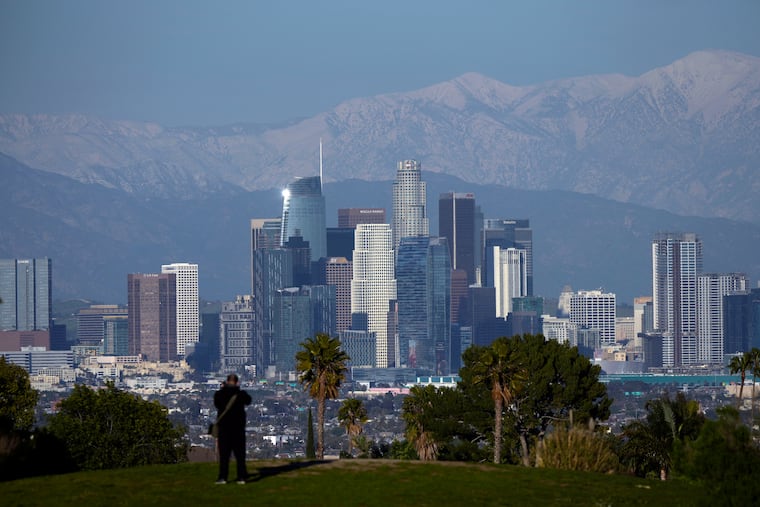
California is no stranger to earthquakes, but the Los Angeles area may be at an increased risk of a more substantial quake in the years ahead.
A recent study in the journal Advancing Earth and Space Sciences found seismic stress is accumulating on key faults near the greater Los Angeles metro area, in some sections reaching peak levels. And the findings reveal what researchers are calling an “earthquake gate” lurking just northeast of the city.
While swarms of smaller quakes have rattled Los Angeles over the past century and a half, the last devastating quake to strike the city was on Jan. 9, 1857. Known as the Fort Tejon quake, the violent magnitude-7.9 tremor ruptured a 225-mile stretch on the southern part of the San Andreas Fault.
But that portion of the fault has since remained largely dormant, with stress continuing to build elsewhere along the fault, as well along the neighboring San Jacinto Fault.
Researchers analyzed 1,000 years of paleoseismic data, or a reconstruction of past tectonic activity. They found that stress along multiple portions of the faults is the highest it has been in at least a millennium, including along the Mojave South segment of the San Andreas Fault and the San Jacinto Bernardino segment of the San Jacinto fault.
The San Andreas and San Jacinto fault systems are the largest in California, and run parallel to each other east of Los Angeles. They meet at a point called Cajon Pass, an “earthquake gate” of sorts.
“The simplest way to think about an earthquake gate is a junction in a road network,” Liliane Burkhard, the study’s lead author, said in an email. “Most of the time, traffic follows one road and stops when it hits the junction. But under certain conditions, it can cross over and continue down a second road, covering much more ground. At Cajon Pass, the San Andreas and San Jacinto faults approach each other closely but do not directly connect at the surface.”
That means seismic activity on one fault can cross the pass and affect the other.
“Whether a rupture on one fault crosses over to the other appears to depend on how similarly stressed the two systems are at the time,” wrote Burkhard, who is also a researcher at the University of Bern in Switzerland. “When their stresses rise together in concert (not necessarily at the same level), the gate tends to open and the rupture can propagate across both faults. When their stress levels are mismatched, the rupture tends to stop at the junction.”
During the 1857 Fort Tejon quake, the rupture did not cross Cajon Pass. But Burkhard referenced the 1812 Wrightwood earthquake, which ruptured both faults. Now, concern is increasing that a similar event could unfold again.
“Right now, both systems are highly stressed and their levels are converging, which makes the current situation worth paying attention to,” Burkhard cautioned.
Both the San Andreas and San Jacinto are “strike-slip” faults, with segments of the Earth’s crust sliding horizontally. Others may be “normal,” “reverse,” or “thrust” faults; the last of these is the most effective at producing tsunamis.
While a significant quake may be overdue, the extent of any future rupture, and subsequent quake magnitude, is impossible to predict. But the researchers’ findings indicate that, when one fault ruptures, both will.
“The stress conditions we model suggest that a joint rupture of both systems is likely and maybe more than at any point in the past millennium, which is the more important and less well-understood dimension of the hazard,” Burkhard said.
The tricky part about predicting earthquakes is that there’s no magic stress threshold that results in a quake.
“You can think of it less like a light switch and more like a pressure gauge that has historically tended to trigger in a certain range,” Burkhard said. “What we can say with confidence is that current stress levels are at or above the high end of those ranges, which tells us that the system is in a state we have not seen in the past 1,000 years.”
But is 1,000 years of data enough to draw conclusions?
Harold Tobin, the director of the Pacific Northwest Seismic Network and a professor at the University of Washington, says yes.
“I think this 1,000-year simulation spans enough time to support a meaningful and useful conclusion,” Tobin, who was not involved in the recent study, said in an email. “[The] record is really short in North America, so paleoseismic evidence — geologic sleuthing — has to be used. The thousand-year paleoseismic record for the Southern California San Andreas and other faults that they use in this study (the “MRM”) is already a phenomenal achievement. … [It’s] enough to capture quite a few earthquake recurrence cycles on the relevant segments of the San Andreas fault system.”
So when might the next big quake occur? Tobin said the complex nature of California’s fault systems makes for limited predictability.
“Major quakes on major fault systems tend toward some degree of periodic recurrence, but that’s variable,” he wrote. “For example, evidence tends to favor more regular periodicity of recurrence for the truly giant subduction zone earthquakes, or for very straight, geometrically simple faults (an example is the Alpine Fault in New Zealand).”
But in Southern California, he said, the complex of interacting faults “may exhibit a more chaotic recurrence pattern.”