Cities race to confront César Chavez’s legacy after assault claims
“I’m in mourning. It’s like losing a dear friend that you thought was almost like a saint. It’s such a betrayal.”
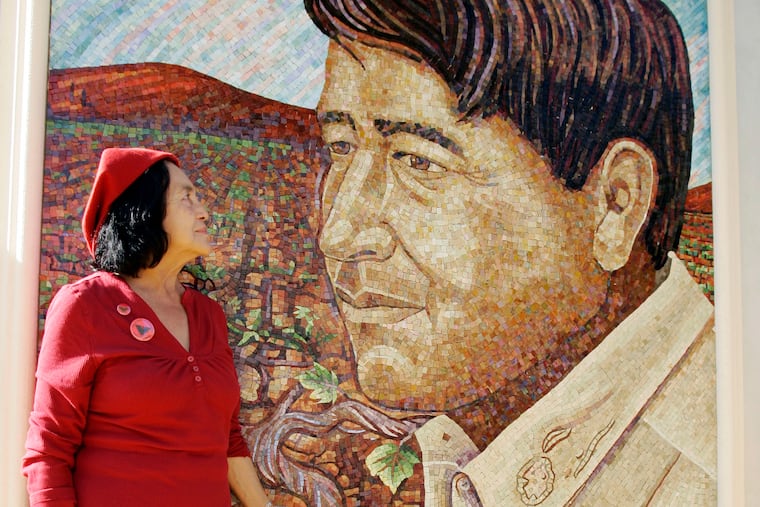
Hours after she learned that César Chavez, the iconic Latino farm labor activist, had been accused of sexually assaulting girls in the movement he led, Austin City Council member Vanessa Fuentes began hearing from constituents demanding the city rename César Chavez Street.
“So many native Austinites have photos with César Chavez and memories of interacting with him,” said Fuentes, the only Latina on the city council. “I’ve already received five emails from residents demanding that we rename it as soon as possible.”
The New York Times reported Wednesday that Chavez, who died in 1993, groomed and sexually abused young girls whose parents worked in the movement during the 1970s. The activist Dolores Huerta, who cofounded the National Farm Workers Association with Chavez, told the Times that Chavez sexually assaulted her when she was an adult.
In a statement, Huerta, who is 95, said she is speaking out because of the new report. She condemned his actions but emphasized that the farmworker movement, which spawned the still-powerful United Farm Workers of America, is bigger than one person.
“We must continue to engage and support our community, which needs advocacy and activism now more than ever,” she said.
The revelations about Chavez drew immediate calls to rename buildings, schools, streets, and other memorials dedicated to him nationwide.
“I’m in mourning. It’s like losing a dear friend that you thought was almost like a saint,” said Alicia Perez-Hodge, cofounder of the Hispanic Advocates Business Leaders of Austin and a district director for the League of United Latin American Citizens. “It’s such a betrayal.”
Born in Yuma, Ariz., Chavez grew up in a Mexican American family that traveled around California picking lettuce, grapes, cotton, and other seasonal crops. Many of the buildings named after him are in those states — including more than three dozen schools in California alone — and across the Southwest.
But Chavez was honored with memorials across the country: statues, libraries, parks, stamps, and even a U.S. Navy ship, in states including Illinois, Maryland, Michigan, Missouri, and Ohio. More than 60 public schools nationwide are named after Chavez, according to a federal database.
Officials in many of these places are rushing to reckon with his legacy. Cities have canceled planned marches to honor Chavez’s birthday, March 31. At the U.S. Department of Labor, where Chavez’s portrait had been placed beside the entrance to an auditorium named after him in 2012, officials removed the picture and placed a U.S. flag over his name at the entrance. Fresno State University officials covered a statue of Chavez on campus, and the University of California at Davis stripped a 25-year-old college-access conference of Chavez’s name.
California became the first state to commemorate Chavez’s birthday, and in 2014, President Barack Obama proclaimed it César Chavez Day.
On Thursday, two top California lawmakers announced they want to rename the holiday. Assembly Speaker Robert Rivas and Senate President pro Tempore Monique Limón, the leaders of the California legislature, said they would pass a bill renaming the holiday Farmworkers Day before the end of the month. The legislation would need Gov. Gavin Newsom’s approval. He said Thursday he supports the name change.
Los Angeles Mayor Karen Bass and city council members signed a proclamation Wednesday renaming the last Monday in March “Farm Workers Day.”
Bakersfield has dropped plans to rename a street for Chavez. Other California cities have prominent thoroughfares named for him, including Los Angeles, where César Chavez Avenue is a major thoroughfare on the historically Latino east side.
A half dozen libraries and dozens of public schools across the state are named after Chavez, as is the student center at the University of California in Berkeley and the Department of Chicana/o and Central American Studies at UCLA.
The Phoenix City Council is set to vote next week on whether to rename the March 31 holiday as well as buildings and city streets that bear Chavez’s name. (The mayor and two city council members want the holiday to be renamed Farmworkers Day.)
Albuquerque Mayor Tim Keller ordered a review of how Chavez is recognized across the city.
“His name should be removed from landmarks, institutions, and honors,” U.S. Sen. Ben Ray Luján (D., N.M.) said.
In Denver, where a park is named after Chavez, the mayor and city council members gathered Thursday to announce that a sign and bust of Chavez had been removed from the park.
“For many of us, this is not just news: This touches our history, our families,” said city council member Amanda Sandoval, noting that her grandparents were farmworkers and that she drove by the Chavez park daily.
Removing mentions of Chavez from the park “was not an easy decision, and I don’t want anybody to think we made it lightly. But it was a necessary one,” she said, adding that community members would determine “what that space should represent going forward.”
Texas Gov. Greg Abbott, a Republican, said that the state will not observe the Chavez holiday and that he will urge the state legislature to remove it when it next convenes. Jacqueline Arias-Bryant, executive director of the Texas House’s Mexican American Legislative Caucus, said it would support abolishing the state holiday and called for a “full reckoning.” A bronze statue of Chavez stands on the University of Texas at Austin campus.
Texas residents and officials have already proposed renaming some of the several streets and highways named after Chavez statewide, notably in Austin, Dallas, and San Antonio.
In Dallas, Soraya Santos felt an urgency to change a street name.
“Time is of the essence. The allegations are out. We should not put up with it for another second,” said Santos, a local activist and administrator of the Reform Dallas Facebook page devoted to municipal politics.
Santos plans to speak at a City Council meeting next week in favor of renaming the street after Huerta.
“It would just be really lovely to be able to do this with her there so we can honor her and celebrate her before we lose her,” she said.
But Santos acknowledges that Texas has a complicated history when it comes to changing controversial memorials. While Dallas’ Robert E. Lee Park was renamed and the Confederate general’s statue removed, there is still a replica of his estate at the park.
“History, we are always going to be grappling with it in some ways,” Santos said.
In Austin, César Chavez Street runs through the historically Latino east side. Residents have taken to Reddit to debate whether the street should be renamed (consensus: yes) and, if so, how.
“It does merit consideration, given everything we know now,” said Perez-Hodge, the Austin organizer, of renaming the street.
Chavez joined striking South Texas laborers in 1966 when they marched north to Austin from melon farms in the Rio Grande Valley to demand better pay and working conditions. Austin’s First Street was renamed after him in 1993. A proposal being crafted by city council members would revert it to its original name.
But at a time when many Latino residents are being priced out of the neighborhood by rising housing costs, Perez-Hodge wants the street to remain a Latino landmark, “something that still symbolizes fairness and justice and the quest for workers’ dignity and safety.”
Residents posted jokes online about renaming the street for resident celebrities such as Matthew McConaughey, Elon Musk, Willie Nelson, or Joe Rogan — or even President Donald Trump. Others suggested naming it after Austin’s first Latino mayor, Gus Garcia.
But the overall favorite was Huerta.
“She is a strong woman leader, and we know history has not accurately portrayed her role, like so many times in history the role of women is diminished,” Fuentes, of Austin’s city council, said.
But the revelations about Chavez gave her pause.
“When you name things after people, living or past, you never know what their story will entail,” Fuentes said, so “there’s a little bit of a hesitancy there to go straight into naming it after a person. The movement is so much more than just one individual.”
Fuentes, the only Latina on the city council, said she began hearing from constituents within hours after reports were published this week, demanding the city rename the street.
“So many native Austinites have photos with César Chavez and memories of interacting with him,” she said. “I’ve already received five emails from residents demanding that we rename it as soon as possible.”
Fuentes said the council might rename the street after a different Latino figure.
“It’s the movement that needs recognition,” she added. “So what’s important to me is that we still find ways to recognize the movement and what Latinos fought for, what that movement has meant for so many of us.”
This article contains information from the Associated Press.