Chile holds an election that could deliver its most right-wing president since dictatorship
Chileans vote in a runoff presidential election between communist former labor minister Jeannette Jara and archconservative former lawmaker José Antonio Kast.
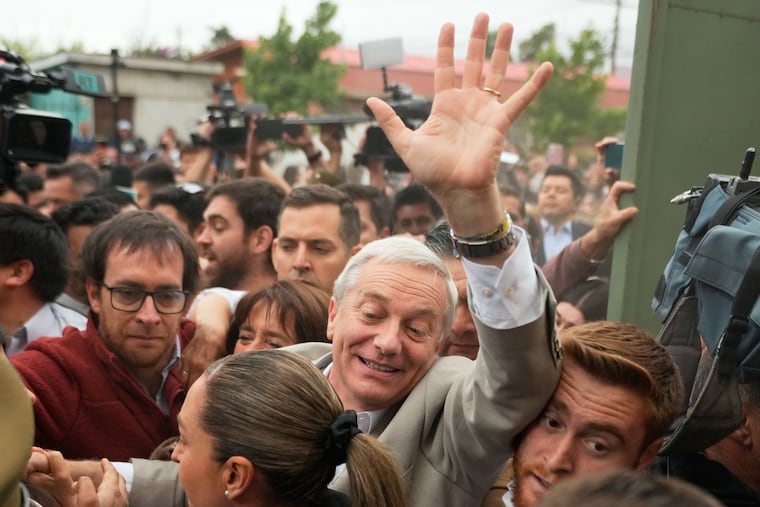
SANTIAGO, Chile — Ultra-conservative José Antonio Kast secured a thumping victory in Chile’s presidential runoff election Sunday, defeating the candidate of the leftist governing coalition and setting the stage for the country’s most right-wing government in 35 years of democracy.
With over 95% of the vote counted, Kast won more than 58% of the votes as Chilean voters overwhelmingly embraced his pledge to crack down on increased crime, deport hundreds of thousands of immigrants without legal status, and revive the sluggish economy of one of Latin America’s most stable and prosperous nations.
His challenger, communist candidate Jeannette Jara who served as leftist President Gabriel Boric’s popular labor minister, had just over 41% support.
“Democracy spoke loud and clear,” Jara wrote on social media, saying that she called Kast to concede defeat and congratulate him on his successful campaign.
Kast’s supporters erupted into cheers in the street, shouting his name and honking car horns.
His campaign spokesperson, Arturo Squella, declared victory from the party headquarters in Chile’s capital of Santiago.
“We are very proud of the work we’ve done,” he told reporters. “We feel very responsible for this tremendous challenge of taking charge of the crises that Chile is going through.”
Kast’s election represents the latest in a string of votes that have turfed out incumbent governments across Latin America, vaulting mainly right-wing leaders to power from Argentina to Bolivia.
On the surface, the two candidates in this tense presidential runoff could not have been more different, fundamentally disagreeing on weighty matters of the economy, social issues, and the very purpose of government.
A lifelong member of Chile’s Communist Party who pioneered significant social welfare measures in Boric’s government and hails from a working-class family that protested against the 1973-1990 military dictatorship, Jara was a dramatic foil to her rival.
Kast, in contrast, is a devout Catholic and father of nine whose German-born father was a registered member of Adolf Hitler’s Nazi party and whose brother served in the dictatorship. He had previously struggled to win over moderate voters in two failed presidential bids.
His moral conservatism, including fierce opposition to same-sex marriage and abortion without exception, had been rejected by many in the increasingly socially liberal country. The admiration he has expressed for the bloody military dictatorship of Gen. Augusto Pinochet also sparked widespread condemnation in his campaign against President Boric four years ago.
But in the past few years, fears about uncontrolled migration and organized crime have roiled the country. Enthusiasm for a hardline approach to crime spread, dominating the election and boosting Kast’s law-and-order platform.
It remains uncertain whether Kast, an admirer of U.S. President Donald Trump, can implement his more grandiose promises.
That includes slashing $6 billion in public spending over just 18 months without eliminating social benefits, deporting over 300,000 immigrants in Chile who don’t have legal status, and expanding the powers of the army to fight organized crime in a country still haunted by Gen. Augusto Pinochet’s military dictatorship from 1973 to 1990.
For one, Kast’s far-right Republican Party lacks a majority in Congress, meaning that he’ll need to negotiate with moderate right-wing forces that could bristle at those proposals. Political compromises could temper Kast’s radicalism, but also jeopardize his position with voters who expect him to deliver quickly on his law-and-order promises.
At each rally, Kast had taken to ticking off the number of days remaining until Chile’s March 11 presidential inauguration, warning immigrants without papers that they should get out before they “have to leave with just the clothes on their backs.”
Jorge Rubio, 63, a Chilean banker in Santiago, said he and like-minded Chileans are “also counting down the days,” adding, “That’s why we’re voting for Kast.”
Boric’s left-wing government was under fire
As the pandemic shuttered borders, transnational criminal organizations like Venezuela’s Tren de Aragua took over migrant smuggling networks to gain a foothold in Chile, long considered among Latin America’s safest countries. Homicides hit a record high in 2022, the first year of President Gabriel Boric’s tenure.
Boric’s approval rating plunged from 50% to 30% within just months of him taking office, and never fully recovered.
Kast insisted that Boric’s government was too soft on immigration, which the far-right politician argues is the main cause of crime. The data does not necessarily support his narrative. But relentless tabloid and television coverage does, Chileans say.
“Unlike this government, Kast understands that migration means insecurity,” said Manuel Troncoso, 54, after voting at a high school down the street from President Boric’s home. “You see in the news how the people committing the worst crimes come from other countries.”
Others say that while Boric failed to fulfill his flagship promise to transform Chile’s market-led economy, the firebrand former student protest leader elected in 2021 succeed in refocusing his agenda to address the country’s security crisis. He sent the military to reinforce Chile’s northern border, stiffened penalties for organized crime, and created the first public security ministry.
“I actually thought this government would be worse. I have to admit it has improved security,” said Mariano Jara, 55, emerging from a polling station.
He said he voted for Kast because “there’s always more that can be done. There’s room to get tougher.”
Chile’s homicide rate has actually fallen in the last two years, and is now on par with the rate in the United States. But that hasn’t changed citizens’ widespread feeling of insecurity.
According to a recent Gallup survey, just 39% of people feel safe walking alone at night. That’s about the same as in Ecuador, which is now in the midst of a violent, drug-driven crime wave.
Crime and migration overshadow concerns
As Boric’s former minister of labor, Jara became popular as the architect of the administration’s most important welfare measures.
As she voted in her family’s working-class neighborhood of Conchali, supporters shouted out her accomplishments, including shortening the workweek to 40 hours, increasing the minimum wage, and overhauling the pension system. “Forty hours!” they chanted.
But those accomplishments didn’t win Jara new supporters. Many centrists were put off by her lifelong membership in Chile’s Communist Party.
To woo security-minded voters, Jara vowed to reinforce borders, register undocumented migrants, and tackle money laundering.
“To me, she represents continuity, and Kast represents Trump,” said María Rojo, 71, waving at Jara as she drove off from the polling station. “Of course, that’s why I support her. I know others feel the opposite.”
Kast’s supporters now include many Chileans who previously spurned him over deeply conservative values. They say they’re willing to trade abstract human rights concerns for increased safety on the streets.
“It’s not very nice to hear that he’s going to separate immigrant children from their parents, it’s sad,” said Natacha Feliz, a 27-year-old immigrant from the Dominican Republic, referring to a recent interview in which Kast warned that immigrant parents without legal status who didn’t self-deport would be obliged to hand their kids over to the state.
“But this is happening everywhere, not just in Chile,” she said. “Let’s just hope that our security situation improves.”