Data suggest struggle in cockpit before deadly China Eastern plane crash
A report by the U.S. National Transportation Safety Board offers new details about the crash in 2022, which killed all 132 people on board.
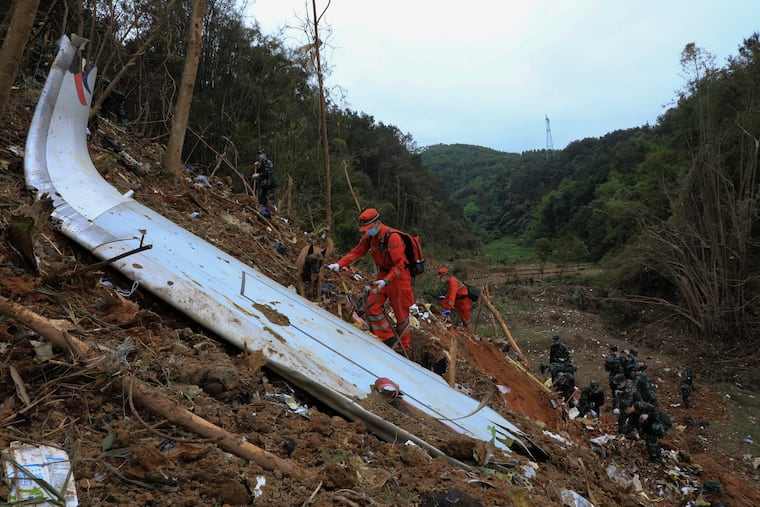
For more than four years, the final moments of China Eastern Flight 5735 remained shrouded in secrecy, with few clues to a baffling descent from 29,000 feet that left no survivors.
Now, new data from the Boeing 737 suggest the crash was no accident. The plane’s fatal dive was a deliberate act initiated from within the cockpit, aviation experts say, following what appears to have been a struggle for control of the aircraft.
The plane, which was operated by highly experienced pilots, had been traveling from Kunming, in southwestern China, to Guangzhou when it plunged almost vertically into a hillside, driving pieces of the aircraft as deep as 60 feet into the earth.
The report by the National Transportation Safety Board shows that the dive began when a pilot or pilots pressed the cutoff levers — essentially, fuel switches — for both engines on the plane mid-flight, according to Jeff Guzzetti, a former accident investigator for the Federal Aviation Administration and the NTSB.
Pressing down the two levers simultaneously stopped fuel flow to the engines and shut them down, Guzzetti said.
Almost immediately, data from the cockpit controls show, the plane entered a terrifying dive and spun in at least one 360-degree roll, Guzzetti said. The data show that control wheels in the cockpit — one each in front of the captain and first officer — were turned to produce that roll, Guzzetti said. (The control wheels on a plane are a little like the steering wheel in a car, but they cause the plane to bank.)
The herky-jerky, back-and-forth movement of the wheels suggests that at least two people were fighting to turn them in different directions. That could mean two pilots were struggling over a single wheel or that the captain and first officer were pushing in different directions on their own wheels, which are set to move in unison.
“Aggressive movements to pitch the airplane down and to roll it dramatically tell me this was an intentional act,” Guzzetti said.
The data about the crash, which was one of the deadliest in China in more than a decade, were released in response to a Freedom of Information Act request to the NTSB. The safety board had assisted in the investigation into the crash and helped retrieve the information from the plane’s flight data recorder, one of the aircraft’s “black boxes.”
It was not immediately clear who submitted the request, or when the NTSB released the report, which can be found on its website.
The data are especially sensitive in China, where the government has released very little information from its own investigation into the crash. Xi Jinping, China’s most dominant leader in decades, has tightened controls on information, particularly when it comes to major disasters, which are seen as potential threats to social stability. In the days after the crash, Chinese officials censored reports and discussion about it.
China’s Ministry of Foreign Affairs and Civil Aviation Administration did not respond to faxed questions about the new data. In 2024, the aviation administration said the pilots and cabin crew had passed preflight medical checks on the day of the crash.
Guzzetti, the former NTSB accident investigator, said other aspects of the data supported the idea that there might have been a struggle between the two pilots for the flight controls.
“If you’re going to roll the airplane, it’s a smooth roll,” he said. “Here the control wheel is going back and forth and back and forth. That kind of indicates to me that there was a struggle.”
John Cox, an aviation safety consultant and retired airline pilot, said he agreed that the fuel cutoff and other commands to the aircraft came from the cockpit, possibly by a single pilot. “A pilot can shut off fuel to both engines at the same time, by moving the levers from run to cutoff,” he said.
The irregular movement of the control wheel suggested a struggle, “but the evidence is not overwhelming or totally conclusive,” Cox added.
The NTSB said the flight data recorder stopped running while the plane was still in descent, at around 26,000 feet. Without the engines functioning, there was no electricity to power the recorder.
The recorder was severely damaged in the crash, the NTSB said. Information from the cockpit voice recorder, the plane’s other black box, was not released.
The flight recorder also revealed that during the initial part of the dive, the plane was descending at as much as a 40-degree angle — far steeper than the few degrees needed for a normal descent, Guzzetti said.
“It’s the kind of movement you see aerobatic airplanes perform in an air show,” Guzzetti said. “It would have been a shock to the passengers because of the forces imparted on them from these drastic maneuvers.”
This article originally appeared in The New York Times.