Chinese firms market Iran war intelligence ‘exposing’ U.S. forces
A wave of viral social media posts detailed equipment at U.S. bases, movements of American carrier groups, and breakdowns of how military aircraft were assembling for strikes on Tehran.
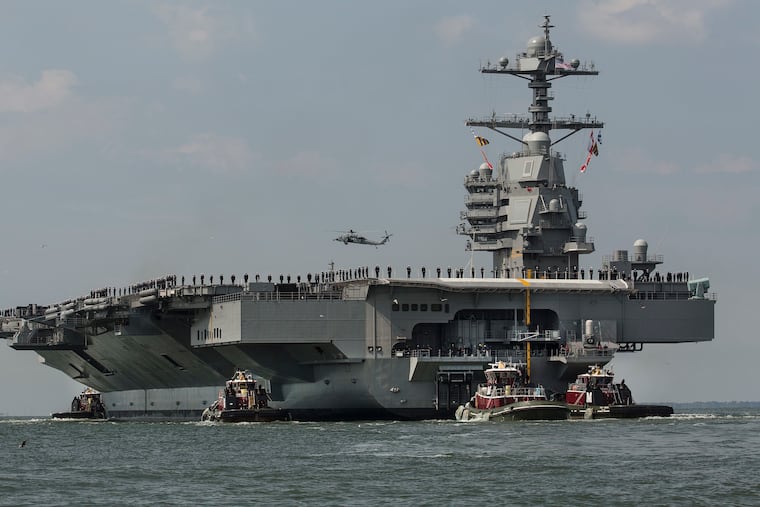
As the war in Iran erupted five weeks ago, social media sleuths across Western and Chinese platforms flagged a wave of viral posts detailing equipment at U.S. bases, the movements of American carrier groups, and granular breakdowns of how military aircraft were assembling for strikes on Tehran.
The intelligence came from a fast growing new market: Chinese firms — some with links to the People’s Liberation Army — marrying artificial intelligence with open-source data to market information they claim can “expose” the movements of U.S. forces.
Beijing has sought to distance itself from any direct involvement in the Iran war, but the firms — many of which have emerged in the past five years as part of the government’s push to harness private AI for military use — are capitalizing on the conflict.
U.S. officials and intelligence experts are divided over whether Chinese firms’ publicly marketed tools pose a genuine threat or are being credibly used by U.S. adversaries, but say the surge in private-sector offerings points to a growing security risk and reflects Beijing’s intent to project the strength of its intelligence capabilities.
Beijing has poured hundreds of millions of dollars into supporting private firms developing AI with practical defense applications under its civil-military integration strategy, and last month announced plans to supercharge those efforts as part of a broader five-year national strategy.
The Chinese Embassy in Washington did not respond to a request for comment.
Private firms have long used open-source data — including flight trackers, satellite imagery, and shipping data — to generate market intelligence. But the growing AI capability of Chinese firms is making these tools more powerful, underscoring the growing challenge of concealing U.S. military movements from adversaries.
“The proliferation of more and more capable private sector geospatial analysis companies in China will augment China’s defense capabilities and ability to contest U.S. forces in a crisis,” said Ryan Fedasiuk, a fellow at the American Enterprise Institute think tank.
MizarVision, a Hangzhou-based firm founded in 2021, is one of the companies that uses a mix of Western and Chinese data filtered through AI to catalogue activity at U.S. bases in the Middle East, track naval movements, and identify the position and number of specific aircraft and missile defense systems.
Images sourced to the firm — which is not part of China’s military but holds a National Military Standard certification required for firms supplying services to the People’s Liberation Army — and posted on Chinese and Western social media, for example, detailed the buildup of U.S. forces in the Middle East on the eve of the launch of Operation Epic Fury, including the passage of the USS Gerald R. Ford and USS Abraham Lincoln carrier strike groups. It also shared detailed breakdowns of the number and types of aircraft massing at Israel’s Ovda Air Base, Saudi Arabia’s Prince Sultan Air Base, and Qatar’s al-Udeid Air Base.
“In the lead-up to the escalation of tensions in Iran in 2026, we quickly identified the locations of weapons and equipment deployed in the Middle East," and “exposed” the refueling patterns of U.S. carrier groups, MizarVizion’s website claims.
Elsewhere on the site, it claims to have tracked U.S. military escalation ahead of the operation to capture Venezuelan President Nicolás Maduro “months in advance” and says it can “track the entire transport process” of U.S. medium-range missiles in the Asian Pacific “in real time.”
MizarVision does not publicly list its clientele and did not respond to requests for comment. It also does not disclose the sources of the data it analyzes — including satellite imagery, ADS-B flight data, and ship AIS data — though, Chinese state media reports, an analysis of images posted online and accounts from two users of the company’s platform suggest it draws on a mix of Chinese and Western sources.
Satellite photos posted by MizarVision appear to include some commercially available imagery from U.S. and European providers, including Vantor and Airbus. Chinese state media has also previously reported that the firm has used imagery from Planet Labs. It remains unclear whether any U.S. companies are knowingly supplying data directly to the firm; most major providers maintain policies that restrict or prohibit such end uses.
A Vantor spokesperson said that it does not sell any satellite imagery to Chinese entities and exercises controls during conflicts, including limiting requests for “imagery over areas where U.S., NATO, and other allied and partner forces are actively operating, as well as over areas that are being actively targeted by adversaries.”
A spokesperson for Planet Labs said that MizarVision is not a client and it had verified that images posted by the firm during the Iran war were not sourced from their satellites. Airbus did not respond to a request for comment.
One person in China working in the private defense industry, who is familiar with the company’s platform and operations, said the firm uses AI to analyze publicly available Western satellite imagery but does not have real-time access to U.S. imaging sources.
“There are constraints, but the advantage is that it uses this data to track the American military specifically … that is not typical for Western firms,” said the person, who requested anonymity because they are not permitted by their employer to speak to the press.
“My understanding is that they are buying a lot of imagery from actual collectors like the Jilin satellite constellation that China operates,” said Fedasiuk, who has tracked the rise of Chinese firms positioning themselves as experts in monitoring U.S. military movements.
Jing’an Technology, another Hangzhou-based firm tracking U.S. military movements in the Middle East, released what it claimed was a recording of two U.S. B-2A stealth bombers communicating with each other during the opening salvos of Operation Epic Fury.
“In the eyes of AI, there is no absolute ‘stealth,’” it said in a post on Chinese social media site describing its analysis in early March. The firm later deleted the recording. In earlier posts, it claims to have tracked similar interactions between U.S. B-52 strategic bombers flying patrols near Venezuela in October.
“While ordinary people were still debating over social media tweets, [Jing’an] frantically cross-validated massive amounts of ship and flight data in just a few days from the end of January to the beginning of February, locking onto more than 100 U.S. warships, dozens of U.S. military aircraft, and recorded more than 100,000 [military-related] movements,” the firm said in a Chinese social media post.
The company did not respond to a request for comment.
U.S. officials and former intelligence analysts say they are skeptical that Chinese firms can penetrate U.S. stealth communications, but warn that the rise of such companies is concerning nonetheless. “Even if the capability isn’t there yet … the big picture concern is the intent,” said one U.S. official who tracks technological threats from U.S. adversaries and spoke on the condition of anonymity.
Analysts say gaps in China’s real-world intelligence suggest the firms’ capabilities may be overstated — pointing to Beijing being caught off guard by the surprise U.S. operation to capture Maduro.
“I think that Chinese intelligence is feeling this pressure. And one way to deal with that is to have these companies go out and say hey, we can see all the American aircraft in the Middle East,” said Dennis Wilder, a senior fellow at the Georgetown University School of Foreign Service who previously served as the CIA’s deputy assistant director for East Asia and the Pacific.
The trend has sparked urgency among U.S. lawmakers.
“Companies tied to the CCP are turning AI into a battlefield surveillance tool against America. The threat from China’s technology ecosystem isn’t theoretical, it’s imminent. ... The United States cannot allow the Chinese Communist Party to turn commercial technology into real-time intelligence on American troops,” the House Select Committee on China said in a statement referencing MizarVision’s work.
Analysts say the work of private firms like MizarVision and Jing’an could also offer Beijing a plausible way to aid partners while maintaining official distance from conflicts.
“The state can benefit from private sector innovation and it can likewise disclaim, credit or blame for the actions of ostensibly private companies, even when they are operating at the direction of the state or with the strong alignment of the state,” Fedasuik said.
Iran is a longtime ally and a key oil supplier, but China has been careful to avoid entering the war, seeking to preserve its image as a peacemaker. This week, in a joint statement with Pakistan, the two countries called for an immediate ceasefire and peace talks “as soon as possible.”
The Washington Post earlier reported that Russia is providing Iran with targeting information to attack American forces in the Middle East, the first such indication that a major U.S. adversary could be actively participating in the war.
Asked on Tuesday about whether U.S. adversaries are sharing intelligence with Tehran, Defense Secretary Pete Hegseth said: “There’s some things adversaries are doing to provide info and intel that they shouldn’t. We’re aware of it and ultimately we move things around.”