China increasingly views Trump’s America as an empire in decline
For decades, many Chinese viewed the United States with a mix of admiration, envy, and resentment. President Trump's volatile second term shattered that image.
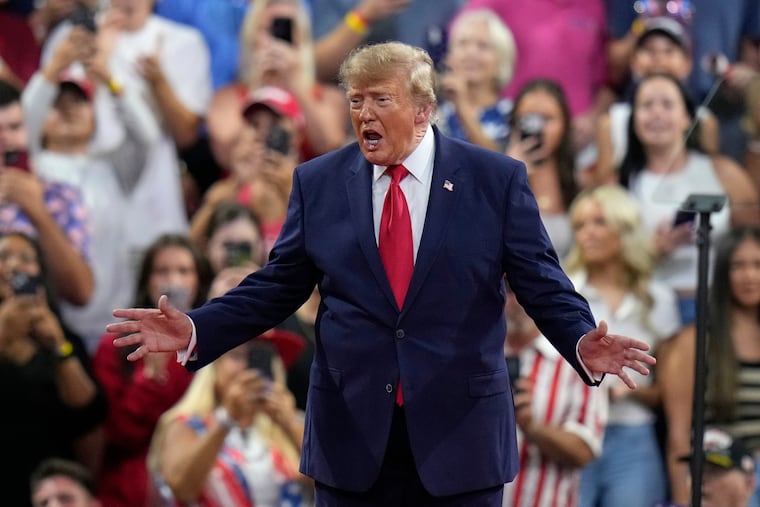
When President Donald Trump visited China in late 2017, Xi Jinping welcomed him with a grand display of Chinese history and culture: a four-hour private tour of the Forbidden City culminating in a performance by the Peking Opera.
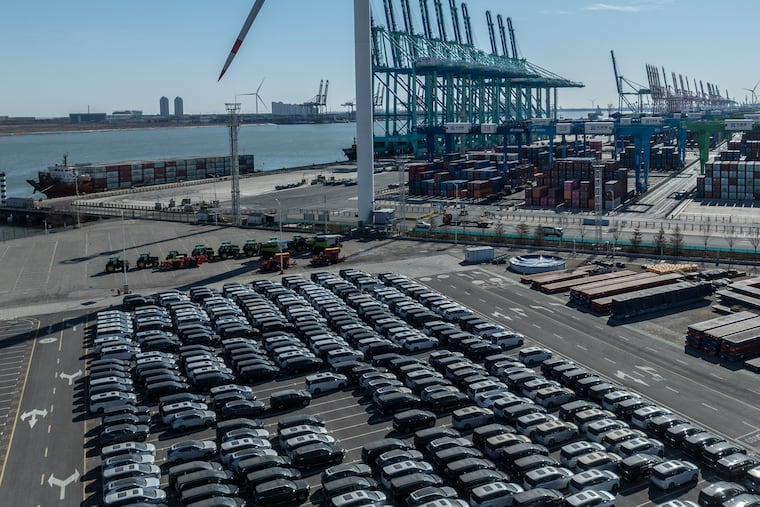
Eight years, a pandemic and two trade wars later, Trump is returning to Beijing, where the theme of future dominance, not ancient majesty, has filled domestic and international headlines with articles about dancing robots, drone swarms, and the quiet hum of electric vehicles.
China increasingly casts itself not as a fading civilization trying to catch up to the West but as a superpower poised to surpass it. Chinese nationalists and state-linked commentators say they have Trump to thank. America under his rule, they say, validates Xi’s worldview centered on “the rise of the East and decline of the West.”
For decades, many Chinese viewed the United States with a mix of admiration, envy, and resentment. America represented wealth, technological sophistication, and institutional confidence. Even critics of Washington who reviled the American system often assumed that it worked.
Trump’s ascent and his volatile second term shattered that image.
In January, a nationalistic Beijing think tank affiliated with Renmin University published a triumphant report about Trump’s first year back in office. The report argued that his tariffs, attacks on allies, anti-immigration policies, and assaults on the American political establishment had inadvertently strengthened China while weakening the United States. Its title: “Thank Trump.”
The report called Trump an “accelerator of American political decay,” with the United States sliding toward polarization, institutional dysfunction and even “Latin American-style instability.” His hostility toward China, the authors argued, was a “reverse booster” that unified the country and helped bring about its strategic self-reliance.
“At this turning point in history,” the authors wrote, “what we hear is the heavy and haunting toll of an empire’s evening bell.”
Such language, once confined largely to nationalist corners of the Chinese internet, has increasingly entered mainstream political discourse.
Evidence of this shift is measurable: The use of terms related to “American decline” in official Chinese sources nearly doubled in 2025, according to a study by two Brookings Institution researchers.
The narrative of American decline did not begin with Trump. For years, Chinese state media and nationalist pundits have highlighted mass shootings, homelessness, political polarization, and economic inequality in the United States as evidence of the failures of Western democracy. More recently, official outlets embraced the viral phrase “kill line,” borrowed from video game culture, to describe what they portrayed as the irreversible downward spiral facing America’s working poor. It’s a familiar tactic of the Communist Party to distract the Chinese public from the country’s own issues.
But Trump’s return to office and his administration’s erratic decision-making in both domestic and foreign policy have supplied the propaganda machine with plentiful fresh material. Images of immigration raids, the Minneapolis shootings and bitter political infighting circulate widely on Chinese social media alongside triumphant commentary about American dysfunction. What once sounded to many educated Chinese like exaggerated propaganda increasingly feels, to some, observational.
A 31-year-old education consultant in northern China who advises families on overseas study told me that parents who had once aspired to Ivy League degrees for their children now saw America as “too chaotic.” A decade ago, more than 80% of his students considered the United States for study abroad, said the consultant, who asked me to use only his family name, Wang, for fear of government retribution. Now, he estimated, the figure has fallen to 45%.
Wang described watching footage of the Jan. 6, 2021, attack on the U.S. Capitol and finding himself thinking of the Red Guards that Mao Zedong dispatched to tear apart China’s institutions during the Cultural Revolution. That feeling returned more insistently with the immigration raids and the targeting of perceived enemies during Trump’s second term.
“The America that represented wealth, freedom and institutional confidence feels like it belonged to a different era,” Wang said.
Among China’s foreign policy analysts, the conversation has turned to what Beijing can gain from the bilateral relationship, which has become more transactional under Trump than under President Joe Biden.
“Only China can save Trump,” said Huang Jing, a professor at Shanghai International Studies University, during a media event that was livestreamed in late 2025. With the U.S. midterm elections approaching, he argued, Trump needed visible wins such as Chinese purchases of American soybeans, corn, and natural gas that could play well in swing states.
“Since Trump,” Huang said at the event, “the United States has become increasingly prone to compromise.”
Wu Xinbo, a leading U.S. studies scholar at Fudan University, offered a similar assessment. If Republicans lose control of the House this fall, he said at the same event, Trump is likely to pivot toward his foreign policy legacy, creating space for a larger accommodation with Beijing.
China, he said, “should make good use of this opportunity.”
The war in Iran has reinforced the view that China has the upper hand with Trump. At a conference in late April, Wu argued that the war reduced Washington’s leverage against China while increasing Beijing’s by consuming U.S. military and diplomatic attention in the Middle East.
The logic helps explain why China’s official language regarding Trump has often been less hostile than it was regarding Biden. According to a project by the Tracking People’s Daily newsletter, which used artificial intelligence to analyze nearly 7,000 Chinese official statements since 2021, Biden was presented as a more systemic threat — so serious that Xi accused Washington of “encirclement and suppression,” unusually confrontational language for a Chinese leader.
By contrast, the study noted, “Trump’s transactionalism is something Beijing understands and can work with.”
Yet belief in U.S. decline has not translated into aggressive Chinese foreign policy, at least not the kind of overt geopolitical gamble that Russia made before invading Ukraine.
China has become more assertive, pressuring U.S. allies, expanding military activity around Taiwan and restricting rare-earth exports in response to Trump’s tariffs. But even as China advances the idea of the decline of American power, it appears wary of directly confronting what many Chinese analysts describe as a still dangerous superpower.
Two factors play into this circumspection. First, many Chinese strategists believe Beijing can do better by sitting back while the Trump administration fumbles. Second, an unstable and distracted United States may also be a more unpredictable one.
China’s export-dependent economy needs a stable international order to function. An erratic United States threatens that stability in ways a confident, predictable America never did, Zongyuan Zoe Liu, an economist at the Council for Foreign Relations, told me.
Xi “is getting the United States he always wanted,” she said, “and the America he most feared at the same time.”
This article originally appeared in The New York Times.