Xi poised to press Trump on arms sales to Taiwan
Xi’s main focus in raising Taiwan will probably be to persuade Trump to slow, or ultimately reduce, U.S. arms sales to the island, experts from China and Washington have said.
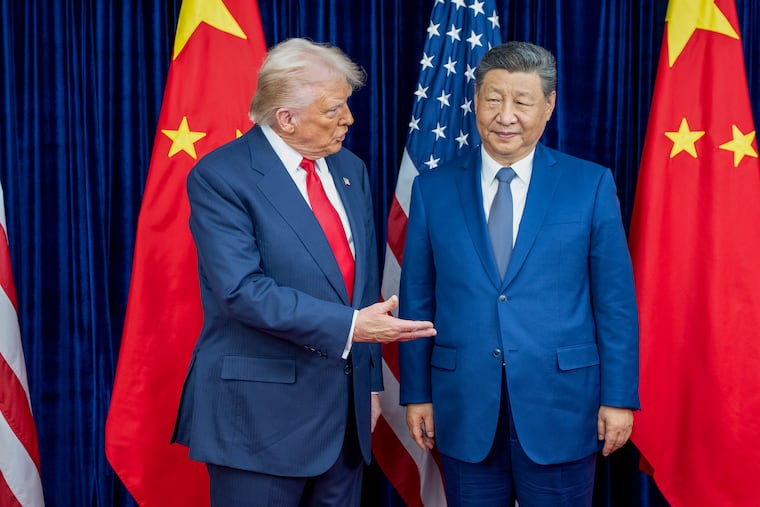
The United States’ stance on Taiwan has rested for decades on a complex latticework of policies designed to support the island democracy while avoiding treating it officially as an independent country, a step that would enrage Beijing.
Many in Taiwan are holding their breath for what may happen to that delicate structure when President Donald Trump, with his off-the-cuff, transactional ways, meets China’s leader, Xi Jinping, in Beijing for a two-day summit starting Thursday. Xi appears poised to lecture Trump on U.S. support for Taiwan, especially weapons sales.
Trump and his officials have said that his trip to Beijing will be focused on trade and investment. But China’s foreign minister, Wang Yi, and other officials have indicated that they also expect the two presidents to discuss Taiwan, the issue that could most likely ignite a war between their countries. China claims Taiwan is its territory, and could use armed force to take it, while the United States says it could intervene to defend Taiwan, a longtime partner.
Beijing’s expectations
“The Taiwan question is at the very core of China’s core interests,” Lin Jian, a spokesperson for China’s Foreign Ministry said last week when asked if the issue would be a priority for Xi at the summit.
Taiwan often comes up in talks between Chinese and U.S. leaders. But the summit’s setting in Beijing will give Xi more opportunity and time to make his case, said Ryan Hass, a former director for China at the National Security Council.
Xi may try to persuade Trump to say that he opposes Taiwanese independence. That could be a setback for Taiwan’s president, Lai Ching-te, though he has said he has no plans to declare independence. Successive U.S. presidents have said they “do not support” independence for Taiwan. Declaring “opposition” may suggest greater sympathy with Beijing’s view that Lai’s government is the side stirring up trouble, experts said.
“It could be easily used by China to claim that the U.S. is taking Beijing’s side, and even create new diplomatic pressure on Taiwan,” said Chen Kuan-ting, a lawmaker from Lai’s Democratic Progressive Party.
Large U.S. arms purchases at stake
Xi’s main focus in raising Taiwan will probably be to persuade Trump to slow, or ultimately reduce, U.S. arms sales to the island, experts from China and Washington have said. In a phone call in February, Xi urged Trump to handle the issue of arms sales with “extreme caution.”
The Trump administration approved $11 billion in arms sales to Taiwan late last year, drawing condemnation from Beijing, which quickly held a two-day military exercise near Taiwan. Another arms sale package worth around $14 billion is awaiting final approval from Trump, who has held off making a decision for months already.
China wants Trump to delay approval, and ultimately to persuade him and his successors to roll back broader military support to Taiwan, said Xin Qiang, the director of the Center for Taiwan Studies at Fudan University in Shanghai.
“But China also knows that’s difficult right now,” he said, “so they hope at least for delays and then a reduction — a reduction in the monetary value of the arms, in the scale, in the quality of the weapons sold.”
China’s economic levers
Xin acknowledged that coaxing Trump to significantly curtail U.S. arms sales would be a long shot. But if the U.S. sells more weapons to Taiwan, he added, “China certainly won’t be as enthusiastic about purchasing goods from the United States like agricultural products or Boeing aircraft.”
Many in Washington, including from both parties in Congress, support weapons sales to Taiwan. Taiwanese lawmakers last week approved a $25 billion special budget to cover the two big weapons packages, including the one waiting in the wings, adding to pressure on Trump. In a letter sent Friday, a bipartisan group of eight U.S. senators urged Trump to move ahead on it.
Secretary of State Marco Rubio, who will accompany Trump to Beijing, last week brushed off speculation that the summit could produce a shift in U.S. policy toward Taiwan. “The Chinese understand our position on that topic. We understand theirs,” Rubio said at a news conference at the White House.
Taiwanese officials have taken reassurance from such comments.
“The U.S. continues to reiterate in both public and private settings that its policy toward Taiwan has not changed,” Tsai Ming-yen, the director-general of Taiwan’s National Security Bureau, told lawmakers in Taipei last week.
Still, Xi could hold out the lure of economic deals and more summits later this year, including in Washington, to try to get Trump to hold back on the latest proposed arms package, said Hass, the former National Security Council official, now a China expert at the Brookings Institution.
“As a result, I have low expectations that Trump will approve another tranche of arms sales to Taiwan between now and this fall,” he said.
This article originally appeared in The New York Times.