U.S. anniversary coins won’t feature any Black Americans or notable women
Over three years, the U.S. Citizens Coinage Advisory Committee sifted through hundreds of ideas for commemorative coins for the 250th anniversary of America’s founding. Their ideas were rejected.
Over three years, the U.S. Citizens Coinage Advisory Committee sifted through hundreds of ideas for commemorative coins to celebrate the 250th anniversary of America’s founding.
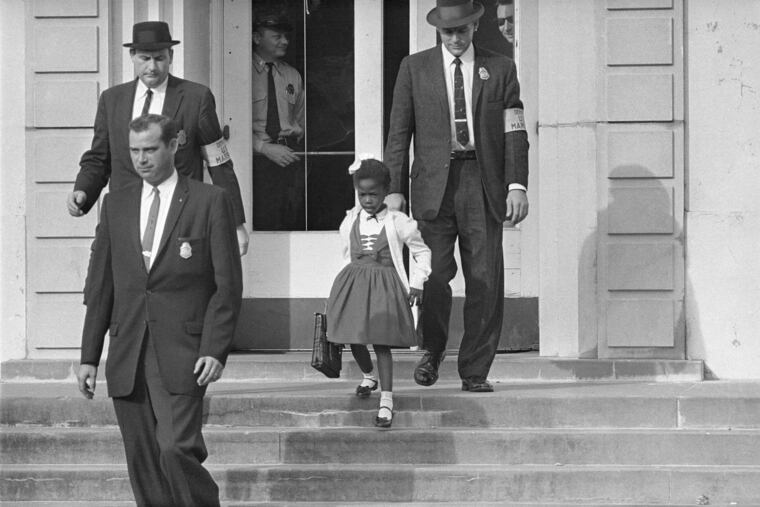
The group settled on five options, including quarters honoring abolitionist Frederick Douglass; Ruby Bridges, a 6-year-old girl who helped integrate public schools in New Orleans; and the women’s suffrage movement.
“The question was do we focus only on what happened in 1776 and the years around that or do we also talk about everything that has happened since then,” said Lawrence Brown, a retired New York City doctor who served on the committee from 2019 to 2024.
“To me, the latter is just as important if not more important because it gives us answers to the questions of how did we maintain that Constitution? How did we maintain our independence?”
In a preview of the Trump administration’s approach to celebrating the country’s 250th birthday, Treasury Department officials announced this month that the agency would ignore the committee’s recommendation and produce quarters that are far less diverse and more traditional. Instead of addressing the country’s racial history, the five coins will feature images of former presidents George Washington, Thomas Jefferson, James Madison, and Abraham Lincoln, as well as a Pilgrim couple.
The Biden administration was focused on diversity, equity and inclusion, and critical race theory, U.S. Treasurer Brandon Beach told Fox News, but the “Trump administration is dedicated to fostering prosperity and patriotism.”
“The designs on these historic coins depict the story of America’s journey toward a ‘more perfect union,’ and celebrate America’s defining ideals of liberty,” Kristie McNally, acting director of the U.S. Mint, said in a statement.
The administration is also considering a commemorative dollar with President Donald Trump’s face on one side and his raised fist with the words “FIGHT FIGHT FIGHT” on the other, a reference to the widely circulated image of the president following an assassination attempt in 2024. Democratic senators have decried the idea as “un-American” and introduced legislation to prohibit “the likeness of a living or sitting president” from appearing on American currency.
The nation’s semiquincentennial offers Trump a rare, high-profile opportunity to shape how Americans understand the country’s history. In addition to the coins, the Post Office is expected to announce commemorative stamps, and the National Endowment for the Humanities is offering up to $200,000 to fund new statues of historical figures.
The new coin designs reflect the Trump Administration’s focus on exalting the country’s pre-civil rights history and depicting idealized images of American life. It is part of an effort to rewrite the past with an exclusionary view of American history, some historians said.
The White House is working with PragerU, a nonprofit that produces educational videos and is known for taking a conservative view of American history, to organize educational initiatives and “freedom trucks,” mobile museums that will be driven across the country during semiquincentennial celebrations.
In September, the administration announced the opening of the Founders Museum in Washington, which has been criticized by historians for its use of AI-generated material and its exclusion of nonwhite voices from the nation’s past. The administration is encouraging educators to re-create the exhibit at their schools with printable versions of the portraits and labels.
“The goal is to instill a sense of patriotism in young Americans,” said Allen Estrin, co-founder of PragerU. “If we don’t have an appreciation of our past, it’s going to be very difficult to imagine a bright future.”
Andrew Rudalevige, a professor of government at Bowdoin College, said that it is not unusual for presidents to put their stamp on historical events and tie them to their agendas. But by working so closely with ideological groups and focusing on issues like DEI, Trump is risking infusing partisan politics into the semiquincentennial and turning off half the country, he said.
“I’d be very happy for more people to read the founding documents and seriously engage with the arguments that founders were making,” Rudalevige said. “But I think unfortunately it’s likely that the celebration is going to be pushed into the same culture wars and the same polarization that seems to affect so much of the country right now when it ought to be a time when we could rise above that.”
Dean Kotlowski, a historian who served on the Citizens Coinage Advisory Committee from 2018 to 2023, said the new coins are part of the administration’s efforts to derail a campaign to diversify the faces on America’s money. “The whole idea was to get away from this kind of presidential history but these coins are very, very traditional,” Kotlowski said.
The committee, which was established by Congress in 2003, began working on coins to celebrate the country’s 250th birthday after Trump signed the Circulating Collectible Coin Redesign Act during the waning days of his first term. The law called for the creation of five quarters, including at least one featuring a woman.
The 11-member committee worked with the National Archives, National Park Service, and historians to develop themes and designs for the coins. They conducted online polls and solicited public comment. The process culminated in a two-day public hearing in October 2024 before the panel submitted its final recommendations to then-Treasury Secretary Janet L. Yellen.
Among the designs recommended for the quarter featuring Bridge is an image immortalized in Norman Rockwell’s 1964 painting of her being escorted to school by U.S. marshals with the words “We Shall Overcome.” The committee chose a portrait of Frederick Douglass that, it said, “conveys his strength as a symbol of the abolition movement.” A third coin celebrating the women’s suffrage movement included a protester carrying a “Votes for Women” flag.
The remaining two quarters would feature images of the Declaration of Independence and the U.S. Constitution.
“The process, as it was supposed to happen, is very well-informed, very public, and taken very seriously,” said Dennis Tucker, who took part in the deliberations during his tenure on the committee from 2016 to 2024. “It’s not clear what went into this decision.”
Trump has been on a campaign to restore what he calls “patriotic education” to the country’s national parks, monuments, and museums. Signs and exhibits related to slavery have been removed from multiple national parks with Trump arguing that they overemphasize the negative aspects of American history. The administration cut funding to small archives and museums across the country but later restored grants to those aligned with Trump’s vision for the celebration of the 250th anniversary.
During his first term, his administration halted efforts to put Harriet Tubman on the $20 bill, with Trump criticizing the Obama-era decision as “pure political correctness.”
David Ekbladh, a professor of history at Tufts University, said Trump’s focus on advancing a traditional version of history has intensified since his first term. “During his first administration, Trump pardoned Susan B. Anthony,” Ekbladh said. In 1872, nearly 50 years before women gained the right to vote, Anthony was arrested for wrongfully and willfully voting.
“But now, even the suffragists are seen as outside the pale of what they want as part of our remembered past.”