Trump appears to back away from threats to Colombia’s president
An abrupt change in tone came when the two leaders agreed to meet during a friendly phone call.
BOGOTÁ — Two days after publicly weighing an invasion of Colombia, President Donald Trump appeared to call it off on Wednesday night.
He said he had spoken to an erstwhile nemesis, Colombian President Gustavo Petro. Trump had previously called Petro a “drug leader” who “better watch his ass.” But after the Wednesday night call, Trump wrote on Truth Social: “I appreciated his call and tone.” The two men agreed to meet in Washington.
It was the most recent jolt to one of the Western Hemisphere’s closest relationships. Days earlier, when Trump said that invading Colombia “sounds good to me,” he was threatening to attack a top recipient of U.S. military assistance.
On Thursday morning, as tensions appeared to ease, Petro reflected on the call, which he said in an X post was brokered by Sen. Rand Paul (R., Ky.) and lasted for 55 minutes.
“I know that President Trump doesn’t agree with me, but it’s more convenient to start a dialogue … than to settle it on battlefields,” he wrote.
No country in Latin America has a closer partnership with the Pentagon. The two countries share intelligence daily; U.S. military liaisons are fixtures in Colombia’s Defense Ministry; and the United States has vetted specialized units within Colombia’s military and police, according to past statements by both governments.
Yet, as the relationship between Trump and Petro deteriorated, the countries found themselves in the bizarre position of historic partners whose leaders were acting as if preparing for war.
In the wake of the U.S. seizure of Venezuelan President Nicolás Maduro, analysts and Colombian officials said they couldn’t entirely discount Trump’s threats to Colombia, even though they seemed profoundly unlikely. Trump called Petro a “sick man who likes making cocaine and selling it.”
In response, Petro said he was preparing his “people” to defend him “from any illegitimate violent act.” A former rebel, he said in a post on X that “for the sake of the fatherland I will take up weapons again.” He sent 30,000 troops to the Venezuela border.
Colombia’s Foreign Ministry did not respond to requests for comment. On Tuesday, the country’s foreign minister, Rosa Villavicencio, said at a news conference that it would respond militarily to any U.S. “aggression.”
“For that, we have a very well-trained army,” Villavicencio said.
The threat of war between the two allies “boggles the mind,” said Adam Isacson, the head of the defense oversight program at the Washington Office on Latin America, a think tank.
“These two countries have had an intimate relationship going back to the Korean War,” Isacson said. “Colombia modeled its joint military structures after [the] U.S. It’s hard to imagine closer relations.”
Trump has frequently pointed to Colombia’s failure to crack down on cocaine exports. In 2023, a U.N. report said coca was being cultivated on 253,000 acres in Colombia, a record high. It was more than half of the global coca crop. On the Wednesday night call, Petro said he “laid out my policy against the narcos that spans nearly 20 years.”
While experts say Petro’s drug policy does bear some responsibility for that growth, there is no evidence that he is complicit in the trafficking of drugs. Still, Trump had appeared to be modeling his accusations against Petro after the drug case the Justice Department built against Maduro, which culminated in a 25-page indictment.
“He better wise up or he’ll be next,” Trump said of Petro last month, suggesting to target Colombia in a possible expansion of the military buildup and antidrug trafficking operations directed at Venezuela.
Petro had been seen by some as having gone out of his way to antagonize Trump over the past year. In September, he spoke at a protest in New York City about the immorality of some U.S. military missions.
“I ask all soldiers in the United States Army not to point their rifles at humanity,” Petro said through a megaphone. “Disobey Trump’s order! Obey the order of humanity!” The U.S. said it later suspended his visa.
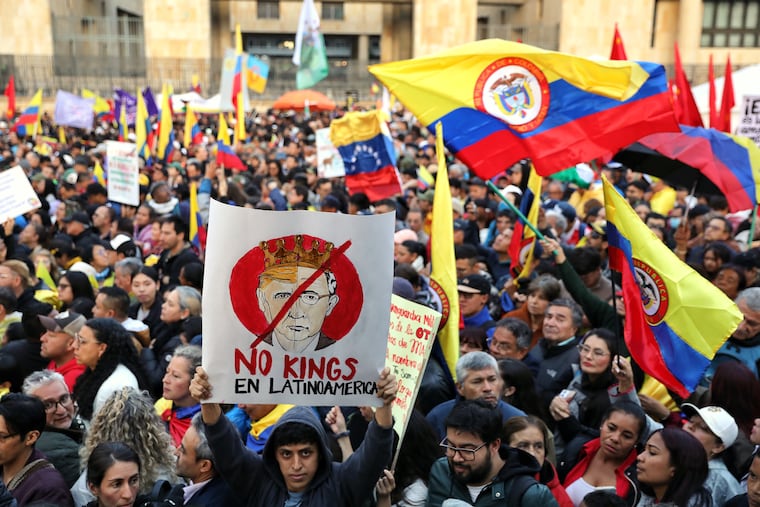
It was the kind of spectacle that many Colombians saw as a political stunt — an effort by Petro to use his vocal opposition to Trump to animate his leftist base. Petro has announced a national demonstration in Bogotá on Wednesday in response to Trump’s comments and “to defend national sovereignty.”
Petro’s term expires later this year, and Colombia’s constitution does not allow him to seek a second consecutive term — another reason many here had doubted that Trump would attempt to capture him. In his Truth Social post on Wednesday, Trump said the White House meeting between the two men would take place in the “near future.”
Petro wrote on X: “Now we have to see the consequences of the reestablishment of diplomatic conversation.”
If that meeting goes poorly — which some experts expect it might — Trump’s threats against Petro could affect the next Colombian election, which will take place in May. Already, opponents of Petro’s coalition are arguing that the next president should be someone who won’t antagonize the U.S., given the political and economic risks.
“Right and center-leaning candidates are telling voters that Petro has been derelict in managing the country’s most important bilateral relationship,” said Elizabeth Dickinson, the deputy director for Latin America at International Crisis Group.
Iván Cepeda, the candidate who will represent Petro’s coalition, has rebuffed Trump’s comments about Petro, writing on X that Colombia is not “a colony or a protectorate of the United States.”
In addition to targeting Maduro, Trump has proved increasingly willing to intervene in Latin American elections to prevent leftist candidates from winning. The candidate he endorsed in Honduras, Nasry Asfura, won the election there by a razor-thin margin after Trump suggested that he would cut aid to the country if Asfura lost.
On Monday, as if to summarize Trump’s evolving foreign policy in the region, the State Department posted on X a photo of Trump with the words: “THIS IS OUR HEMISPHERE.”