Three words in the Declaration of Independence paint a cruel picture of Natives
As the United States marks the 250th anniversary of the Declaration, Native American scholars and tribal leaders are reflecting on the Founding Fathers’ use of the derogatory description.
McKaylin Peters, a 24-year-old Native American graduate student at Johns Hopkins University, still recalls when she first heard the words “merciless Indian savages.”
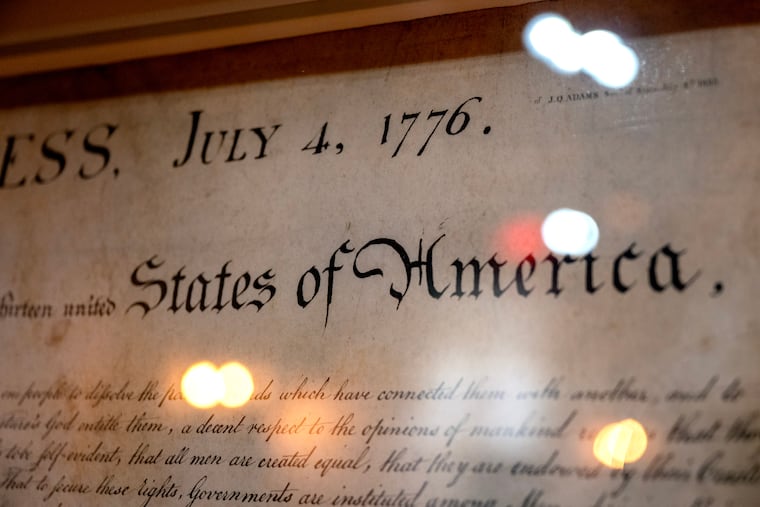
Sitting in social studies class at her predominantly White middle school near Green Bay, Wisconsin — a school that once used an image of an Indian as its mascot, she cringed when the teacher read a passage deep in the Declaration of Independence: “He has excited domestic insurrections amongst us, and has endeavoured to bring on the inhabitants of our frontiers, the merciless Indian Savages, whose known rule of warfare, is an undistinguished destruction of all ages, sexes and conditions.”
Peters said she and the six other Native students in the class looked quietly at one another.
“I was upset. It just rolled off her tongue very easily,” recalled Peters, a citizen of the Menominee Nation who is getting her master’s in organizational leadership. “It seemed like no one else was shocked except for us, the Indigenous students in the classroom. We were like, ‘Did she really just say that?’”
As the United States marks the 250th anniversary of the Declaration — a document fundamental to the nation’s founding and still revered — Peters and other Native American scholars and tribal leaders are reflecting on the Founding Fathers’ use of the derogatory description for Indigenous people in 1776. Many note that while the Declaration promises that “all men are created equal,” its ideals were not extended to everyone.
The document’s portrayal of Indigenous people helped establish a moral and legal framework that justified decades of devastating U.S. policies toward Native communities, according to historians. Celebrations of the 250th anniversary of the Declaration’s signing come amid a striking contrast: Native tribes are working to reclaim ancestral lands, revive lost languages and preserve cultural traditions, while the Trump administration has sought to remove or downplay references to slavery, Native dispossession and other dark chapters of U.S. history in parks and museums and on government websites.
“It’s not just a line in an old document,” Peters said. “It’s a reminder that this country was built by declaring us less than human. When the Declaration of Independence calls us that, it’s a message that Native youth sadly still hear today in classrooms, policy debates and in how society talks about us.”
Many historians and Indigenous historians say the term “savages” did more than reflect 18th-century attitudes. It helped perpetuate stereotypes of Native Americans and contributed to their marginalization; centuries later, it adds to feelings, especially for Native youths, of being excluded from America’s national story. A 2022 study by Texas A&M University researchers found that the Declaration’s pejorative reference to Native Americans helped normalize a view of them as threats rather than as sovereign nations and peoples with rights.
For many Native people, the meaning — and impact — of the phrase is emotional and complicated.
Some discover the wording as adults and are appalled. Others see it as a reminder of racist attitudes and centuries of broken treaties, land theft and forced assimilation. Some young people have reclaimed the epithet, debating it on social media and displaying it on T-shirts and tattoos as a symbol of resilience and empowerment. An Indigenous-led heavy metal band intentionally used the phrase as its name.
“It’s become sort of an ironic touchstone,” said Kevin Gover, the Smithsonian Institution’s undersecretary for museums and culture. A citizen of the Pawnee Tribe of Oklahoma, Gover said he did not encounter the term until middle age. After his initial outrage, Gover said, he responded as many Native people do: by mocking it.
“Even we, on the side of the descendants of those who were victimized, have to take a nuanced view,” said Gover, who is also the former director of the National Museum of the American Indian in D.C. “In many respects, it’s a badge of pride that our ancestors had the wherewithal to survive and allow us to be alive in this time.
“We can acknowledge the wrong,” he said, “and be grateful for our ancestors’ fortitude.”
Hartman Deetz, an enrolled member of the Mashpee Wampanoag — the Massachusetts tribe that famously helped the Pilgrims survive their first Thanksgiving in 1621 — said the wording reflects the opposite of how Indigenous people treated White settlers.
“They were fed when they were starving, given hospitality by us, but they treated us in a way that was savage and merciless in the dispossession of our homelands,” said Deetz, who served as a consultant for an exhibition at the Museum of the American Revolution in Philadelphia about the Declaration and the history behind it. “It was framed in a way that justified the treatment they brought upon us, and it continues to this day in attempts to sell our sacred sites for copper mines and to drill for oil and mining on our lands.
“The colonial enterprise hasn’t stopped,” he said. “There’s such a disregard for Natives to exist or have rights of where we do exist. That’s the legacy of these words.”
The words originated in an early draft of the Virginia Constitution written by Thomas Jefferson, who later included it in the Declaration of Independence, which Congress adopted.
Ironically, some historians say, the characterization of Native people contradicts Jefferson’s own views. In “Notes on the State of Virginia," a book Jefferson wrote that laid out many of his views on race, government and religious freedoms, he was “very sympathetic to Native people,” said Kevin Butterfield, a historian at the Library of Congress. Jefferson described Indigenous people as just, honorable and noble — a sharp contrast to the widespread European belief that Indigenous people were inferior.
But Jefferson understood the Declaration was political rhetoric — a kind of “public relations piece,” said Butterfield, who is the acting chief of the Manuscript Division at the Library of Congress. He placed it near the end to bolster the case for independence.
“He’s trying to paint the worst possible picture of how the king is approaching his interactions with the American colonists,” Butterfield said. “So he’s laying out horrible wartime atrocities from the Revolutionary War.”
The description reflected colonial attitudes and the realities of frontier warfare, scholars say. Colonists were hostile toward Native Americans, who were powerful political and military figures and, just like other nations, protecting their sovereignty. Some Native nations had allied with the British — a move that many settlers resented — and many colonists also opposed King George III’s Proclamation of 1763, which barred settlement west of the Appalachian Mountains.
Repeated violence between Indigenous people and settlers also helped shape the ideology behind the description, including the French and Indian War and Dunmore’s War in 1774, when Virginia colonists fought the Shawnee and Mingo to expand into the Ohio Valley, according to historians. In the summer of 1776, as the Declaration was drafted and adopted, a lesser-known conflict unfolded when Cherokee warriors attacked frontier settlements across parts of Virginia, North Carolina, South Carolina and Georgia. Colonists responded by burning more than 50 Cherokee towns and driving Native people from their homes.
By 1776, the Founding Fathers “understood their need to accuse the king of what they considered the ultimate crime — partnering with Indigenous peoples and arming them,” said Ned Blackhawk, a Native American author and Yale University historian. “So they created this vilification in the Declaration that, in many ways, was at odds with their experience of living alongside Natives for generations.”
The rhetoric was part of a broader racial ideology taking shape during the Revolutionary era, said Blackhawk, an enrolled member of the Te-Moak Tribe of Western Shoshone Indians of Nevada.
“They were deeply committed to Enlightenment principles, but those were restricted to people similar to themselves,” he said. “Native Americans became a foil in simplified and racialized ways.”
Tracy L. Canard Goodluck, executive director of the Center for Native American Youth at the Aspen Institute, said she is disappointed the term is either glossed over or not taught in many school curriculums, its impact not discussed.
It wasn’t until she was a student at Dartmouth College, she said, that she fully understood the context of the description. She was angry, but the new knowledge also awakened in her a passion for educating others about Indigenous history and mistreatment. Goodluck, a member of the Oneida Nation who is also Mvskoke Creek, said in her previous work as a teacher in Seattle and Albuquerque she taught about Indigenous people and the harsh characterization in the Declaration.
“It shouldn’t just be about White history,” she said. “It should be about all history — the good, the bad and the ugly.”
She said it’s also important to educate the public, so every Fourth of July, she wears a T-shirt emblazoned with the phrase from the Declaration.
“Those words served the purpose back then as a way to dehumanize Native people in this country,” said Goodluck. “We need to change that narrative. We’re still here. We’re doctors, lawyers, teachers and political leaders.
“I am that merciless Indian savage who my ancestors prayed for to do great things.”