France reports first Ebola patient as cases in Africa surge above 1,000
Insufficient contact tracing and the refusal of many residents to avoid contact with the bodies of loved ones killed by the Ebola virus are accelerating the epidemic.
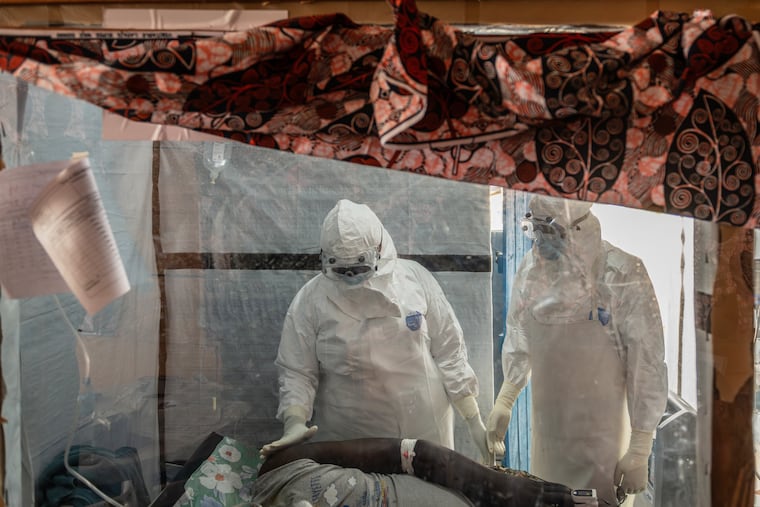
NAIROBI, Kenya — Reported Ebola cases have surged above 1,000 in the Democratic Republic of Congo, and health experts are warning this could be one of the worst outbreaks, rivaling the largest on record, which killed 11,365 people in West Africa from 2014 to 2016.
On Wednesday, French officials announced the country’s first case of Ebola from this outbreak — a doctor who had traveled to Congo on a humanitarian mission. The doctor was being treated at a special medical facility and was reported to be in stable condition, according to a statement from the French Health Ministry.
With more than 250 confirmed deaths in Africa, the World Health Organization said Tuesday that the current outbreak, first reported in May, has the largest number of confirmed cases during the first month of any Ebola outbreak in Africa.
There have been 17 outbreaks since the discovery of the virus in 1976, involving three strains. The current strain, Bundibugyo, has been seen only twice before, in 2007 in Uganda and in 2017 in Congo. There is no specific treatment or vaccine for it.
“None of those previous outbreaks had the magnitude of the volume of cases and geographical spread that we are seeing today,” said Manuel Albela, an epidemiologist with Doctors Without Borders who is working with the Ebola response team.
“And even that comparison — again, one month into the declaration of the outbreak — it falls short, because we have never seen almost 900 confirmed cases just after one month of the declaration of the outbreak,” Albela said. “Going back to the comparison with the outbreak in West Africa, it’s a very similar situation because we don’t have a specific treatment for this specific virus.”
Diagnosing Bundibugyo is complicated, because there is no specific test kit for the rare strain and this is one reason the strain initially spread fast without detection.
The virus is now present in at least three eastern provinces in Congo. Ituri province, the epicenter, has recorded 954 confirmed cases, with 91 more in North Kivu province and three in South Kivu province, according to government data released Sunday, with 267 people reported dead.
In neighboring Uganda, 20 infections and two deaths have been reported.
Misinformation and distrust about the virus have complicated the response, leading many infected people to refuse treatment.
Health workers have been attacked during contact tracing and when relatives are denied access to the infected bodies of their loved ones.
On Friday, in the Mambangu neighborhood of Beni, angry residents attacked workers who went to disinfect the home of someone who died of Ebola, according to said Serge Kambale, 39, a doctor who spoke to the Washington Post by phone from the city.
During the incident, two workers were injured when the locals started throwing stones at them. Fabrice Kavono, a witness, said that the crowd attacked the health workers and accused them of fabricating the disease for material gain.
“It is the second time Ebola is in Beni, but they say it’s in Bunia and Mongbwalu only and that they are making it up here to make money,” Kavono said.
Another witness told the Post that people with relatives in Mongbwalu, the mining town in Ituri province at the center of the outbreak, were fleeing in droves to relatives in parts of North and South Kivu — spreading the virus as they traveled.
Onesphore Bangenza, the leader of the Ebola Response Team in Bunia for Mercy Corps, a nonprofit group, said that burials in which relatives insisted on washing bodies of loved ones and touching them were still happening, and that residents were not adhering to distancing guidelines.
“We have motor taxis transporting more than three people,” Bangenza said. “There are people who do not want to be tested. The scale of the outbreak could be larger.”
In May, 30 people who had exhibited Ebola-like symptoms died at a displacement camp in Kigonze that hosts families fleeing conflict in the region, Reuters reported.
Two aid workers confirmed that 13 deaths had been reported at the camp within 48 hours and that more 30 total deaths were expected.
“The constant movement and overcrowding of refugees in camps is causing fear that this virus could spread even more and the scale of the outbreak may grow” Bangenza said, adding that conditions in the camps were abysmal. “No water, no latrines,” he said. “The hygiene condition is very, very bad.”
New Ebola cases have been reported in cities such as Beni where an ISIS-affiliated rebel group, the Allied Democratic Forces, has waged attacks, prompting families to flee their homes.
At a local hospital in Beni, a patient admitted with malaria asked to be discharged early because he feared that others at the hospital would have Ebola and infect him, he told the Post. While he was in the hospital, the ADF attacked an area near the hospital, killing seven people.
“First, I was afraid that because I exhibited malaria symptoms, which are similar to Ebola, I would be assimilated with people with Ebola,” the patient said, speaking on the condition of anonymity to discuss private health matters. “In the small hospital, there is no clear follow-up, so anything can happen. Then, the attack scared me more.”
Congo has been besieged by years of conflict especially in the mineral-rich eastern regions of the country, which boast the world’s largest deposits of coltan and cobalt, used to manufacture electronics.
Cycles of violence have also weakened health systems in the region.
Just last week, protests broke out in Kinshasa, Congo’s capital, after people learned of a proposal to change the constitution to allow an extension of term limits, which would allow President Félix Tshisekedi to stay beyond his current term, which was supposed to be his last.
The Rwanda-affiliated M23 rebel group was working with health teams after two cases of Ebola were discovered in Goma, a city that M23 controls, the group’s deputy spokesperson, Oscar Balinda, told The Post. M23 controls large swaths of territory in eastern DRC.
The United States has sent $375 million in aid, so far, to contain this latest Ebola outbreak, Trump said during a recent Group of Seven meeting in France.
Experts say more must be done contain the outbreak.
“One of the key factors to try to control an outbreak of Ebola is to decentralize as much as possible the testing capacity, so that the tests can be done in the places where the cases are,” said Abela, the epidemiologist. “And I think that this, little by little, is happening. But, as usual, we want things to happen yesterday.”
Abela also said that contact-tracing is crucial but not enough is being done. “At the moment, I think there are 70 percent of the contacts being followed up when the target is normally 95 percent, according to the DRC authorities.”
He added: “This is clearly one of the gaps.”