Police in Britain arrest former ambassador Mandelson in probe into Epstein ties
British investigators are looking into allegations he passed sensitive government information to the late sex offender.
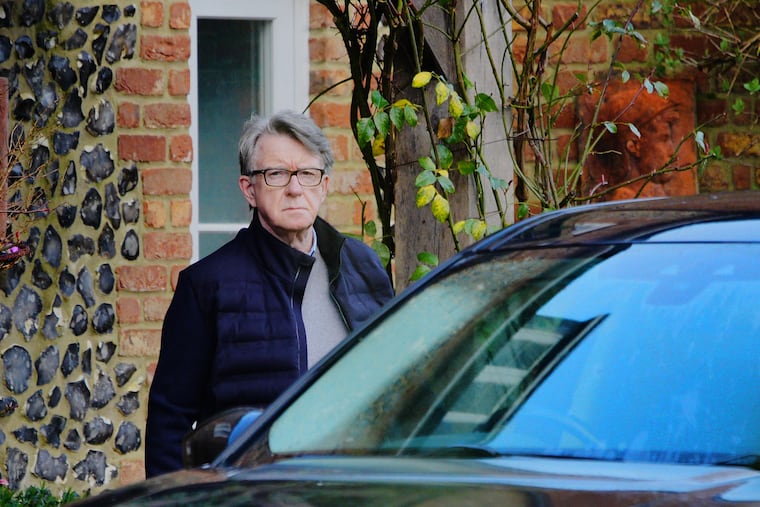
LONDON — British police on Monday arrested Peter Mandelson, a former U.K. ambassador to the United States, in a misconduct probe stemming from his ties to the late Jeffrey Epstein. It came days after a friendship with Epstein landed the former Prince Andrew in police custody.
Both men are suspected of improperly passing U.K. government information to the disgraced U.S. financier, and the high-profile British arrests are some of the most dramatic fallout from the trove of more than 3 million pages of Epstein-related documents released last month by the U.S. Justice Department.
London’s Metropolitan Police force said “officers have arrested a 72-year-old man on suspicion of misconduct in public office” at an address in north London. He was taken to a police station for questioning.
The man was not named, in keeping with British police practice, but the suspect in the case previously was identified as the former diplomat, who is 72. Mandelson was filmed being led from his London home to a car by plainclothes officers on Monday afternoon.
Under U.K. law, police can hold a suspect without charge for up to 24 hours. This can be extended to a maximum of 96 hours. Mandelson could be charged, released unconditionally, or released while investigations continue.
Claims of leaked government information
Police are investigating Mandelson over claims he passed sensitive government information to Epstein a decade and a half ago. He does not face allegations of sexual misconduct.
His arrest came four days after Andrew Mountbatten-Windsor, the former Prince Andrew, was arrested in a separate case on suspicion of a similar offense related to his friendship with Epstein. Andrew was released after 11 hours in custody while the police investigation continues.
Mandelson served in senior government roles under previous Labour governments and was U.K. ambassador to Washington until Prime Minister Keir Starmer fired him in September after emails were published showing that he maintained a friendship with Epstein after the financier’s 2008 conviction for sex offenses involving a minor.
The files released in January contained more explosive revelations about Mandelson’s ties to Epstein, whom he once called “my best pal.”
Messages suggest that Mandelson passed on sensitive — and potentially market-moving — government information to Epstein in 2009, when Mandelson was a senior minister in the British government. That includes an internal government report discussing ways the U.K. could raise money after the 2008 global financial crisis, including by selling off government assets. Mandelson also appears to have told Epstein he would lobby other members of the government to reduce a tax on bankers’ bonuses.
British police launched a criminal probe earlier this month and searched Mandelson’s two houses in London and western England.
The decision to appoint Mandelson nearly cost Starmer his job earlier this month, as questions swirled around his judgment about someone who has flirted with controversy during a decades-long political career.
Though he acknowledged he made a mistake and apologized to victims of Epstein, Starmer’s position remains precarious. His future may rest on the release of files connected to Mandelson’s appointment. The government has pledged to begin releasing those documents in early March, though the timeline may be complicated by his arrest.
Mandelson a contentious figure
Mandelson has been a major, if contentious, figure in the center-left Labour Party for decades. He is a skilled — critics say ruthless — political operator whose mastery of political intrigue earned him the nickname “Prince of Darkness.”
The grandson of former Labour Cabinet minister Herbert Morrison, he was an architect of the party’s return to power in 1997 as centrist, modernizing “New Labour” under Prime Minister Tony Blair.
Mandelson served in senior government posts under Blair between 1997 and 2001, and under Prime Minister Gordon Brown from 2008 to 2010. In between, he was the European Union’s trade commissioner. Brown has been particularly angered by the revelations and has been helping police with their inquiries.
Mandelson twice had to resign from government during the Blair administration over allegations of financial or ethical impropriety, acknowledging mistakes but denying wrongdoing.
He later returned to government and was back on the political front line when Starmer named him ambassador to Washington at the start of U.S. President Donald Trump’s second term. Mandelson’s trade expertise and comfort around the ultra-rich were considered major assets. He helped secure a trade deal in May that spared Britain some of the tariffs Trump has imposed on countries around the world.
The status of the deal is now up in the air after Trump announced a new set of global tariffs in the wake of a U.S. Supreme Court decision quashing his previous import tax order.
Earlier this month Mandelson resigned from the House of Lords, Parliament’s upper chamber, to which he was appointed for life in 2008. But he still has the title — Lord Mandelson — that went with it.