Epstein victims demand meeting with King Charles in Washington
Palace officials have said the king and queen would be unable to meet with victims while investigations of the former prince, Andrew, are underway.
LONDON — A state visit by a British monarch is typically an exercise in flummery, smooth diplomacy, and a royal spectacle. But King Charles III and Queen Camilla’s trip to Washington later this month risks being overshadowed by mounting calls for him to meet victims linked to the late financier and sex offender Jeffrey Epstein, whose ties to the king’s younger brother, Andrew, have stirred ongoing controversy.
“We strongly urge King Charles to meet with us and survivors and hear what we have to say,” the family of Virginia Giuffre wrote in an email to the Washington Post, adding to the growing pressure on Buckingham Palace ahead of the trip. Giuffre, who died by suicide last year, said she was trafficked by Epstein to then-Prince Andrew and forced to have sex with him on three occasions, the first time when she was 17 years old.
The royal visit is intended to commemorate 250 years of American independence and, perhaps, to help steady relations at a time of strain in the trans-Atlantic alliance.
President Donald Trump recently labeled Prime Minister Keir Starmer as “no Winston Churchill” over Britain’s reticence to get involved in the war against Iran. The broadsides appear not to have damaged Starmer, with some commentators describing his stance as a Love, Actually moment — a reference to the 2003 film in which Hugh Grant plays a U.K. prime minister who stands up to a bullying U.S. president.
The palace has yet to release full details of the visit.
But moments after Buckingham Palace announced it would take place in late April, with exact details to be confirmed in due course, Trump posted on social media that it would run from April 27 to 30 and would include a “beautiful Banquet Dinner.” Congressional leaders have also invited the king to address a joint meeting of Congress.
What is designed as a ceremonial visit, however, risks becoming a test of the monarchy’s willingness to confront one of the royal family’s most difficult and persistent controversies.
The former prince, now known as Andrew Mountbatten-Windsor, relinquished his Duke of York title last fall after excerpts were made public from Giuffre’s memoir in which she wrote that she was forced to have sexual encounters with him as a teenager. As scrutiny intensified, Charles stripped Andrew of his prince title and forced him to vacate his residence at Royal Lodge.
In January, when the Justice Department released documents related to the case of Epstein, who died in prison in 2019, they included photographs of a man, apparently Andrew, crouching over a female lying prone on the floor. In February, Andrew was arrested on suspicion of misconduct in public office, related to his work as a global trade envoy for the British government.
When Charles stripped Andrew of his prince title and other honors, the palace said that “their Majesties” — in the plural — wished to make clear that “their thoughts and utmost sympathies have been, and will remain with, the victims and survivors of any and all forms of abuse.”
For families and survivors, the issue now is whether those words carry weight beyond symbolism.
Survivors, relatives, and politicians are urging the king and queen to make time publicly to meet with victims during the trip.
Brad Edwards, a lawyer for a second woman who claims she was sent to the United Kingdom by Epstein for a sexual encounter with Andrew, said in an email that “it is clear that Prince Andrew’s access to Epstein’s victims was made possible by his connection to the Royal Household. The Palace has publicly expressed sympathy for the victims, which we initially took at face value.
“Unfortunately, those statements have proven to be performative — effectively window dressing — as the king and the palace, through lawyers, have made clear that they will not meet with the victims,” Edwards wrote. “If the Palace meant what it said, then the Palace should and would engage. But it won’t.”
Sigrid McCawley, another lawyer representing victims, said in a statement, “An audience with King Charles for survivors would be a step in the right direction by the monarch in acknowledging the wrongs that were committed by one of their own but were hidden from the public for far too long.”
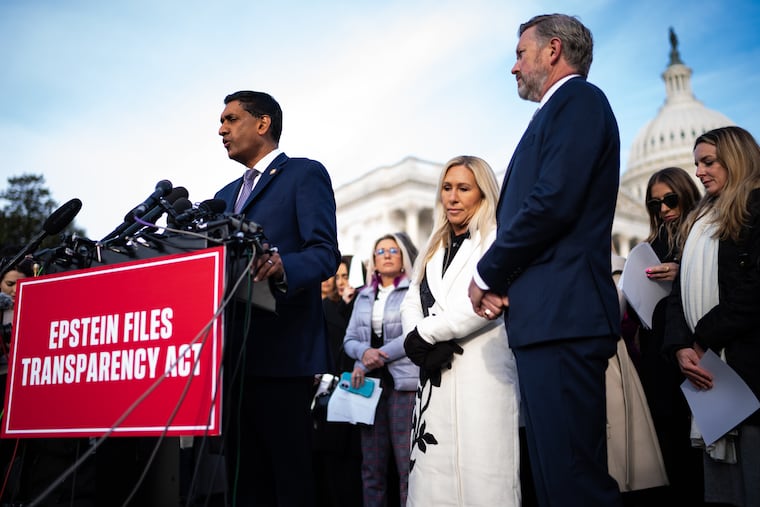
Rep. Ro Khanna (D., Calif.), a co-sponsor of the Epstein Files Transparency Act, has written to Charles to request that he meet with victims during his U.S. visit to discuss “how powerful individuals and institutions failed them.”
“As you are aware, this is not solely an American matter,” Khanna wrote in his letter posted on social media. He pointed to Epstein’s ties to the U.K. through his British girlfriend Ghislaine Maxwell and other “British public figures.”
The issue has also surfaced in Westminster. This week, Starmer was asked at a news conference if there was a “moral case” for the king to meet the victims. Starmer sidestepped the question, saying instead that the focus would remain on the 250th anniversary of American independence.
The issue has been made more pointed by Queen Camilla’s long-standing advocacy for survivors of sexual violence — she has done more in this area than any other royal — and the palace’s previous expressions of sympathy.
Andrew reached an out-of-court settlement with Giuffre but has always denied any wrongdoing.
Palace officials said that the king and queen would be unable to meet with victims while investigations are still underway.
While the inquiry involving Andrew’s arrest relates to misconduct in office, several British police forces are also pursing separate Epstein-related inquiries, including allegations that Epstein used British airports in the trafficking of women and girls.
For some, that legal sensitivity has provided a defensible reason to resist the growing calls for meetings.
Baroness Helena Kennedy, a lawyer and member of the House of Lords, told the BBC that she didn’t think a public meeting would be “wise for relatives of someone who’s still being investigated in relation to those allegations.”
Mark Stephens, a media and human rights lawyer, said in an interview that Charles wasn’t formally prohibited from meeting survivors, but that doing so would inevitably attract criticism that the monarchy was intervening in continuing legal matters.
Robert Hardman, author of a new biography on Queen Elizabeth II, said there was no precedent for a British monarch getting involved in ongoing legal proceedings during a state visit, but noted that allegations surrounding the king’s brother and Epstein would be among several sensitive issues likely to shadow the trip, alongside tensions over Canada, Greenland, NATO, and the war in Iran.
“There will be many elephants in the room,” Hardman said.